
From a Garage to $3.8 Trillion: Apple at 50
Three growth curves — economic, ecosystem, and creative — explain why the company's flywheel is so hard to break.
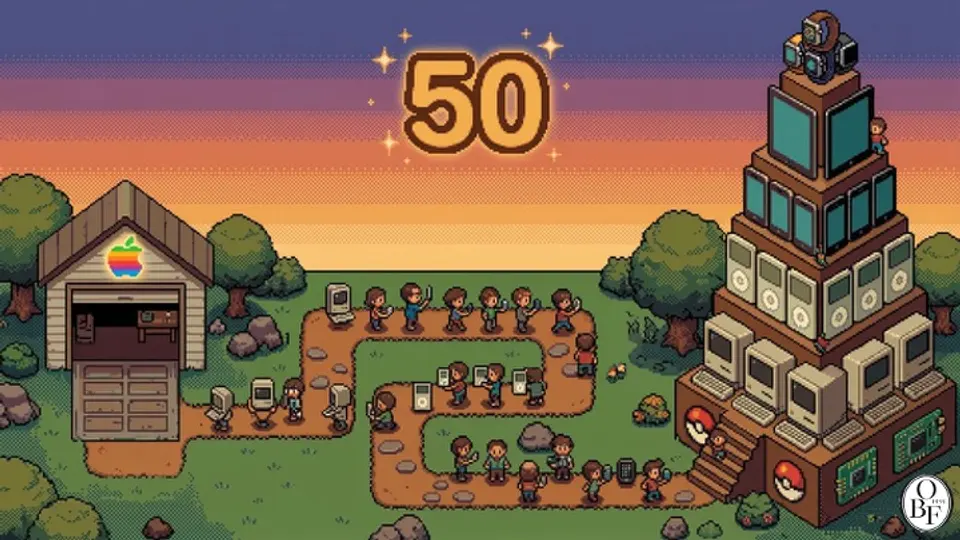
Opening
Dear reader, April 1, 2026 is Apple’s 50th birthday.
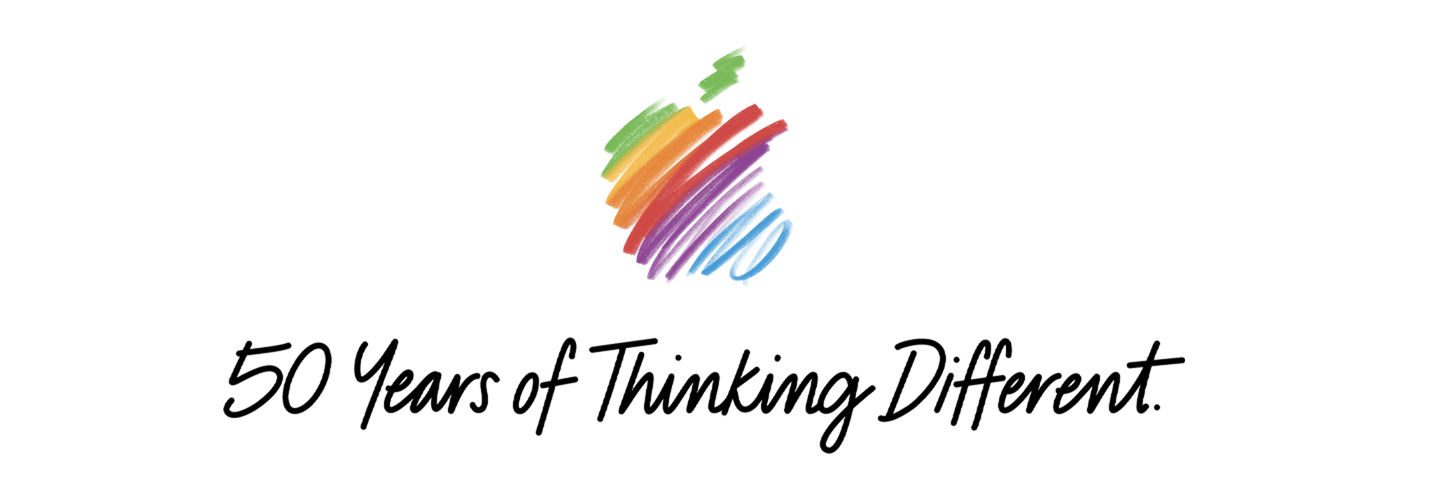
On April 1, 1976, three people — Steve Jobs, Steve Wozniak, and Ronald Wayne — gathered in a garage in Los Altos, California, and founded a company. Exactly 50 years later, Tim Cook published an open letter titled “50 Years of Thinking Different,” announcing the company’s 50th-anniversary celebrations.
When people tell Apple’s history, they usually run through a chronological list of “innovative products.” I want to take a slightly different angle. I’m going to read Apple’s 50 years as three growth curves — economic growth, ecosystem growth, and creative growth. I’ll walk through how these three curves intertwined to produce the Apple of today, and why that structure doesn’t collapse easily.
Economic Growth: From a Garage to Surpassing a Nation’s GDP
Put Apple’s economic growth in numbers and it looks almost unreal.
On December 12, 1980, Apple went public at $22 per share. Its market capitalization at the time was about $1.8 billion. It was the largest tech IPO since Ford, and more than 300 people became millionaires in a single day. Steve Jobs, then 25, woke up worth $217 million overnight.
But the trajectory that followed is even more remarkable. In 1997, Apple’s market cap was about $2.3 billion — barely above its IPO level. The talk at the time was that Apple was 90 days from bankruptcy, and it only caught its breath thanks to a $150 million investment from Microsoft.
Roughly 20 years later, on August 2, 2018, Apple became the first U.S. company to cross a $1 trillion market cap. It passed $2 trillion in August 2020 and $3 trillion in June 2023. As of March 2026, its market cap stands at about $3.75 trillion, making it the second most valuable company in the world.
Let me convert that into numbers you can actually feel. Apple’s current market cap of $3.75 trillion is on par with the GDP of the United Kingdom. It’s larger than the GDP of France or India. From the brink of bankruptcy in 1997 to exceeding the economic output of an entire nation took just one generation.
What if you had invested $1,000 at the IPO? After five stock splits, it would be worth about $2.5 million today. That works out to a compound annual return of roughly 23% — nearly three times the S&P 500’s average annual return of about 8% over the same period. But if you look only at these numbers, you miss the point. The real reason Apple’s economic growth curve never bends lies in the second curve.
Ecosystem Growth: From a Company That Sells Products to One That Runs a ‘Planet’
Let’s start with the numbers to grasp how enormous Apple’s ecosystem is. At its January 2026 earnings call, Tim Cook announced that Apple’s global active device base had surpassed 2.5 billion — up 150 million from 2.35 billion a year earlier. With the world’s population at about 8.2 billion, that means roughly one in three people on Earth uses an Apple device.
What deserves even more attention is the economic circulation these devices generate. As of 2024, developer billings and sales facilitated by the App Store ecosystem reached about $1.3 trillion. More than 90% of that goes directly to developers — transactions on which Apple collects no commission. Since the App Store launched in 2008, developers have earned more than $550 billion in cumulative revenue.
The growth of the services segment is worth watching too. In fiscal year 2025, Apple’s services revenue was about $109 billion. Ten years earlier, in 2015, it was under $20 billion. Over the past decade, services accounted for nearly half of Apple’s total revenue growth. And the gross margin1 on those services exceeds 75% — profitability in a different league from hardware (roughly 37–41%).
Understanding this structure matters. Apple is not a company that sells iPhones; it’s a company that uses the iPhone as a gateway to pull users into its ecosystem. There’s a hardware chain running from iPhone → Mac → AirPods → Apple Watch → iPad, and stacked on top of it sits a services layer: the App Store, iCloud, Apple Music, Apple Pay, and Apple TV. The more devices you own, the more services revenue grows; the more convenient the services, the harder it becomes to leave the devices. Recently, Apple lowered the barrier to entry with the ₩990,000 (~$680) MacBook Neo, and it keeps shipping its entry-level e-series line as well.
According to Counterpoint Research, as of 2025, one in four active smartphones worldwide is an iPhone. Apple and Samsung are the only two smartphone brands with more than 1 billion active devices. Yet in 2025, Apple recorded the largest net increase in devices among the top eight brands — more, reportedly, than the other seven brands combined.
The most recent quarter (December 2025) shows what this ecosystem can do. Total revenue of $143.8 billion, up 16% year over year — an all-time quarterly record. Both iPhone and services posted their highest revenue ever, and every region delivered double-digit growth.
Creative Growth: Why “Think Different” Is Not Just a Slogan
The third curve is the hardest to measure in numbers, but perhaps the most important.
Right after Steve Jobs returned in 1997, Apple launched the “Think Different” campaign. Alongside black-and-white photos of people who changed the world — Einstein, Gandhi, John Lennon, Martin Luther King — ran the copy “Here’s to the crazy ones.” Apple was on the verge of bankruptcy at the time, and the ad sold not a product but a set of values.
28 years later, on March 12, 2026, Tim Cook closed his 50th-anniversary letter with that very phrase: “Here’s to the crazy ones. The misfits. The rebels. The troublemakers.” This is not mere nostalgia. It’s an act of reconfirming the origin point of Apple’s brand identity.
Apple’s creative growth is built from a handful of decisive moments.
The 1984 launch of the Macintosh popularized the GUI (Graphical User Interface)2 for personal computers. It was the moment that shattered the assumption that “computers are for experts only.” (Personally, I think ChatGPT — which opened the LLM era and made recent AI usable by everyone — picked up that baton.)
The iPod in 2001 and the iTunes Store in 2003 dismantled and rebuilt the music industry’s distribution structure itself. They created a paradigm of buying music by the song rather than by the album, and consuming it digitally without physical media. The iPhone in 2007 is a turning point that needs no explanation — it’s no exaggeration to say it invented the smartphone category itself. And when that led to the App Store (2008), the explosive growth of the ecosystem curve I described above began.
What’s worth noting here is that none of these transitions ‘improved’ an existing market — they ‘redefined’ it. Apple didn’t build a better MP3 player; it changed how music is consumed. It didn’t build a better phone; it created the concept of a computer in your pocket.
The striking passage in Tim Cook’s 50th-anniversary letter is this one. Apple says it will pay more attention to what people have done with its tools than to the tools themselves. Running marathons, writing books, starting businesses, reaching a family member in the hospital, recording a child’s first steps. Technology is the starting point; the real protagonist of the story is the user.
This is not marketing rhetoric — it locks precisely into Apple’s actual business strategy. It’s exactly why Apple focuses on services and the ecosystem. Hardware provides the tools, and services let users do things on top of those tools. The more users do, the harder it becomes to leave the ecosystem, and that cycle feeds back into economic growth.
Oz’s Lens
I’ll confess: writing this piece stirred up some fairly personal feelings. My first smartphone was an iPhone 3GS. Today I use an iPhone 17 Pro, plus a MacBook Pro, Mac Studio, iPad Pro and mini, AirPods Pro and Max — honestly, I can’t imagine getting through a day without Apple. And yes, I’m an Apple shareholder too.
But as someone who has spent years thinking about GTM strategy, I read Apple’s 50 years less as a ‘moving success story’ than as ‘a textbook of the strategic moat3’.
Three curves reinforcing one another — in strategy, this is called a flywheel4. Good products attract users, users grow the ecosystem, the ecosystem generates services revenue, and that revenue is reinvested into building even better products — a self-reinforcing loop.
The core of this structure is switching cost. AirDrop, Handoff, Universal Clipboard, iCloud sync — each of these features is trivial on its own, but add them all up and the cost of moving to another ecosystem becomes enormous. Think of it as 2.5 billion devices held together by this glue.
That said, there’s one thing I want to flag from a data professional’s perspective. Market capitalization is only one of many ways to measure a company’s value. Because stock prices reflect market expectations and sentiment, calling something “a $3.75 trillion company” does not mean “a company creating $3.75 trillion of value.” In particular, the fact that Apple ceded the number-one spot to Nvidia in the AI era is a signal that the market weighs ‘future potential’ more heavily than ‘past success.’
That’s what makes this 50th anniversary interesting. Apple is famous for being a company that doesn’t look back, yet this time it put “50 Years of Thinking Different” front and center. I read this not as a simple celebration but as a narrative reset for the next 50 years — a message to both the inside (employees) and the outside (markets, consumers): “Our essence was thinking different, and it will stay that way.”
Closing
Summing up Apple’s 50 years in three curves:
- Economic growth: from a $1.8 billion IPO to $3.75 trillion — a corporate value that surpasses a nation’s GDP.
- Ecosystem growth: a self-reinforcing loop built from 2.5 billion active devices, a $1.3 trillion app economy, and $109 billion in services revenue.
- Creative growth: a product philosophy that ‘redefines’ markets rather than ‘improving’ them, and a brand identity that hands the starring role in technology back to the user. The flywheel structure in which these three curves reinforce one another is precisely why Apple is still growing after 50 years. And at the hub of that flywheel are the people reading this right now — us, the 2.5 billion users.
References & Further Reading
- Apple Newsroom, “Apple to celebrate 50 years of thinking different”, 2026.03.12. : Apple’s official 50th-anniversary press release, with the full text of Tim Cook’s letter.
- Apple Newsroom, “Apple reports first quarter results”, 2026.01.30. : The primary source for the latest results data, including 2.5 billion active devices and $143.8 billion in quarterly revenue.
- Apple Newsroom, “2025 marked a record-breaking year for Apple services”, 2026.01.13. : Official material summarizing the scale of the App Store ecosystem and services performance.
- Apple Newsroom, “Global App Store helps developers reach new heights”, 2025.06.: The Analysis Group study underpinning the $1.3 trillion App Store ecosystem figure.
- Counterpoint Research, “Global Active Smartphone Installed Base by Brand Share, 2025” : The original report behind the analysis that one in four active smartphones worldwide is an iPhone.
- Statista, “Apple’s quarterly services revenue” : A visual look at how services revenue has grown over the past decade.

The author, Kwangseob Ahn, is a professor of business administration at Sejong University and lead consultant at OBF (Oswarld Boutique Consulting Firm). At the university he teaches statistics and data analysis, including business data management and business analytics, while in the field he leads GTM strategy and AI strategy consulting, designing the interface between technology and business. He has published academic research on memory architecture for AI dialogue systems (HEMA) and runs Daily Arxiv, a project that curates global AI papers every day. He completed a master’s program at Korea University’s Graduate School of Management of Technology and graduated from its KMBA. He is the author of Those Who Outsource Their Thinking: Homo Brainless.
Footnotes
-
Gross Margin: the share of revenue left after subtracting direct costs. A 75% gross margin means that for every 100 won earned, direct costs amount to only 25. This is why the services business is far more profitable than hardware. ↩
-
GUI (Graphical User Interface): a way of operating a computer by clicking icons with a mouse. Before the Macintosh, you had to type text commands directly. ↩
-
Moat: an investing term Warren Buffett uses often — a structural competitive advantage that keeps rivals at bay, like the water channel surrounding a medieval castle. ↩
-
Flywheel: a business-strategy metaphor for a circular structure that is hard to spin at first but, once turning, accelerates on its own momentum. It’s also a framework popularized by Amazon’s Jeff Bezos. ↩
Related issues
 Issue #58Business
Economists Got 5x Faster. But What About Quality?
The real contest is between how fast we catch errors and how fast we create them.
 Issue #53Business
TikTok's $10 Billion 'Fee' Isn't Really About a Fee
The US government is testing how to turn regulatory power into a revenue-generating asset
 Issue #48Business
China's 15th Five-Year Plan: Structure Over Speed
The era of speed is over — what Beijing is really trying to change is the fundamental makeup of its economy.
Your take shapes the next issue
What resonated most in this issue, or where has your experience been different?