
OpenAI's Five-Punch Day Reveals Its Real Strategy Shift
Sora didn't fail — OpenAI abandoned it on purpose.
Opening
Reader, there was a product Disney bet $1 billion on. It hit 1 million downloads in 5 days and topped the App Store charts. That product disappeared yesterday. After just 6 months.
This is the story of OpenAI’s Sora.
But that’s not all. On the same day, Sam Altman announced a reorganization via internal memo, and stepped back from overseeing the safety team himself, declaring he’d focus on “building data centers” instead. Then, ChatGPT transformed into a shopping platform hosting Walmart, Target, and Sephora. And on top of that, reports surfaced that OpenAI is courting private equity firms with a guaranteed 17.5% return to win over the enterprise market.
Five headline-worthy pieces of news, in a single day. Coincidence?
I don’t think so. This is a single strategy — the pivot from “AI that impresses” to “AI that earns.” In today’s issue, I want to unpack why these 5 announcements belong to the same story, why Sora’s death was a choice rather than a failure, and what the direction OpenAI is heading toward means for the entire AI industry.
Sora’s Exit After 6 Months — What Happened
The Sora app launched in September 2025. It surpassed 1 million downloads within 5 days and topped the iOS App Store’s Photo & Video category. Technically, the Sora 2 model could generate native audio and realistic physics simulations, earning it the label “the most impressive video generation model in existence” at the time.
In December, Disney signed a 3-year deal licensing Mickey Mouse, Marvel, and Pixar characters to Sora, alongside a $1 billion equity investment. It was the largest IP deal in the AI video industry.
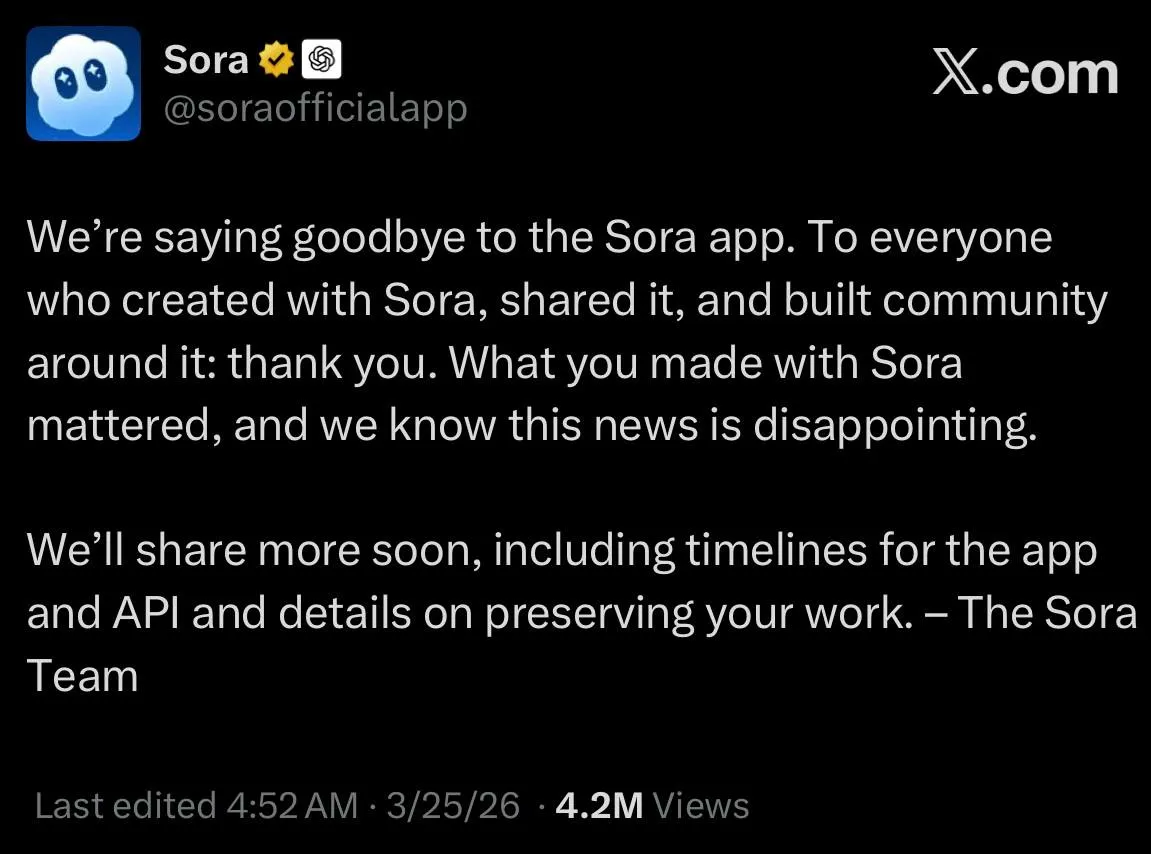
Then, on March 24th, it suddenly ended. The Sora team posted a brief farewell on X (formerly Twitter), with no official explanation for the shutdown. Disney withdrew both the investment and the licensing agreement.
Why kill it? There’s no official reason, but the puzzle pieces exist.
CNN quoted an OpenAI spokesperson saying that “as demand for computing1 grew, tradeoffs became necessary for products with high compute costs.” NBC framed it as part of a cost-cutting push ahead of an IPO2. And Altman’s internal memo, released the same day, fills in the rest of the picture.
Related issues
🔒 NVIDIA GTC 2026: The Blueprint, Not the Chips
One trillion dollars in order visibility, a $20 billion acquisition paying off, and the 'token factory' business model
🔒 AI Is Getting Smarter. Is It Also Getting More Alike?
A NeurIPS award-winning study finds that leading AI models converge on nearly identical answers to open-ended questions.
🔒 Could a One-Won Stamp on Every Email Kill Spam?
In a world where sending a message costs nothing, your attention became a free resource up for grabs.
Your take shapes the next issue
Reply with your experience or perspective — the best responses feed into future issues.
Sign in to commentAny registered reader can comment — it takes 10 seconds.