
The Day Four-Legged Robots Join the Border Watch
"Hey robot, first watch's done — fancy a round of WD-40?"
Opening
Dear reader, Bloomberg and Korea Economic Daily both broke the same story today: Hyundai Motor Group is teaming up with the Army to deploy robots to the front lines. Boston Dynamics’ four-legged robot Spot, Hyundai’s mobility platform MobED, and the wearable robot X-ble Shoulder will take on surveillance, search, and supply missions along the GOP1 fence line.
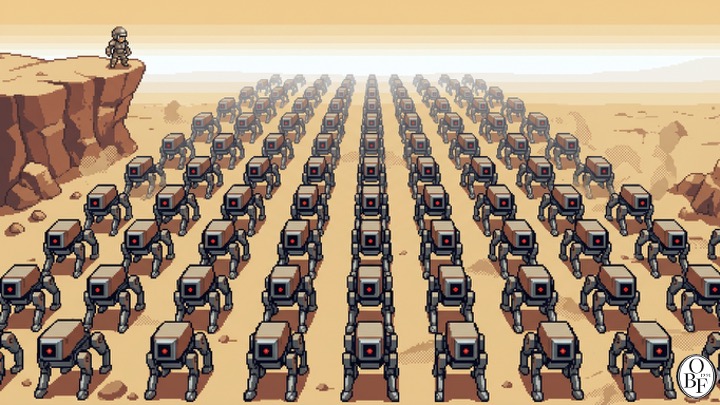
When you hear “military robot,” it’s easy to picture the android soldiers of sci-fi films — but reality looks a bit different. Right now, on the Ukrainian front, robots are capturing Russian positions, and Israel is calling the fighting in Gaza the “first robotics war.” In 2026, humanity is already fighting robot wars.
Let me get straight to the point: Korea’s decision here isn’t a technology experiment. It’s a structural shift in national security, forced by the unavoidable reality of the demographic cliff.
🤖 What’s Actually Happening on the Battlefield Right Now
Long before Korea started discussing military robots, robots on the battlefield were already seeing real combat.
In April 2026, Ukrainian forces captured a Russian position using only ground robots and drones — a battle with not a single human soldier involved. A Ukrainian unit commander told CNN: “We will never outnumber the enemy. So we have to build our advantage through technology.”
The numbers make the pace of change even clearer. Ukraine’s Ministry of Defense signed $2.5 million worth of ground robot contracts in the second half of 2024. By Q1 2025, that figure had jumped 60-fold to $150 million. The target for the first half of 2026 is contracts for 25,000 unmanned ground vehicles (UGVs)2. President Zelensky announced that drones and robots carried out more than 22,000 missions in just the past three months. The goal is to replace a third of the infantry with drones and robots within the year.
A RAND Corporation analysis nails the core point: “For Ukraine, fighting a numerically superior enemy for four years straight, replacing irreplaceable humans with cheap, expendable robots is a necessary condition for continuing the war.”
Yaron Sarig, director of Israel’s Ministry of Defense DDR&D3, said at Tel Aviv Defense Tech Week in December 2025: “In this conflict, we mobilized the entire defense ecosystem to deploy tens of thousands of autonomous systems on the battlefield, from drone swarms to nimble ground robots.” He dubbed the Gaza fighting the “first robotics war.”
The Israeli military converted retired armored vehicles (M113s, D-9s) into unmanned robots, and used Roboteam’s compact tactical robot, the MTGR, for tunnel searches. Brigadier General Oren Giber of the IDF’s Armored and Combat Vehicle Command described the future of ground warfare as “manned vehicles and robotic UGVs operating as a team” — a lead vehicle advances, a robot wingman enters the combat zone first, and the UGV launches small drones.
Here’s the core point: whether robots are useful on the battlefield is a question that’s already been answered. What remains is “how far, and in what way.”
Related issues
🔒 Google Chrome Secretly Installed a 4GB AI Model on Your PC
An AI installed to protect your privacy never asked for your consent—here's what that paradox reveals.
🔒 Rosedale's AI Camera Fence: Who's Inside, Who's Out
If safety can be purchased, who ends up paying the price?
🔒 Everyone Can Code Now: Who Are We Building For?
As AI drives coding costs toward zero, the real question becomes who software should serve.
Your take shapes the next issue
Reply with your experience or perspective — the best responses feed into future issues.
Sign in to commentAny registered reader can comment — it takes 10 seconds.