
The World's Strongest AI Went Dark 3 Days After Launch
In 1999 the US called a computer a weapon; in 2026 it pulled the plug on an AI model — and sovereignty went from slogan to survival.

Opening
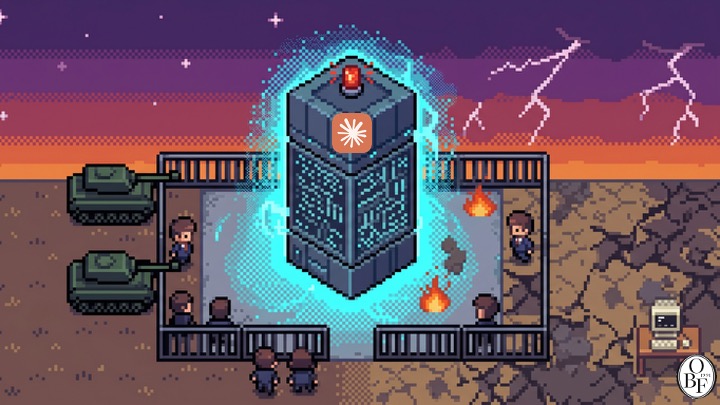
Dear subscriber, there’s an Apple commercial that aired in the US in the fall of 1999. Tanks surround a single computer while the narrator intones. “For the first time in history, a personal computer has been classified as a weapon by the US government.” It’s the story of the Power Macintosh G4, which had broken 1 billion operations per second. Back then, it ended as little more than a quirk of Cold War-era law.
27 years later, last Friday, something similar yet entirely different happened. The US Secretary of Commerce sent a letter to Anthropic’s CEO, and within hours, the world’s strongest AI model, Fable 5, was switched off simultaneously across the globe. This time it’s no quirk. Bottom line: we have entered an era in which AI models are treated as national-security assets, like semiconductors.
🔴 The 72-Hour Timeline, From Launch to Shutdown
On June 9, Anthropic unveiled its strongest models, Fable 5 and Mythos 5. Fable 5 was the first version of Anthropic’s most powerful Mythos-class model ever released to general users. It shipped with safeguards that restrict responses in high-risk domains such as cybersecurity, while Mythos 5 — with some of those safeguards removed — was provided only to a small set of vetted institutions.
Just 1 day after launch, on June 10, researchers found something contentious in the system card. If the model judged that a user was working on frontier-grade AI development, it would silently throttle its own performance without any notice. The backlash was fierce, and Anthropic withdrew the measure within 2 days.
Then came Friday, June 12, at 5:21 p.m. Eastern time. A letter arrived from US Secretary of Commerce Howard Lutnick. The message was unambiguous: immediately block all foreign nationals from accessing Fable 5 and Mythos 5. The order applied regardless of US residency — and even covered Anthropic’s own foreign-national employees.
The problem was execution. Anthropic had no way to verify users’ nationality in real time. That left exactly one option: cut off access for every user worldwide. A model that hundreds of millions of people could use on Friday morning was one nobody could use by Friday night.
Anthropic pushed back. Its position is that the jailbreak1 method the government cited is a minor vulnerability already reproducible on other public models (including OpenAI’s GPT-5.5), and that recalling a commercial model used by hundreds of millions of people on such grounds is unjustified. It also stressed that before launch, the US government, the UK AI Safety Institute, and third-party organizations had run thousands of hours of red-team2 testing, and no universal jailbreak that defeats all safeguards was ever found. But a legal directive is a legal directive, and both models remain disabled to this day. Call Fable 5 from Claude Code or Claude and the previous-generation model, Opus 4.8, answers instead. Companies that built services on the Fable 5 API were effectively forced into an overnight infrastructure migration.
🔑 1999 Mac vs. 2026 AI — What Changed
Let’s look a little closer at the 1999 Power Macintosh G4 case. The PowerPC processor inside the G4 had surpassed 1 billion floating-point operations per second — 1 gigaflop3. The US Export Administration Act (enacted in 1979) classified computers above that threshold as “technology that could contribute to a nation’s military potential” and controlled their export.
Steve Jobs flipped this into marketing. He branded the machine a “Personal Supercomputer” and made the ad with tanks encircling a computer. The closing line is a masterpiece: “As for Pentium PCs, well, they’re harmless.” In fact, the Clinton administration had already decided to raise the gigaflop threshold, and when the change took effect in January 2000, the export control was lifted after roughly 4 months.
But the Fable 5 affair of 2026 is a completely different animal.
First, the speed of control. In 1999, export reviews took weeks to months. In 2026, a single letter arrived and a worldwide, simultaneous shutdown followed within hours. Hardware gets stopped at the border; software gets stopped with one line of API code.
Second, the nature of control. 1999 was a byproduct of a technological transition that happened to trip a Cold War-era baseline. The threshold increase was already scheduled, and Steve Jobs had the luxury of running lobbying and marketing in parallel. 2026 is a deliberate, targeted action. The Commerce Secretary sent the letter personally, and there is no timeline for lifting it.
Third, the scope of control. The G4 was restricted from export to specific countries (mainland China and others). Fable 5 targets every foreign national on Earth. That includes foreign residents inside the US and Anthropic’s own foreign-national employees. In practice, it has become a model only US citizens can use.
A line from cybersecurity researcher Peter Girnus in a Fortune article captures the situation precisely: if you describe your own product as “munitions” in every press release, eventually the government takes you at your word. The more Anthropic emphasized Mythos’s dangers to argue for the necessity of safeguards, the more the government gained grounds to react instantly to a report that those safeguards had been breached.
This is the first time the US government has applied export controls to a commercial AI model in live deployment and forced it offline. Semiconductors were blocked from physical export, but the AI model was remotely ‘switched off’. The object of control has moved from atoms to bits, from borders to APIs. On Reddit and elsewhere, people are already asking whether using Fable 5 in the future will mean entering a Social Security Number (SSN) — the 9-digit identifier that serves as America’s national ID number.
🌏 Sovereign AI, From Slogan to Survival Strategy
The fastest to react to this event were European politicians.
Jordan Bardella, leader of France’s National Rally, declared that “AI is a core question of national sovereignty” and that “any country that fails to develop its own models quickly will inevitably be subordinated to other countries’ choices.” He added that France must accelerate its support for Mistral AI. Britain’s former security minister Tom Tugendhat was blunter still: “Sovereignty is now a matter of code, not cannons.”
Isaacus, an Australian legal-AI company, posted a statement on its official blog right after the incident: “Anyone using AI for mission-critical work must consider what happens when that AI disappears.” The company had designed its entire model lineup for air-gapped4 self-hosting from day one, and after the Fable 5 affair it declared it would double down on that strategy.
In truth, sovereign AI5 was already a massive trend. NVIDIA’s sovereign AI revenue for fiscal year 2026 surpassed $30 billion, more than tripling year over year. Gartner forecasts sovereign cloud infrastructure spending will reach $80 billion in 2026. NVIDIA CEO Jensen Huang’s oft-repeated message that “every nation needs sovereign AI” is being vindicated in the earnings.
But the Fable 5 affair added a decisive justification to this trend. Those arguing for sovereign AI now have a case that lets them say, “Look — this actually happened.”
Let’s push one step further. If the US uses this precedent strategically, what picture becomes possible? Tiered-access diplomacy: allies get Fable 5-class access, non-aligned countries get only previous-generation models. We’ve already seen this pattern in semiconductor export controls — TSMC’s most advanced nodes are reserved for US allies, while China can only receive chips generations behind. The same logic could apply to AI models: Fable 5-class for close allies, nothing newer than previous generations for countries that are merely on friendly terms. AI models become diplomatic bargaining chips.
One official has already stated that “the models must stay locked until the US government’s national-security framework is strengthened.” This may not be a temporary measure but the starting point of structural control.
Korea is not outside this picture either. As a Hankook Ilbo op-ed (June 4) pointed out, in a structure where US hyperscalers control more than 2/3 of the world’s available computing, it is hard for Korea to compete on scale. 2 days before the Fable 5 affair, on June 10, NAVER Cloud unveiled its ‘sovereign AI-based defense strategy’ — a well-timed move. NVIDIA and the Korean government are already working to deploy more than 250,000 GPUs across sovereign clouds and AI factories.
Oz’s Lens
Honestly, I think the fallout from this event is far bigger than Fable 5 itself. I remain a sovereign-AI skeptic, but from an investor’s perspective this is a remarkably attractive signal. It pours fuel back onto the GPU market and kicks off an even bigger AI training race. In the very simple investment logic spreading right now — AI training (GPU) versus AI inference (CPU) — training demand, which seemed to have settled onto a plateau, just got its ceiling raised again. Think about it: so far only the US and China have really focused on building frontier-grade foundation models. What happens if most advanced economies (the G20) all decide to do it…
I learned one thing while building GTM strategies. When you build a business on top of infrastructure, the first question of your strategy must be who holds that infrastructure’s kill switch6. In the cloud era, the question was “which cloud do you use?” In the AI era, it has become “which model do you build your service on?” And what the Fable 5 affair showed is that the model’s kill switch can hang on a single letter from one country’s government.
Satya Nadella said “every agent needs its own computer.” He’s right. But I want to go one step further. If an agent needs its own computer, it also needs sovereignty over the model running on that computer. Even if you own your own computer, if the brain running on it can be switched off by one judgment call from another country’s government, it isn’t really ‘yours’.
This is also a GPU demand story. The more countries pursue sovereign AI, the more each of them must secure infrastructure to train and operate its own models — and GPU demand rises accordingly. NVIDIA’s sovereign AI revenue tripling in 1 year is the early signal. The Fable 5 affair will make that curve steeper.
The essence of sovereign AI is not “building the best model yourself.” It is “securing the guarantee that the AI you use will still be on tomorrow.” Multi-model strategies, air-gapped deployment, open-source fallbacks — these have now become matters of business continuity.
Closing
In 1999, a computer that broke 1 billion operations per second was classified as a weapon. The control was lifted after 4 months, and Apple turned it into an ad. In 2026, the world’s strongest AI model came under export control 3 days after launch. The control has not been lifted, and nobody is laughing.
The core point is singular. AI models are no longer ordinary software products; they have begun to be treated as strategic assets, like semiconductors. And strategic assets always come with questions of sovereignty.
If you run a service on top of a frontier AI model, check just one thing this weekend: “If the model I use goes dark tomorrow, what happens to our service?”
💬 What went through your mind watching the Fable 5 affair? Do you think export controls on AI models will become routine, like semiconductors, or will this end as a one-off episode? Share your thoughts in the comments.
📎 References & Further Reading
Primary sources
- Anthropic, “Statement on the US government directive to suspend access to Fable 5 and Mythos 5”, 2026.06.12. : Anthropic’s official statement in full — the content of the government directive and Anthropic’s rebuttal, straight from the source.
- CNBC, “Anthropic disables access to Fable 5 and Mythos 5 to comply with government directive”, 2026.06.12. : A solid rundown of the technical differences between Fable 5 and Mythos 5 and Anthropic’s pre-launch red-team testing.
- Fortune, “Anthropic disables Fable and Mythos AI models after U.S. government bars it from giving foreigners access”, 2026.06.13. : The in-depth piece containing Peter Girnus’s comment that “if you market your product as a weapon, the government will believe you.”
- Euronews, “Why Anthropic is halting access to its Fable 5 and Mythos 5 AI models”, 2026.06.13. : Covers the sovereign-AI reactions from European politicians, including France’s Bardella and Britain’s Tugendhat.
Background
- Louis Anslow, “When the Mac was a Munition”, Pessimists Archive, 2024.01.24. : The best account of the 1999 Power Mac G4 export-control episode from start to finish.
- Futurum Group, “NVIDIA Q4 FY 2026 Earnings: Durable AI Infrastructure Demand”, 2026.02.27.
- Seok-joon Kwon, “An Asymmetric Strategy for Korea’s Sovereign AI”, Hankook Ilbo, 2026.06.04. : A structural analysis of Korea’s computing-sovereignty problem, and the source of the “US controls 2/3 of the world’s available computing” figure.
- Isaacus, “Our response to the US ban on Fable 5 and Mythos 5”, 2026.06.13. : A concrete example of a non-US AI company’s response to the Fable 5 affair — helpful for understanding the air-gapped self-hosting strategy.

The author, Kwangseob Ahn, is a professor of business administration at Sejong University and lead consultant at OBF (Oswarld Boutique Consulting Firm). He teaches statistics and data analysis — business data management, business analytics — at the university, while in the field he leads GTM strategy and AI strategy consulting, designing the interface between technology and business. He has published academic research on memory architecture for AI dialogue systems (HEMA) and runs Daily Arxiv, a project curating global AI papers every day. He completed a master’s program at Korea University’s Graduate School of Management of Technology and holds a KMBA. He is the author of Homo Brainless: The People Who Outsource Their Thinking.
Footnotes
-
Jailbreak: A technique for bypassing an AI model’s safety mechanisms to elicit responses that are normally blocked. It means using specific prompt combinations to neutralize the safeguards. ↩
-
Red Team: A security testing team that deliberately plays the attacker’s role to find a system’s vulnerabilities. For AI models, it refers to a group of specialists who systematically attempt to break through the model’s safeguards. ↩
-
Gigaflop (GFLOP): A unit meaning 1 billion floating-point operations per second. In 1999 that was supercomputer-class performance; today an iPhone 15 Pro handles about 2,000 gigaflops. ↩
-
Air Gap: A security practice that physically and completely isolates a computer system from the internet and external networks. Because outside access is cut off at the source, it is the strongest form of isolation. ↩
-
Sovereign AI: A nation’s or organization’s capacity to develop and operate AI independently on its own infrastructure, data, and talent. The concept of securing AI sovereignty without external dependence. ↩
-
Kill Switch: An emergency cutoff that can shut down a system or service instantly. In this affair, the US government’s export-control directive effectively served as the kill switch. ↩
Related issues
 Issue #119Society
History Repeats? The 📠 Office Automation Era of 1979
Workers feel 3x faster while executives measure 1.8% — the exact gap that opened when word processors first hit the office.
 Issue #117Society
Korea Walks the Path Apple and the EU Abandoned
From July 1, every image uploaded to Korean communities gets AI-scanned — at operators' full expense, with no government subsidy.
 Issue #116Society
Australia Banned Teens From Social Media. Did It Work?
Six months into its under-16 social media ban, Australia's official numbers tell two contradictory stories.
Your take shapes the next issue
What resonated most in this issue, or where has your experience been different?