
Google Cut the Bill, Not the Price Tag
The unit of AI-model competition is shifting from price per token to cost per task.
Opening
Today (July 21, local time), Google announced Gemini 3.6 Flash. To be precise, three models: Gemini 3.6 Flash, 3.5 Flash-Lite, and 3.5 Flash Cyber. Outside our regular publishing rhythm, this is timely enough that I wanted to get a special edition to you quickly.
Pricing is $1.50 per million input tokens and $7.50 per million output tokens. Most coverage has focused on the benchmark scores. But one other line in the announcement caught my eye.
“It consumes 17% fewer output tokens than the previous model.”
Dear reader, let me give you the bottom line first: the real news in this announcement isn’t performance. It’s a signal that the unit of AI pricing competition is shifting from “price per token” to “how few tokens it takes to do the same job”—in other words, fuel efficiency.
What Happened
Google shipped three things this time: the flagship Gemini 3.6 Flash, the ultra-lightweight 3.5 Flash-Lite, and the security-focused 3.5 Flash Cyber.
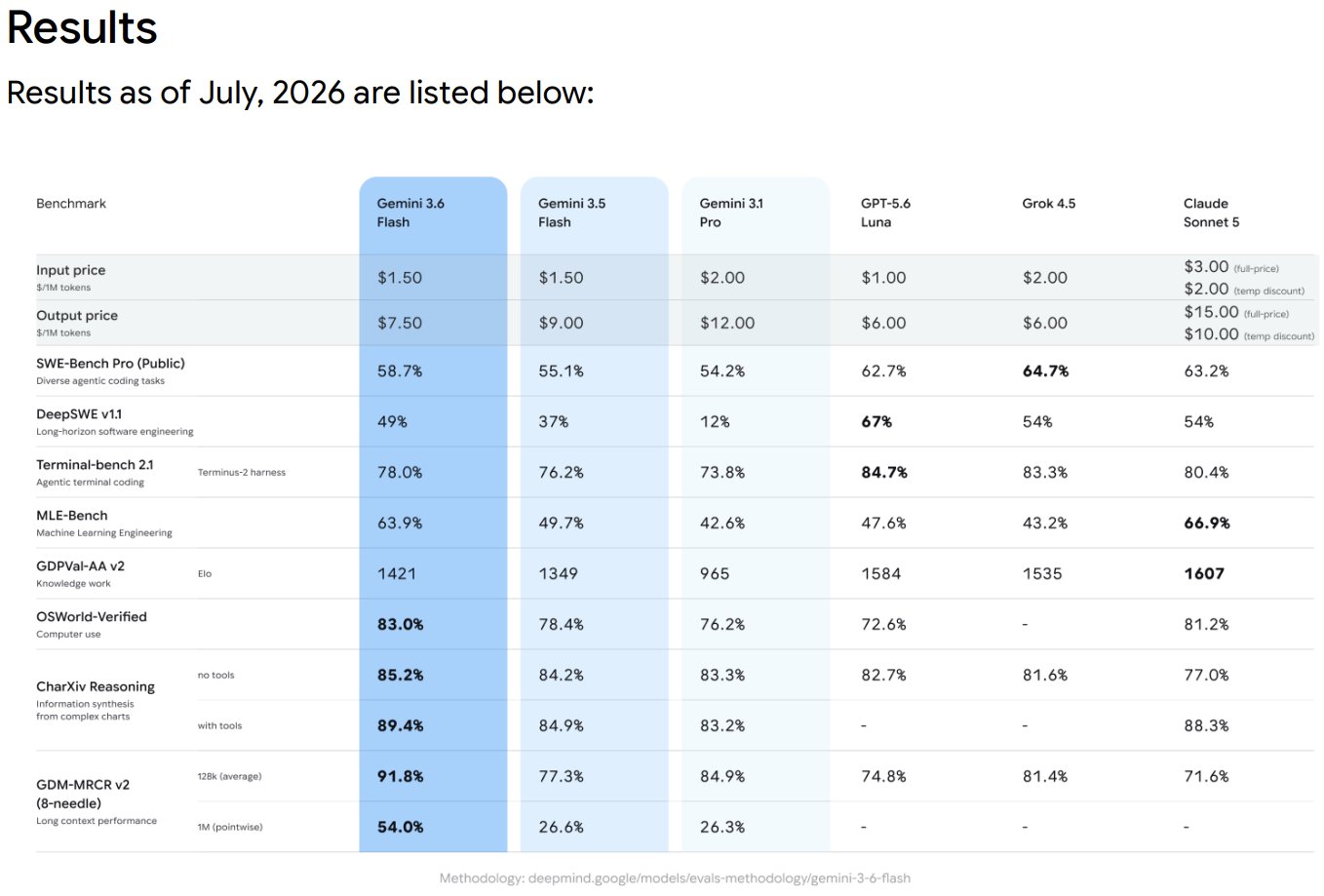 Let’s start with the numbers. The output price of 3.6 Flash is $7.50 per million tokens, down about 17% from the previous model 3.5 Flash’s $9.00. The input price is frozen at $1.50. Performance rose too: on DeepSWE, a long-horizon coding benchmark, from 37% to 49%; on MLE-Bench, a machine-learning engineering benchmark, from 49.7% to 63.9%; and on OSWorld-Verified, which tests direct computer-screen operation, from 78.4% to 83.0%.
But what Google’s announcement dwelled on most wasn’t the scores—it was efficiency. By the Artificial Analysis Index1 , output token consumption dropped 17%, and in some tasks such as DeepSWE, by as much as 65%. The number of reasoning steps and tool calls themselves went down.
The companion 3.5 Flash-Lite is interesting too. At $0.30 input and $2.50 output, it churns out 350 tokens per second and scored 54.2% on the SWE-Bench Pro coding benchmark—beating the higher-tier 3 Flash (49.6%) from the previous generation. It’s a case of the junior lineup toppling the senior lineup from one generation back.
At the tail end of the announcement, Google also let slip that pretraining for Gemini 4 has begun. 3.5 Pro, meanwhile, is in partner testing.
Why Efficiency, Not Price
To understand this, you need to look at the pricing trajectory of the Flash line.
In June 2025, Gemini 2.5 Flash priced at $0.30 input and $2.50 output. Then 3 Flash rose to $0.50 and $3.00, and this past May, 3.5 Flash climbed to $1.50 and $9.00. The input price quintupled in a single year.
This trend spawned the reading that “the era of cheap AI is ending.” According to the research firm Epoch AI, the cost of delivering the same performance falls 5 to 10 times every year—yet vendors have stopped passing those savings on in their pricing. As OpenAI’s roughly $3.7 billion in 2025 revenue against a $5 billion loss suggests, the low prices we’ve seen so far were closer to subsidies for market capture, and now that investors are demanding profit over growth, those subsidies are being withdrawn.
 Yet 3.6 Flash just cut its price. It looks like a contradiction, but that’s exactly where this announcement’s core lies: the price cut is the side dish; the main course is the drop in consumption.
Back when humans used AI through chat, the price per token was essentially the cost—one question, one answer, done. But in agentic workloads, the model plans on its own, calls tools, reviews results, and burns tokens the whole way through. Costs pile up in intermediate steps that no human ever reads. In this world, it’s not the price sheet but “how many tokens does this model use to finish one task” that governs the bill.
Let’s run the math. If the output price drops 17% and token consumption drops 17%, the output cost per task falls by roughly 30%. The price sheet shows only 17%, but the actual bill drops 30%. For reference, a million tokens is about 750 pages’ worth of A4 text. Producing that much output now costs $7.50, or about ₩10,000.
To sum up: prices have already risen about as far as they’re going to, and now the competition has shifted to adjusting effective prices through efficiency—without touching the sticker price.
Three Companies, One Ring
What matters more is that this competition isn’t Google’s game alone.
As of July, lining up the price sheets in this weight class looks like this: OpenAI’s GPT-5.6 Luna at $1 input / $6 output, xAI’s Grok 4.5 at $2 and $6, and Anthropic’s Claude Sonnet 5 at a temporary discount of $2 and $10. Sonnet 5 reverts to its list price of $3 and $15 starting in September. Just a year ago, frontier-level performance simply didn’t exist at this price point—now the flagship products of all three companies are crowded into this exact band.
The benchmarks split every which way. By Google’s own comparison table, Luna leads on long-horizon coding (DeepSWE) with 67%; 3.6 Flash leads on computer operation (OSWorld) with 83.0%; and Sonnet 5 tops the Elo2 score on GDPval-AA v2, a knowledge-work evaluation, at 1607. There’s no outright winner. With performance unable to settle the contest, the center of gravity has to shift to price and efficiency.
So here’s how I see the picture ahead. Price sheets will keep converging. Differentiation will happen in three places: first, the token efficiency we discussed today; second, effective-discount mechanisms like caching and batch processing; and third, routing3—swapping between cheap and expensive models depending on the nature of the task. On the buyer side, in fact, it’s becoming standard practice to stop pinning workloads to a single model and instead switch models based on task complexity.
Oz’s Lens
From my own experience designing B2B pricing sheets while building GTM strategy, Google’s move here is textbook margin defense: hold the nominal price while lowering the effective price. Cutting the sticker price shaves revenue across the board, but improving fuel efficiency channels the discount selectively to “the good customers who use a lot”—the ones running agents at scale, exactly the customers Google wants to keep.
For buyers, the implication is clear: model price-comparison sheets can no longer be more than a reference point. Even at the same price, actual costs can differ by multiples depending on how many tokens get burned. In the end, you have no choice but to measure against your own workload. Pick a handful of representative tasks your team runs often, and build a routine that measures “cost per task” every time a new model ships. That’s far more accurate than staring at a price sheet.
One caution though. The 17% efficiency figure is an average across benchmarks the vendor selected. It’s a pattern I’ve seen repeatedly while working with data—these averages vary widely by workload. It’s entirely possible for efficiency to improve dramatically on document summarization while actually using more tokens on code generation. The standard should be measurements from your own tasks, not the vendor’s average.
Closing
Let me sum up today’s issue in three lines.
Google cut 3.6 Flash’s price by 17%, but the real message is that it does the same job with 17% fewer tokens. In the agent era, cost is governed by token consumption, not the price sheet, and the unit of competition is shifting to “cost per task.” What buyers need isn’t an eye for cheaper models—it’s a routine for measuring cost against their own workloads.
Here’s one thing worth trying this week: pick three or four representative tasks your team handles with AI, and measure the cost per task with the model you’re currently using—just once. It’ll make your next model-switching decision much easier.
If you’ve ever switched models in your own work, I’d love to hear in the comments about a moment when the bill surprised you—whether you switched based on the price sheet alone and got a shock, or you benefited from efficiency instead. I’ll fold it into the next issue.
💬 Tell me in the comments about a time your bill diverged from expectations after switching models. I’ll bring it into the next issue. 📨 If you know a colleague wrestling with AI costs, please share this piece.
References & Further Reading
Primary sources
- Google, “Introducing Gemini 3.6 Flash, 3.5 Flash-Lite, and 3.5 Flash Cyber”, Google Blog, 2026. Link ··· This is the primary source for today’s issue—both the benchmark tables and the pricing are here.
- Artificial Analysis, “Gemini 3.6 Flash: Intelligence, Performance & Price Analysis”, 2026. Link ··· This is the source of the 17% token-efficiency figure. It’s the most useful independent metric for comparing effective costs across models.
Background
- XDA Developers, “Google’s Gemini 3.5 Flash costs 3x the model it replaced, and the era of cheap AI is ending”, 2026. Link ··· This piece lays out the Flash line’s pricing trajectory and the “end of the subsidy era” argument. It connects to the second section of today’s issue.
- 9to5Google, “Google launches Gemini 3.6 Flash and 3.5 Flash-Lite, teases Gemini 4”, 2026. Link ··· An article covering the announcement’s context and the news about Gemini 4 pretraining.
- AI2Work, “GPT-5.6 vs Claude Sonnet 5: Inside the Frontier Price War”, 2026. Link ··· I referenced this for competitor pricing structures and temporary-discount details.

Footnotes
-
Artificial Analysis Index: An independent benchmark service that measures and compares the performance, speed, and cost of major AI models. Because it’s third-party measurement rather than vendor self-reporting, it’s widely cited across the industry. ↩
-
Elo score: A relative-ranking method borrowed from chess. Two models’ outputs are pitted against each other, with the winner’s score rising—so it reflects relative standing, not an absolute score. ↩
-
Routing: A method that automatically assigns incoming tasks to the most appropriate model among several, based on difficulty. Easy tasks go to cheaper models, hard tasks to pricier ones, lowering overall cost. ↩
Related issues
Fable Can't Enter China, But GPT Can
Chips got blocked, but the models didn't—and that gap is sovereign AI's real face.
🔒 The World's Strongest AI Went Dark 3 Days After Launch
In 1999 the US called a computer a weapon; in 2026 it pulled the plug on an AI model — and sovereignty went from slogan to survival.
Ferrari's Designers Still Start With a Pencil
When AI erased the grunt work, it also erased the ladder junior employees used to learn on
Your take shapes the next issue
Reply with your experience or perspective — the best responses feed into future issues.
Sign in to commentAny registered reader can comment — it takes 10 seconds.