
BYD's 5-Minute Charging Is About Structure, Not Speed
It's not about who can build the same technology — it's about who shares the same industrial structure
Opening
Dear reader, how long does it take to fill up a car with gas at a gas station? About 5 minutes. Now, we’ve entered an era where electric vehicles can charge at roughly that same speed.
On March 5, in Shenzhen, China, BYD Chairman Wang Chuanfu (王传福) took the stage himself to announce something far more than just a charger. Combine the 1,500kW1 Flash Charging system with Blade Battery 2.0, and a battery can go from 10% to 70% in 5 minutes, and to 97% in 9 minutes. Even at -30°C, it can reach near-full charge in 12 minutes.
The numbers alone might not mean much. But consider that in the US, a 350kW charger — considered “ultra-fast” — takes 15 to 25 minutes to reach 80%. BYD’s charging speed is more than 4 times the previous best. But I think there’s a more important question than the raw numbers. I drive a Tesla Model Y now; before that, I drove an Ioniq 5. So this charging speed really hits home for me. With the Ioniq, DC fast charging took about 40 minutes; with the Tesla, on a Supercharger, it’s around 20 minutes. So going from 10 minutes down to 5… it genuinely feels like we’re closing in on gasoline-car territory.
Why can only BYD do this? And is it really only BYD’s story? Or to put it bluntly — is this just hype?
Today’s topic is genuinely difficult and complex. I wrote and deleted footnotes several times myself.But!If you read closely, you’ll come away with a clear overall picture of both the EV industry and the secondary battery industry!
The Secret Behind the 5-Minute Charge: It’s a ‘System,’ Not a Charger
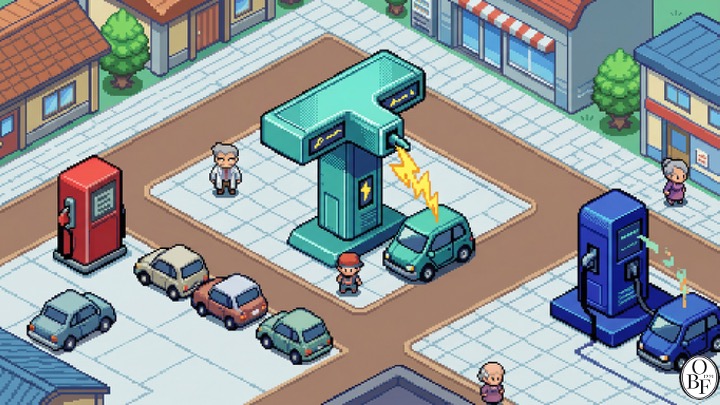
You can’t explain why BYD’s Flash Charging is fast by pointing to the charger alone. It’s possible because the car, the battery, the charger, and even the power infrastructure were all designed together as a single system. Ironically, this is also something they could do precisely because they started late.
Let’s start with Blade Battery 2.0. This battery, developed by BYD over six years, is still based on LFP (Lithium Iron Phosphate)2 chemistry, but its internal structure has been completely redesigned. BYD calls it the “FlashPass ion transport system”: the cathode3 particle structure is engineered in multiple layers so lithium ions can escape faster, an AI-optimized electrolyte4 boosts ion conductivity, and the anode5 is designed so lithium ions can insert in all 360 degrees. Energy density6 improved 5% over the previous generation, and by CLTC7 standards it delivers a range of more than 1,000km (about 621 miles).
Let me flag one fact-check here. Some foreign media reported that this battery uses LMFP (Lithium Manganese Iron Phosphate)8 chemistry, but BYD’s official announcement specifies LFP. LMFP raises energy density by adding manganese — so if BYD actually raised LFP’s energy density through structural innovation alone, that’s arguably an even more remarkable achievement.
Next is the charger itself. A T-shaped overhead design keeps the cable off the ground, and a pulley system that slides along a rail lets you connect regardless of where the charging port is located. It looks like a design innovation on the surface, but the real substance is the hardware capability to deliver 1,500kW through a single connector. For reference, last year’s first-generation system needed two GB/T9 cables connected simultaneously just to reach 1,000kW.
And the cleverest part is the ESS (Energy Storage System)10. Each charging station is equipped with battery storage that charges slowly from the grid and then acts like an amplifier when a vehicle needs charging. This prevents a sudden 1.5MW11 load spike from hitting the grid. Thanks to this approach, charging stations can be installed even in places where the power infrastructure isn’t sufficient.
Related issues
🔒 From a Garage to $3.8 Trillion: Apple at 50
Three growth curves — economic, ecosystem, and creative — explain why the company's flywheel is so hard to break.
🔒 Economists Got 5x Faster. But What About Quality?
The real contest is between how fast we catch errors and how fast we create them.
🔒 TikTok's $10 Billion 'Fee' Isn't Really About a Fee
The US government is testing how to turn regulatory power into a revenue-generating asset
Your take shapes the next issue
Reply with your experience or perspective — the best responses feed into future issues.
Sign in to commentAny registered reader can comment — it takes 10 seconds.