
China Grew Under Containment. Now It Locks the Door.
U.S. sanctions meant to contain China ended up accelerating its self-sufficiency.
Opening
Dear subscriber, on July 20th, two seemingly opposite pieces of news came out of China on the very same day.
One was that Z.AI had completed a 1-gigawatt (GW) data center built entirely on Chinese-made chips—not a single Nvidia chip in sight. The other was a report that the Chinese government is considering export controls to block core AI models and chip technology from leaving the country.
One is confidence—“we can build it ourselves.” The other is a bolt on the door—“we won’t let this leave anymore.” They look like unrelated stories at first glance, but I think they’re actually two halves of the same story. To cut to the conclusion: this is the moment China, long on the receiving end of U.S. containment, declared “now we have something worth protecting too.” And ironically, it was U.S. containment itself that brought that moment forward.
Two Stories, Same Day
Let’s start with the data center. According to Bloomberg, the facility Z.AI (formerly Zhipu AI) completed is roughly 1GW in scale. That’s enough power to simultaneously supply around 750,000 households—think of the entire electricity load of a decent-sized mid-tier city. Z.AI is reportedly running several computing clusters that each bundle over 10,000 chips, and this infrastructure is being used to train the next-generation GLM¹ model.
The key point is that it was built “entirely with Chinese-made chips.” With the U.S. blocking exports of Nvidia’s high-performance chips to China, domestic accelerators filled the gap. In fact, Z.AI had already announced earlier this year that it trained a model using only Huawei hardware. If that was an experiment to confirm “yes, it can be done,” this 1GW center reads more like a declaration: “we’re going to keep running at this scale.” Properly training a single frontier model requires infrastructure at exactly this magnitude, and the fact that it was built purely with domestic chips is symbolic in itself.
The second story from the same day points in the opposite direction. The Financial Times reported that China’s Ministry of Commerce is consulting with major AI and semiconductor firms while considering tighter export controls. There are broadly three targets under review: the transfer abroad of core technology like AI model weights² and algorithms; the transfer abroad of AI chip IP designed by Chinese companies and advanced semiconductor technology; and Western acquisition (M&A) of Chinese AI companies or the poaching of their technology.
On one side, hard proof that China can build without Nvidia. On the other, a declaration that it won’t let this be taken away anymore. I don’t see these as two unrelated news items—I see them as the front and back of a single story.
The Boomerang Containment Built
To understand this picture, we need to go back a few years. The original storyline was simple: the U.S. blocked exports of advanced chips and equipment to China, and China scrambled desperately not to fall behind. The purpose of containment was clear—keep China permanently dependent on U.S. technology.
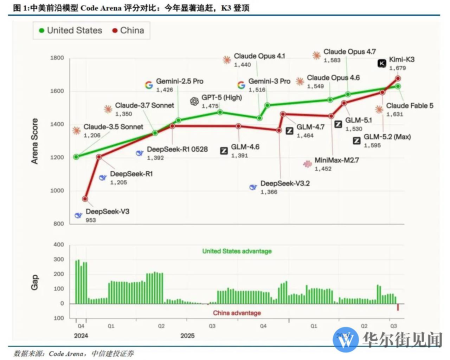
But the outcome diverged from the intent. Once the road was blocked, China dug its own. Huawei pushed forward with its Ascend³ accelerators, and companies like Cambricon and Alibaba followed. On the model side, a string of systems emerged that were judged to be near world-class—DeepSeek, Moonshot AI’s Kimi, and Z.AI’s GLM. A key turning point came when DeepSeek reportedly delivered top-tier performance at a fraction of the cost, shocking the market. It cracked the conventional wisdom that “frontier models are impossible without astronomical spending and the latest Nvidia chips.” Z.AI’s new data center is proof that this self-reliance drive has moved beyond “experiment” to “actual infrastructure capable of training frontier models.”
 Of course, I need to be honest here. This doesn’t mean Chinese chips have caught up to Nvidia. Various analyses show that Chinese accelerators still lag behind Nvidia’s latest generation in performance per watt⁴. That means achieving the same amount of training requires more chips and more power. The real bottleneck isn’t the compute chip itself but memory (HBM) and the networking technology that links chips together—and those happen to be exactly where China lags furthest behind. What’s more, this data center story rests on a single anonymous source, so the precise chip type and scale haven’t been verified yet. It’s worth reading this with a degree of caution rather than taking it at face value.
Still, an important line has been crossed—not the line of “being the best,” but the line of “being self-sufficient.” And here’s the real twist: China isn’t picking up the export-control weapon for the first time. It has already used exports of raw materials essential to semiconductors and defense—gallium, germanium, rare earths—as leverage, tightening and loosening them by turns. In fact, late last year it eased some controls it had previously tightened, which shows this isn’t a blanket ban but rather a valve to be opened and closed as needed. What’s different this time is exactly one thing: the target of control has moved up from “raw materials” to “AI itself.” Containment aimed to create dependency, but the result was to grow an opponent capable of picking up its own weapon.
But America Is Locking the Same Door
So far, this reads like a story of China defensively bolting the door. But look at the other side, and you’ll see America isn’t playing a different game. It’s playing the same game from the opposite end.
U.S. Treasury Secretary Scott Bessent has said in several recent appearances that the U.S. will come to control 80% of the world’s AI compute capacity. That’s a jump from the current 50–60% share to 80%. He pinned down AI leadership as “a national strategy the U.S. absolutely cannot afford to lose,” going so far as to say “if we lose in AI, it’s game over.” Markets read this as a signal that the government would back, at the national level, the astronomical capital expenditure (CapEx) of Nvidia and the cloud companies.
As someone who’s spent time working with data, let me add one note here: there’s no officially recognized statistic that measures “global share of AI compute capacity.” There’s no agreed-upon standard for what exactly 80% is a share of, or how it’s measured. So this number is less a “measured fact” than a “political target.” But I’d argue that being a target is precisely what makes it significant. The fact that a country’s own Treasury Secretary publicly declared compute share to be a national strategic goal is itself a signal that AI infrastructure has moved from being “the market’s problem” to “the state’s problem.”
So the picture snaps into place: China locks up model weights and chip IP, saying “now we have something worth protecting,” while America pins down compute capacity as a national asset, saying “we will hold 80%.” An AI cold war that was once one-sided pressure is now becoming a symmetric structure where both sides lock their own doors using the same logic.
What Gets Locked, What Stays Open—Korea Sits on That Line
What catches my attention most in this export-control review isn’t what gets blocked, but what stays open. According to reports, China appears to be settling on continuing to allow AI models to be served abroad via APIs or cloud, while moving to block the export of model weights and chip IP.
 This distinction is the crux of it. Renting access via API means “you may use it, but you don’t own it”—access can be cut off or conditioned at any time. But if you take away the weights or the chip designs, they become yours. You can run them, modify them, embed them in your own systems. In other words, China is drawing a line between giving away a service and giving away sovereignty. It’s an exact mirror of the American stance we just saw. In fact, this is China reflecting back, almost verbatim, the very logic the U.S. has used against it all along.
So what does this mean for us, especially for businesses? I think the assumption of a single, unified global AI supply chain is coming to an end. Two worlds—the American stack and the Chinese stack—are splitting apart, and mixing the two freely is becoming increasingly difficult. That changes the question companies need to ask. Not “which model performs best?” but “which stack am I dependent on right now, and do I have an alternative if it gets cut off?”
Let me sketch this concretely. Right now, countless startups worldwide take open Chinese models like DeepSeek or GLM and build them into their own services, because they’re cheap and perform well. But if China begins to restrict release of frontier model weights going forward, companies whose business sits on top of those models could one day face a situation where “the next version simply isn’t available.” Companies that lean entirely on U.S. models carry the mirror-image risk on the other side. That’s exactly why the term “sovereign AI⁵” has been coming up so much more often lately. And it’s not just technology at stake here. This round of controls even extends to blocking Western acquisitions of Chinese AI companies. That means it’s not just the technology being locked down—it’s the companies and the people who made it, held within national borders too.
And this is where Korea’s position gets interesting. As I mentioned, China’s biggest bottleneck is memory—HBM. And the companies that make HBM best in the world are SK Hynix and Samsung Electronics. Korea, it turns out, sits right at the crossroads of both the American stack and the very wall China is trying to climb over. That’s powerful leverage, but it’s also a position that draws pressure from both sides to declare “whose side are you on?”
Let me add one more thing: it’s not yet clear this control will roll out smoothly. China’s own AI companies haven’t exactly welcomed it. Whether it’s DeepSeek or Z.AI, they want to grow overseas users and revenue, and tightening exports would hamstring their own global expansion. In fact, they’re reported to have raised concerns with the government that excessive regulation would hurt their competitiveness. The tension between a government determined to protect and companies determined to expand will determine how far these controls actually go.
Two Armed Nations Now Sit Down at the Table
Up to this point, the conclusion seems to flow in a single direction: two blocs building walls and splitting apart. But today’s Reuters report has a slightly different texture. The U.S. and China are reportedly coordinating to hold their first official government-to-government AI talks in September. This follows the Trump-Xi summit last May, and on the American side, none other than Treasury Secretary Bessent is expected to lead it.
At first this seems odd—“weren’t they splitting apart, why the talks?” But I think this is closer to negotiation than reconciliation. What’s on the table is “risk management”: the military use of frontier AI, cyberattacks targeting critical infrastructure, and the misuse of powerful open-source models. Experts even suggest that the biggest achievement of the first talks won’t be some grand agreement, but simply agreeing on what a “frontier AI model” even means.
If “frontier model” still sounds abstract, let’s put a concrete face on it. According to reports, China plans to put Anthropic’s Mythos model on the agenda for these talks. Mythos is so capable of finding security vulnerabilities on its own and writing attack code that Anthropic never released it publicly, opening it only to a small set of vetted partners. The publicly released Fable 5 is a version of Mythos with the dangerous capabilities stripped out. A company voluntarily locking away its own strongest model, only for a foreign government to single that exact model out and put it on the negotiating table—there’s no better illustration of the fact that “AI has become a weapon.”
I’ve seen this pattern before. It’s exactly what U.S.-Soviet nuclear arms-control negotiations looked like during the Cold War: aiming weapons at each other while first agreeing on the definition of the weapons, then drawing lines that must not be crossed. Arms-control talks are not a place where weapons get laid down. They’re a place where both sides acknowledge they have weapons, and build rules on top of that acknowledgment. So these talks aren’t reversing the split—they’re closer to a diplomatic procedure that formally recognizes the reality of “two AI blocs.” A negotiating table only gets set once both sides have weapons to place on it. And there’s one more detail worth noting: the person leading these talks isn’t a tech regulator, but the very Treasury Secretary Bessent who declared the “80%” goal. The fact that the person handling money and sanctions has taken charge of the AI file is a signal that AI has left the category of “product” and become the language of national economic security.
Oz’s Lens
I think reading this purely as tech-competition news misses the point.
There’s a pattern I’ve confirmed again and again while building go-to-market strategies: market battles are often decided not by “whose product is better” but by “who holds the switch.” Even the best technology can be rendered useless overnight if whoever controls the supply decides to flip that switch. So I don’t read these two stories as a scene in a performance race—I read them as the inflection point where AI models and chips cross over from being “products” to being “strategic assets.”
Overlaying Bessent’s “80%” remark makes one more thing clear. This isn’t defense on one side—it’s interlocking gears. When China locks something down, America tightens further, saying “see, we need to hold this.” When America tightens, China locks down further, saying “see, we need to be self-reliant.” Each side’s defense becomes justification for the other’s escalation. What’s frightening is that once these gears start turning, it becomes hard for either side to be the first to say “let’s stop.”
It’s true that “Chinese chips still can’t match Nvidia.” But that also misses the core of this signal. What matters isn’t “being the best”—it’s “whether things keep running if cut off.” China has judged that it has crossed that line, which is why, unlike before, it’s started locking down what it now considers worth protecting. This is entirely my own interpretation, but I believe this threshold of “self-sufficiency” will become a far more important indicator going forward than any performance chart.
Closing
To sum up:
First, the two July 20th stories aren’t separate—they’re one and the same. It’s the moment China declared, “we now have something worth protecting in AI,” and ironically, it was U.S. containment that brought that moment forward.
Second, America is now shouting “80% of compute,” and the two countries are even setting up a negotiating table in September. We’ve entered an era of AI arms control—building walls, then jointly setting the rules for those walls.
Third, the question to ask isn’t “which model is best,” but “which stack am I leaning on right now.”
If you found today’s story interesting, next time I’ll take a separate look at what kind of card Korea’s HBM can actually play between these two stacks.
How much is your company or project leaning on one stack or the other right now—whether U.S. models and chips or Chinese ones? Have you thought through an alternative in case that supply gets cut off, or are you still at the “surely that won’t happen” stage? Let me know in the comments—I’ll feature the most striking examples in the next issue.
💬 Share your own stack check-up in the comments—I’ll fold it into the next issue.
📨 If you have a colleague curious about the U.S.-China AI landscape, please forward this along.
References & Further Reading
Primary sources
- Financial Times, “China considers tighter export controls on AI models and chips”, 2026.7. ··· This is the primary source for the export-control review discussed here. “What gets blocked and what stays open” is the core evidence behind today’s piece.
- Bloomberg, “Z.AI Completes Giant Data Center With Chinese Chips to Train AI”, 2026.7.20. ··· The story of the 1GW center built entirely with Chinese chips. Worth reading with the caveat that it rests on a single anonymous source.
- Wallstreetcn, “Bessent: The U.S. Will Soon Control 80% of Global AI Compute”, 2026.7. ··· The source for America’s “compute sovereignty” declaration. Worth reading alongside the caveat that no officially recognized statistic exists for measuring “compute capacity share.”
- CNBC (citing Reuters), “U.S., China to hold AI talks in September, Reuters sources say”, 2026.7.21. ··· Reports on the push for the first official U.S.-China AI talks in September. Treat the detailed agenda and dates as “proposals under discussion,” since they’re still being coordinated.
Background
- Tom’s Hardware, “China’s chip champions ramp up production… but HBM and fab production capacity are towering bottlenecks”. ··· Useful for understanding why China gets stuck on memory (HBM) even as it ramps up chip production.
- CSIS, “Beyond Rare Earths: China’s Growing Threat to Gallium Supply Chains”. ··· Shows that this “AI export control” didn’t come out of nowhere—it’s a continuation of raw-material controls.
- TechCrunch, “Anthropic releases Claude Fable 5, a version of its Mythos model”, 2026.6.9. ··· Background on what Mythos—the model raised in the talks—actually is, and why Anthropic held back releasing it.
Glossary
¹ GLM: A large language model family developed by Z.AI (formerly Zhipu AI). Alongside DeepSeek and Kimi, it’s considered one of China’s leading frontier models.
² Model weights: The “bundle of numbers” an AI model acquires through training. A model’s actual capability effectively lives here—hand over the weights, and the recipient can run that exact model themselves. That’s why weights are the core target of export controls.
³ Huawei Ascend: Huawei’s line of AI accelerators meant to substitute for Nvidia GPUs. It’s currently regarded as the leader in China’s AI chip market.
⁴ Performance per watt: A measure of how much computation is achieved per unit of electricity used. The lower this figure, the more power and chips it takes to accomplish the same task.
⁵ Sovereign AI: The push for a country to build AI capabilities—models, chips, data, infrastructure—that it can control on its own, without being at the mercy of other nations. The term has been coming up much more often lately as countries increasingly treat AI, like energy, as a national security asset.

Related issues
Fable Can't Enter China, But GPT Can
Chips got blocked, but the models didn't—and that gap is sovereign AI's real face.
🔒 Silicon Valley Is Quietly Running on Chinese AI
It's not about cost—it's a signal that AI's center of gravity is shifting
The Price of Not Looking at China Properly
Two large-scale studies show Western scientists barely cite Chinese papers — and Korea has the same blind spot in batteries and chips.
Your take shapes the next issue
Reply with your experience or perspective — the best responses feed into future issues.
Sign in to commentAny registered reader can comment — it takes 10 seconds.