
The Hidden Bill for 588,000 Remote Workers' Mental Health
They loved working from home — but 588,000 Americans didn't see this mental health bill coming.
Opening
Dear reader, do you love working from home?
You probably do. A morning that starts at a relaxed pace with no commute, a load of laundry thrown in between meetings, a day free from your picky boss’s watchful eye. In a 2024 survey, 80% of American workers named remote work as the happiest way to work. Many said they’d take a 4-10% pay cut just to keep it. Taking remote work away has effectively become a benefit cut.
But earlier this month, a paper published in Science raised an uncomfortable question about this “happiness.” Tracking data on 588,322 Americans over 13 years, the study found that remote work explains a third of the deterioration in mental health. The remote work we love so much has been quietly eating away at our mental health.
Let me give you the conclusion first: this isn’t a case for “go back to the office.” It’s a story about a bigger-than-expected gap between what we like and what’s good for us — and a cost that accumulates so slowly, we never notice it happening.
🔍 The Uncomfortable Truth 580,000 People Revealed
Natalia Emanuel of the Federal Reserve Bank of New York, Emma Harrington of the University of Virginia, and Amanda Pallais of Harvard University. This study, published in Science by three economists, stands out first for its sheer scale.
They pulled data on 588,322 people from five nationally representative U.S. surveys, covering 2011 through 2024. Crucially, they deliberately excluded 2020-2021, the peak pandemic years — cutting off in advance the objection that “everyone struggled because of Covid.” If mental health deterioration is still clear once that period is removed, then it isn’t pandemic fear driving the effect — it’s remote work itself as a way of working.
The team used a difference-in-differences method1, comparing occupations where remote work is feasible (finance, software, etc.) against occupations that require in-person presence. After the pandemic, the frequency of remote work in feasible occupations rose to three times (3x) the 2019 level. The gap that opened up between these two groups is the heart of the study.
Let’s unpack the numbers one by one.
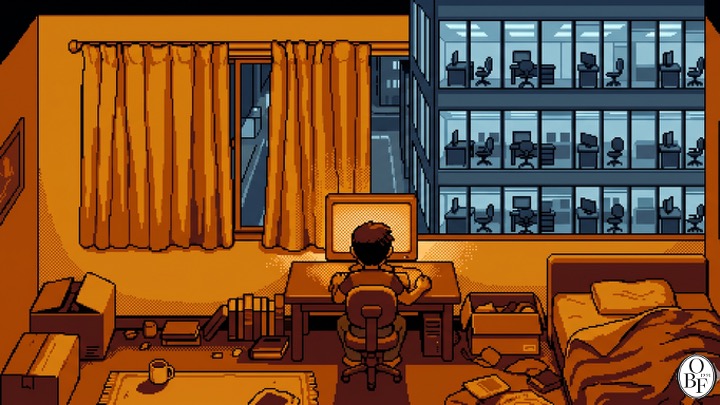
84% of remote workers spend their entire workday alone. On average, they spend more than 1 hour more alone each day than their in-office counterparts. More than half felt their sense of connection with colleagues had weakened. Even online, immediate feedback dropped, and contact with people outside their immediate team fell noticeably.
So far, this might be predictable. Here’s the finding that really matters: remote workers didn’t compensate by socializing more after work. A quick hello with an office colleague, a brief chat with the café barista, a nod exchanged with a fellow commuter on the subway — these small moments of contact simply vanished, and more and more days ended without them.
One experiment result stands out. When commuters were asked to strike up conversations with strangers nearby, they reported greater happiness than when sitting quietly alone — a result that surprised even the participants themselves. The contact we dismiss as trivial turns out not to be trivial at all.
As a result, psychological distress, mental-health-related medical visits, and antidepressant prescriptions rose significantly faster in remote-feasible occupations than in in-person occupations. This increase began in 2020 and hasn’t let up through 2024. That means it isn’t driven by recent anxieties like fear of AI displacement — the structural shift of remote work itself is still at work. Overall, remote work raised psychological distress by 7%, accounting for a third (1/3) of the total mental health deterioration the researchers measured over 13 years.
🧠 Why We Don’t Notice
This raises a question: if such a large cost is accumulating, why do people still love remote work? Why would they take a pay cut just to keep it? The research team’s answer: the costs of remote work are subtle and accumulate slowly. They’re dangerous precisely because they aren’t felt immediately.
As loneliness creeps in slowly, people blame other changes: adjusting to a new job, a breakup, drifting from friends, getting older. The connection to remote work rarely occurs to them. The researchers make this same point: “Workers may not recognize the costs remote work imposes on their well-being, and those costs take time to accumulate.”
This resembles the gap between “decision utility” and “experienced utility” in behavioral economics. The immediate reward of saving commute time is visible right away — you gain 1 hour every morning. The cost of reduced social contact, on the other hand, accumulates slowly over months and years. Because the two are felt on different timelines, a gap opens between the judgment “I like this” and its actual effect. It’s like adding one more spoonful of sugar every day — you don’t feel it today, but your health checkup tells you the story a year later.
There’s a vicious cycle here too. Show up at an office where half your colleagues are working remotely, and all you’re left with is the feeling, “why did I even come in?” A half-empty office isn’t an appealing alternative. As the office’s social value declines, people prefer remote work even more, and as more people go remote, the office empties out further.
In this study, remote workers living with family had relatively stable mental health — the conversation shared at the dinner table after work fills in some of the day’s social void. Remote workers living alone, by contrast, saw their psychological well-being decline by 20%. With no automatic social contact to fill the gap, the void left during work hours simply stays empty after hours too. Day after day repeats: waking up alone, working alone, eating dinner alone.
🇰🇷 Korea’s Structural Variable
You might be thinking, “This is a U.S. study — isn’t Korea different?” And you’d be right: remote work in Korea accounts for just 4.4% of all workers, about 960,000 people, far lower than the U.S.’s 23%.
But what this study implies for Korea has less to do with the remote work rate itself than with the structure underneath it.
As of 2024, Korea has 8,045,000 single-person households, 36.1% of all households — an all-time high. In Seoul, that share climbs to 39.9%, meaning nearly 4 out of every 10 households live alone. Just 5 years ago, the figure was 30.2%; it’s setting a new record every year.
In a social survey by Korea’s National Data Agency, 48.9% of single-person households reported feeling lonely on a regular basis — 10.7 percentage points higher than the overall household average of 38.2%. In 2024, 3,924 people died of godoksa2 (lonely deaths), a 7.2% increase from the previous year.
Recall the core finding from the Science paper: “remote workers living alone saw their mental health deteriorate by 20%.” Korea’s remote work rate is low, but its share of people living alone ranks among the highest in the OECD. The soil for social isolation is already thick and deep.
The workplace is where Korean adults form most of their social relationships. University alumni gatherings are becoming less frequent, and neighborhood communities are dissolving into apartment-complex anonymity. Korean IT companies like Kakao and NCSOFT have announced office-return mandates, and globally, Amazon and Walmart continue to push RTO3. But if this return amounts to nothing more than an order to “raise productivity,” rather than a deliberate design to restore social connection, its effect will be limited.
What would happen if remote work spread to U.S. levels in Korea? The last social adhesive — the workplace — would loosen too. The conditions are already in place for the isolation structure among Korea’s 8.04 million single-person households to deepen far faster than it does now.
One more point worth noting: the study acknowledges its own limitation of not distinguishing between fully remote and hybrid work. The researchers speculated that hybrid work might have a protective effect, mitigating the impact of isolation — a point worth considering as Korean companies design hybrid models built around 2-3 office days per week.
Oswald’s Lens
Honestly, reading this paper, the first thing that came to mind was an old dilemma from GTM strategy.
In user surveys, “I like this feature” and “this feature actually helped me” are different questions. Quite often, the features users like don’t match the features that boost retention4. Build exactly what users ask for, and short-term satisfaction rises — but so does long-term churn, in a strange paradox.
Remote work fits this pattern exactly. The immediate reward of saved commute time is undeniable. But the cost of losing that 3-minute daily chat with a colleague isn’t felt until 3 months later. It’s the same difference as an instant backlash when you remove a feature, versus a quiet churn 6 months after you add one.
So I read this study’s message not as “go back to the office” but as “design for encounters.” The paper’s authors make the same point: we can’t turn back the clock to 2019. What we can do instead is design deliberately — relocate scattered coffee machines into a central hub, add a “team connection” item to performance reviews, have managers arrange a weekly 1:1 between colleagues. Small structural changes like these can create connection.
Just as changing user behavior in a product requires designing the incentive structure, restoring social connection at work requires designing the structure of encounters. Leave it to individual will, and we’ll keep choosing to type alone — because we like it, without ever realizing that what we like and what’s good for us are two different things.
Closing
To sum up:
The convenience of remote work is real. But as the data on 580,000 people shows, so is the cost of isolation that slowly accumulates behind that convenience. For people living alone in particular, that cost shows up as a 20% figure. And Korea, where 36% of households are single-person, already has a structure that’s more vulnerable to this cost.
The crux isn’t “where you work” but “how connected you are.”
When Robert Putnam5 warned 26 years ago about a society “bowling alone,” his solution wasn’t to visit the bowling alley more often. It was to recreate reasons to bowl together. The solution for the remote work era is the same: not “go back to the office,” but design reasons to be together.
This week, why not be the one to suggest lunch with a colleague first? One small invitation might be the first step toward shrinking an invisible bill.
Do you feel more “connected” working remotely or working from the office? And have you ever stopped to question whether that feeling is actually true? Let me know in the comments.
References & Further Reading
Primary sources
- Natalia Emanuel, Emma Harrington, Amanda Pallais, “Home alone: Remote work, isolation, and mental health”, Science, Vol. 392, June 4, 2026. : If you’re curious about the methodology, I recommend the Supplementary Materials section.
- Natalia Emanuel, Emma Harrington, “We Liked Remote Work. Then We Looked at the Data.”, The New York Times, June 2026. : A summary column written by two of the paper’s authors themselves. It’s a much easier read than the paper, and their personal experiences — working remotely during pregnancy, caring for a sick child — make it easy to grasp the context.
Background
- Robert D. Putnam, Bowling Alone: The Collapse and Revival of American Community, Simon & Schuster, 2000. : A classic that warned of the “collapse of social capital” 26 years ago. The Science paper’s final paragraph picks up exactly where Putnam’s concerns left off. (A Korean translation exists too, but its overly literal title meant it never quite caught on…)
- Korea’s National Data Agency, “Single-Person Households in Statistics, 2025”, December 9, 2025

The author, Kwangseob Ahn, is a professor of business administration at Sejong University and lead consultant at OBF (Oswarld Boutique Consulting Firm). He teaches statistics and data analysis — business data management and business analytics — while leading GTM and AI strategy consulting in the field, designing the seam between technology and business. He has published academic research on a memory architecture for AI dialogue systems (HEMA) and runs Daily Arxiv, a daily curation of global AI papers. He holds a master’s from Korea University’s Graduate School of Technology Management and a KMBA. He is the author of Homo Brainless: The People Who Outsource Their Thinking.
Footnotes
-
Difference-in-Differences: A research method that compares the difference in change shown by two groups (e.g., remote-feasible occupations vs. in-person-required occupations) before and after a specific event (the pandemic). External factors affecting both groups (like a recession) cancel out, isolating the pure effect of remote work itself. ↩
-
Godoksa (lonely death): A death that occurs while a person is socially isolated and living alone, not discovered for some period afterward. Korea’s Act on the Prevention and Management of Lonely Deaths has been in effect since 2021. ↩
-
RTO (Return to Office): A corporate policy requiring employees who worked remotely or in hybrid arrangements after the pandemic to return to the office. As Amazon, Walmart, Kakao, and other global and domestic companies have rolled this out one after another, it’s become a major labor market issue. ↩
-
Retention: The share of customers who continue using a product or service after a given period. Unlike short-term satisfaction, it indicates whether users are genuinely finding long-term value. ↩
-
Robert D. Putnam: Professor Emeritus of Political Science at Harvard University. In his 2000 book Bowling Alone, he warned that social bonds among Americans were rapidly weakening. He’s the scholar who popularized the concept of “social capital.” ↩
Related issues
Polymarket Faked Bets to Rack Up 140 Million Views
A prediction market sold FOMO instead of transparency.
China Optimizes, Japan Orchestrates, Korea Bets ₩800T
Three countries, three different bets on where the real AI fight happens — and the layer Korea's plan leaves empty.
The Coupang Leak Meant Spam. This One Meant Lives
A hack of the UN World Food Programme exposed the names and home locations of 600,000 Gaza households living in a war zone.
Your take shapes the next issue
Reply with your experience or perspective — the best responses feed into future issues.
Sign in to commentAny registered reader can comment — it takes 10 seconds.