
China Optimizes, Japan Orchestrates, Korea Bets ₩800T
Three countries, three different bets on where the real AI fight happens — and the layer Korea's plan leaves empty.
Opening
Dear reader, over my last two newsletters, I asked the same question of two different countries.
In the Japan edition (“The Researcher Who Left with ₩900 Billion, and the 138 Who Stayed in Tokyo”), I asked: is AI a game of capital, or a game of methodology? Sakana AI conducted frontier models with a tiny 7B orchestrator and pulled frontier-grade performance out of them. It was the first working proof of the hypothesis that you can win without building bigger.
The Researcher Who Left with ₩900 Billion, and the 138 Who Stayed in TokyoThe lab that chose kaizen over the compute warIn the Korea edition (“The Country That Asks Chatbots for Its Fortune — Can It Become AI’s No. 3?”), I asked: will Korea become a country that builds AI, or one that uses it best? The enthusiasm ranks No. 1 in the world, but the model gap sits at 40%, talent is draining out at OECD rank 35, and the insistence on building a “proprietary model” from scratch could be a rerun of Galápagos syndrome.
The Country That Asks Chatbots for Its Fortune — Can It Become AI’s No. 3?World-leading enthusiasm, a 40% model gapWriting those two pieces, I deliberately held one thing back. What hand Korea would actually play hadn’t been decided yet. Then, on June 29, that hand was revealed at Yeongbingwan, the state guest house of Cheong Wa Dae (Korea’s presidential compound, also known as the Blue House). The Ministry of Trade, Industry and Energy hosted a joint interagency briefing called the “National Report on Korea’s Three Great Leap Megaprojects.” ₩800 trillion (~$576B) for semiconductors, ₩550 trillion (~$396B) for AI data centers, and physical AI designated as a national strategic industry. On the numbers alone, it’s staggering.
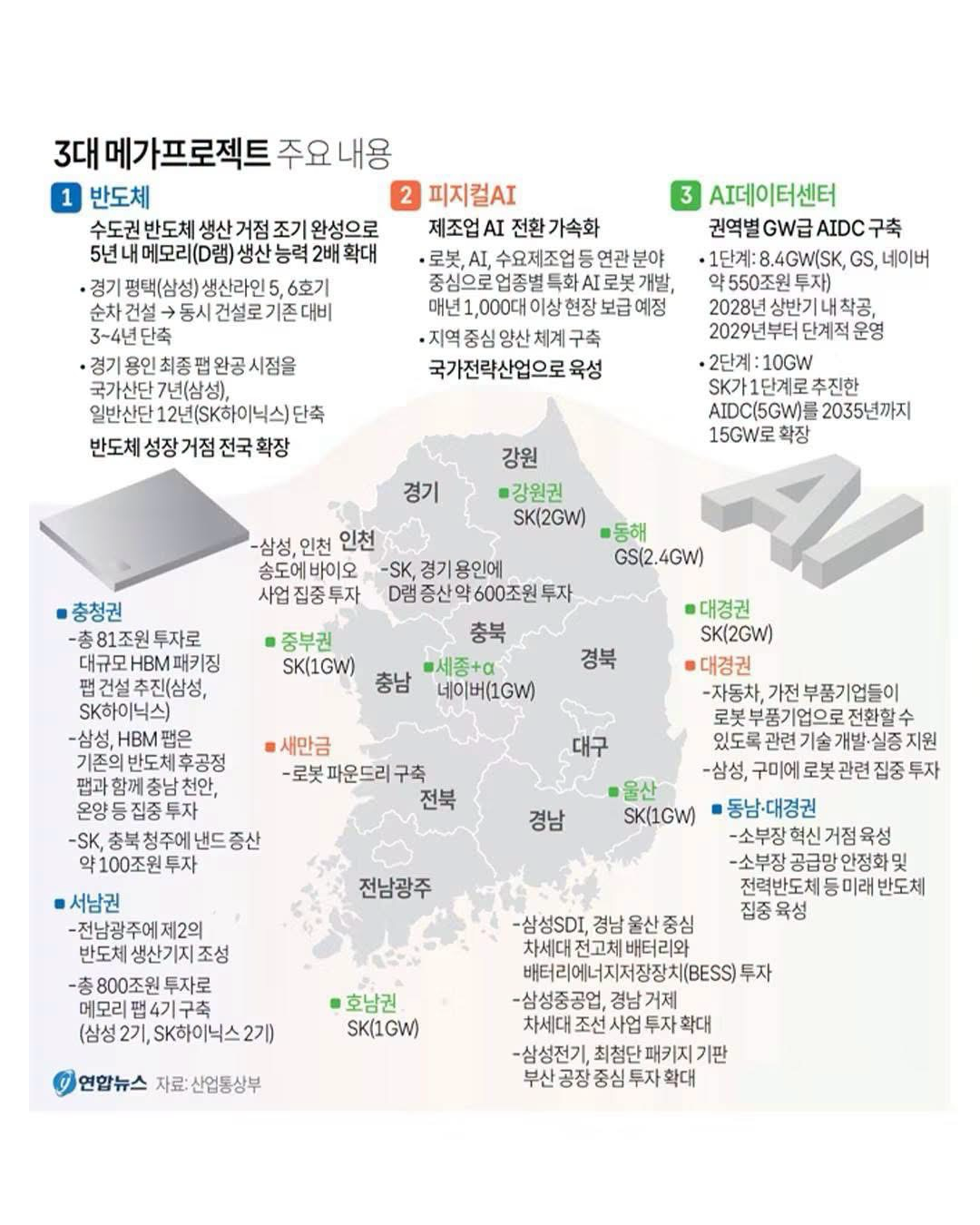
So today closes out the trilogy. I’ll line up which layer China, Japan, and Korea each bet on, and walk through what’s in — and what’s missing from — the hand Korea revealed yesterday. The short version: Korea’s bet is smarter than it looks, but the single most important square on the board is still empty.
Same Game, Three Different Courts
First, let me lay out where each of the three countries has put its money and talent, on a single page. The key point is that they’re fighting on entirely different layers. They’re all lumped under the label “AI race,” but they’re actually playing different sports.
🇨🇳 China: Making Scaling Efficient
China is following the American playbook of scaling, but redefining it as “efficiency” under the constraint of export controls. DeepSeek is the symbol of that shift. Back in late 2024, it got R1 to ChatGPT o1-level performance using just 2,048 H800 chips; in April 2026, it shook up the field again with V4, adding million-token context and sparse attention. In June, it announced the DSpark framework, which it says boosted response speed by up to 85% while reducing dependence on larger chip infrastructure.1
What’s interesting is that even inside China, the center of gravity has already shifted — from training to inference, from building models to using them well. There have even been reports that as much as 80% of the roughly 500 data centers built in the ChatGPT boom’s aftermath sit idle.2 China is still scaling, but not the American way — it’s bending the cost curve itself downward. Qwen, GLM, and DeepSeek are rapidly gaining global adoption through open weights plus rock-bottom API pricing. In practice, Chinese models are winning over American companies on sheer cost-performance, geopolitics notwithstanding.
[Kwangseob Ahn’s AI Synthesis] Why American Companies Are Sending Money to Chinese AI CompaniesUber blew through its entire year’s AI coding-tool budget in just four months. With roughly 5,000 engineers using agentic coding tools, the monthly fee per engineer ran from $150 up to…🇯🇵 Japan: Orchestration
Japan has stepped back from the race to build models directly. Sakana AI itself declared explicitly that “resource-constrained countries like Japan should focus their model-development efforts on post-training.”3 On June 22, it proved that philosophy with an actual product: Sakana Fugu.
A tiny 7B-parameter orchestrator directs frontier models like GPT-5.5, Claude, and Gemini — deciding who handles which part of a task, verifying the results, and recursively calling itself when needed. Fugu Ultra outperformed Opus 4.8, Gemini 3.1 Pro, and GPT-5.5 on major benchmarks including SWE-Pro, GPQA-D, and LiveCodeBench. Sharper still: it matched that performance even though Fable 5 and Mythos Preview — both blocked by export controls — weren’t even in its pool of available agents.4
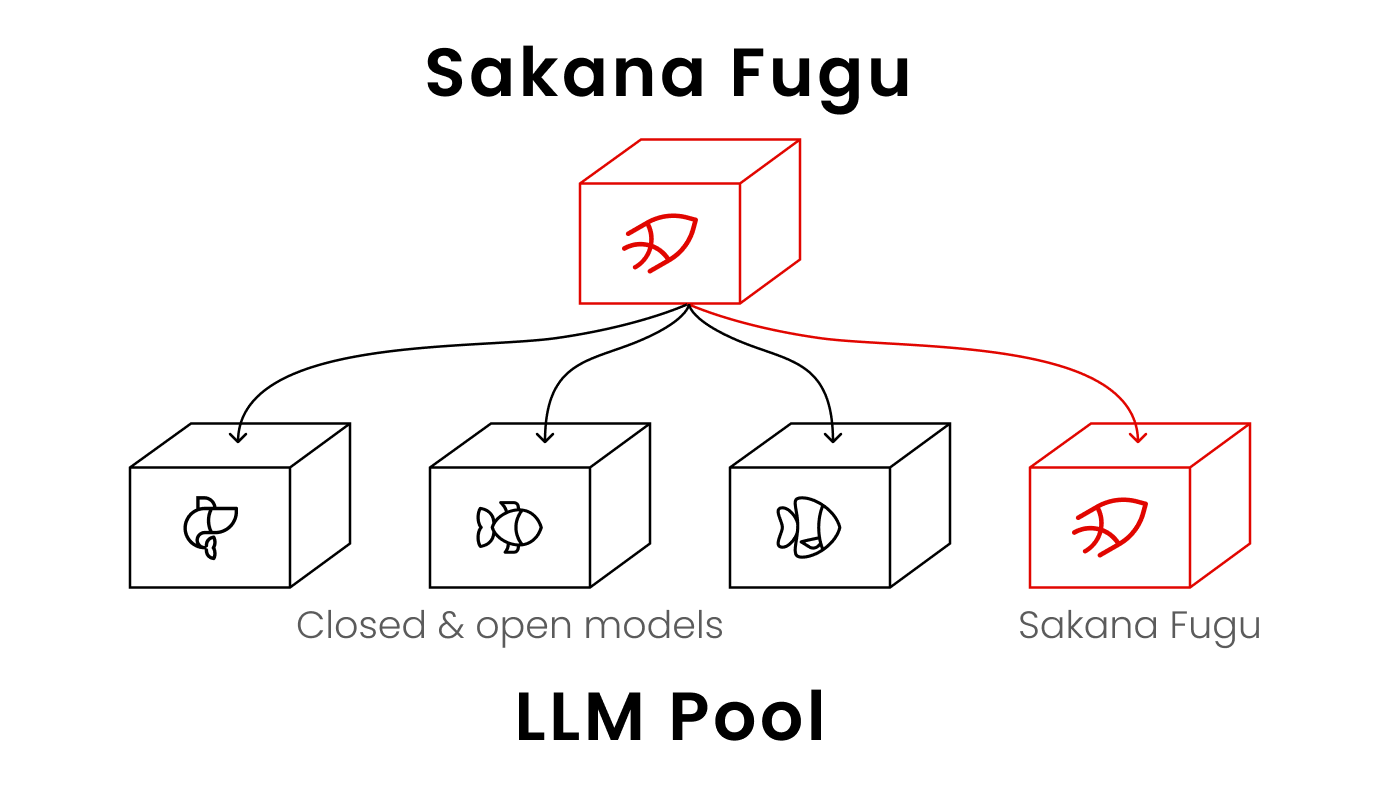
This is the decisive point from a sovereign-AI standpoint. Even if a specific frontier model gets caught by export controls, Fugu dynamically recombines whichever models it can still access (a “Swappable Pool”) to reconstruct equivalent performance. Just as fugu — the pufferfish it’s named after — becomes a delicacy only once its poison is precisely removed, this architecture dodges the poison of external regulation to preserve AI sovereignty. It’s a strategy of holding “command” over models without owning any of them.
🇰🇷 Korea: The Physical Layer
And yesterday, Korea’s hand was revealed. Its center of gravity is unmistakable: semiconductors, physical AI, AI data centers. This isn’t a bet on AI’s “software” — it’s a bet on the “physical body and heart” that AI will ride on.
- Semiconductors: ₩800 trillion invested in the southwestern region (South Jeolla and Gwangju), building four new memory fabs. DRAM capacity to double within 5 years. The goal: widen the supply-chain lead Korea already holds in HBM.
- Physical AI: Top-3 globally in AI robotics, top-1 globally in physical AI by ~2030. Humanoids specialized for 10 target industries, and an AI transformation of manufacturing.
- AI data centers: Phase 1 at 8.4GW (SK, GS, Naver; roughly ₩550 trillion), rising to 18.4GW total by phase 2. The goal: become Asia-Pacific’s largest AI infrastructure hub by 2030.
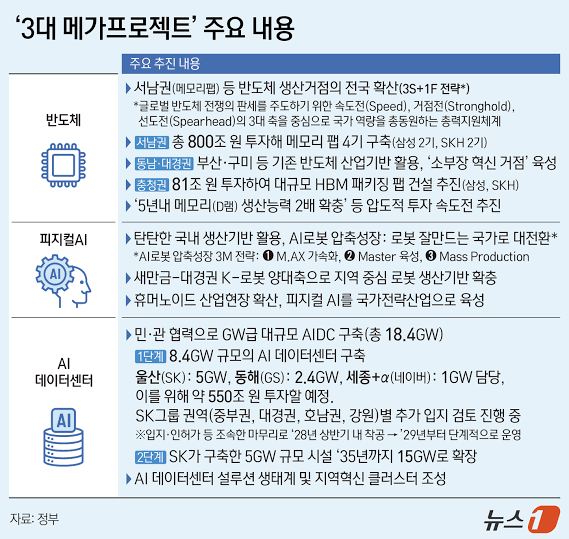
In the Korea edition, I wrote: “Bind AI most deeply into the areas where Korea already has global competitiveness — semiconductor process optimization, battery quality control.” Yesterday’s M.AX platform and manufacturing data factory point exactly in that direction. It’s the national-scale version of the “best-user” strategy.
Korea’s Bet: Half Right
Let me start with the compliment: this bet is smarter than what I worried about in the Korea edition.
Beating the US and China head-on in the foundation-model race is unrealistic. Private AI investment in the US alone is $285.9 billion — 42 times Korea’s entire AI budget of $6.7 billion. Trying to close that gap through model performance is closer to self-justification than strategy. Yesterday’s announcement, though, sidestepped that head-on fight and put its weight on areas where Korea is genuinely No. 1 — HBM, manufacturing density, robot density.
In particular, physical AI is a smart choice. It’s an entirely different game from the text-LLM race. Here, Korea’s manufacturing data, process-operation know-how, and world-No.1 robot density — 1,220 robots per 10,000 workers — become real assets. US Big Tech has neither the data nor much interest in this space, so the competitive landscape itself is different. The position of “borrow the brain (foundation model), but build the body and heart ourselves” is, frankly, a hundred times more realistic than “beat GPT with a proprietary foundation model.”
That’s the good half. The problem is the other half.
But There’s No Conductor
Reading yesterday’s announcement start to finish, one thing kept nagging at me. There are semiconductors. There are robots. There are data centers. But the entire layer of “how do we combine and direct this intelligence” is missing.
Japan filled that square with Fugu. Korea’s document doesn’t have that square at all. In its place, what you find instead is: “a K-model free of dependence on foreign technology,” “securing a world-class general-purpose intelligence model,” “developing a world-class proprietary physical AI foundation model within three years.”
To see why this matters, I need to bring back an episode I covered in the Korea edition. This past January, Naver Cloud was eliminated from the government’s Sovereign AI Foundation Model project (dubbed “Dokpamo,” short for the Korean phrase “Dokja AI Paundeisyeon Model,” meaning “Sovereign AI Foundation Model”). The reason: it had used an overseas open-source encoder, which meant it failed to meet the “from scratch” standard5. It was the moment that revealed even the company that had invested longest and most in AI in Korea didn’t have a model “built from the ground up.”
That Dokpamo project is now a four-way race among LG, SKT, Upstage, and Motif Technologies. One team will be cut in the second evaluation this August, and the final two will be chosen next February.6 Yesterday’s megaproject copied that same “from-scratch Dokpamo” DNA wholesale into a physical-AI version. It’s restarting a game Korea couldn’t win in general-purpose LLMs, just with the stage changed to physical-AI foundation models.
This is where the decisive difference with Japan shows up.
Japan has Sakana — a private frontier lab that actually made the methodology work — so it can layer a self-improvement engine and an orchestration layer on top of its consortium (AIST, Swallow, Stockmark). It doesn’t have to build every model itself; it holds the intelligence that commands the models.
Korea has no one in that seat. There’s no clear body responsible for the orchestration layer, and no proven private physical-AI lab either. Naver’s elimination is exactly what that absence looks like. The government wants to fill this gap with a “large-scale, cross-ministry R&D project,” but whether a consortium-style national project can actually run a Sakana-style kaizen loop is an entirely different question. While the state pours ₩800 trillion into building the body, the conductor moving that body is still, most likely, going to be a foreign frontier model.
That’s the real gap in yesterday’s announcement. Before pouring ₩800 trillion into the physical layer, Korea needed to decide on the architecture of the intelligence that would ride on top of it. There isn’t a single line about orchestration — nothing like Fugu — anywhere in the document.
Oz’s Lens
Let me be honest. The judgment to shift weight toward the physical layer in yesterday’s announcement was correct. But that’s as far as it goes. On top of that smart judgment, I saw Korean AI policy’s oldest disease sitting right there, unchanged.
That disease is called the “compulsion to build.”
In tech management and GTM strategy work, I’ve watched this exact losing pattern play out over and over: the moment a resource-poor player insists, “even so, we have to build all of it ourselves.” The phrases in yesterday’s document — “escaping dependence on foreign tech,” “world-class proprietary model,” “proprietary physical AI foundation model within three years” — aren’t strategy. They’re pride. And pride comes at a steep price. Korea is about to lose the same game it already lost by a proven 40% gap in general-purpose LLMs, just with the stage swapped to physical AI. The “from scratch” standard that eliminated Naver in January has been resurrected — this time on top of robots.
What’s more frustrating is that this isn’t a case of Korea failing to notice Japan. Right next door, Japan proved with an actual product — a tiny 7B model — that you can win without building everything yourself. It chose to command models rather than own them. Korea has that answer sheet sitting right in front of it, and still clings to the old grammar of “we’ll build it all from scratch.” Instead of studying kaizen, it’s choosing to build a bigger factory.
Look at the asymmetry with a cold eye. China solved it through efficient scaling. Japan solved it through orchestration. Both have their own answer to “how do we handle intelligence?” And Korea? It has a body (semiconductors) and a heart (data centers), but not a single blueprint for the nervous system connecting the two. In this ₩800 trillion anatomical chart, the brain and spinal cord are simply blank. That blank is being filled with the slogan “proprietary model development R&D” — but that’s a wish, not a blueprint.
Here’s the scenario that genuinely scares me. Five years from now, Korea completes the world’s most sophisticated AI body. No. 1 in HBM, No. 1 in robot mass production, the largest data-center footprint in Asia-Pacific. But the intelligence moving that entire body is GPT, or Gemini, or Fugu. The line I wrote in the Korea edition — “this is the realm of subcontracting, not of owning something as ours” — repeats itself word for word in physical AI. A country that builds the most expensive vessel, and fills it with a borrowed brain.
I honestly don’t know who wins in the end. Maybe whoever holds the physical layer takes everything. But that scenario rests on exactly one condition: that we can conduct the intelligence riding on top of the body. Without that condition, ₩800 trillion isn’t a decisive bet — it could become the most expensive subcontracting-equipment investment in the world. I do think Korea has grabbed a once-in-a-generation opportunity in semiconductors right now. And I think this policy emerged precisely because Korea holds a position that combines some of the world’s most skilled labor, facilities, and infrastructure with a geographically and geopolitically strategic location relatively insulated from natural disasters.
In other words — isn’t the ideal picture for Korea to become something like the Petra of data centers and every power-generation hub in the world? And shouldn’t we, alongside that, prepare the model and the operational capability to conduct the whole thing ourselves? That’s the imperfect but honest conclusion I’ve landed on.
Closing
To sum up:
The question running through this whole trilogy was really just one question: where in the AI race do you actually need to fight? China answered with efficient scaling. Japan answered with orchestration. And yesterday, Korea answered with the physical layer. I think all three are smart choices given each country’s own constraints. I’d grown frustrated watching Korea sing nothing but the foundation-model tune, so this announcement was genuinely a relief. I think a foundation model is worth having as a baseline capability, but it shouldn’t be our main focus — and we can’t catch up to frontier-level performance overnight anyway. On top of that, I think it’s time to stop gaming benchmarks, too.
But there’s still one blank in Korea’s answer. In a ₩800 trillion blueprint for building a body, the architecture of the intelligence that will command that body is missing. Japan proved that layer with a single 7B orchestrator; Korea is still trying to solve it with the old grammar of “proprietary, from-scratch models.” I’ve seen a few domestic startups and companies claiming they’ve hit No. 1 in the world on their own benchmarks lately — if true, that would genuinely be remarkable. But when a project that’s published a paper on arXiv with single-digit citations, and gets no traction on GitHub, openly claims to have beaten NVIDIA and achieved the world’s No. 1 world model… isn’t there a bit of a gap there? Sure, maybe clueless foreign press just can’t recognize the technology quietly sitting in little Korea over in the East. That couldn’t possibly be it, could it. Let’s get a grip.
Next time you see a Korean AI policy announcement, don’t just look at the investment figures (₩800 trillion, ₩550 trillion) — ask this question instead: “Whose intelligence, and what, will conduct this infrastructure?” If that square stays empty, Korea could end up building the world’s most sophisticated AI body, only to fill it with someone else’s borrowed brain.
Just as Cyworld — Korea’s pioneering early social network — built the world’s earliest social network and still missed the shift to mobile, I hope Korea doesn’t build the world’s fastest AI body only to miss the intelligence riding on top of it.
💬 What do you think, reader? Will the AI race ultimately be decided by the “body” (the physical layer), or by “command” (orchestration)? Let me know in the comments.
References & Further Reading
Primary sources
- Ministry of Trade, Industry and Energy, “National Report on Korea’s Three Great Leap Megaprojects,” press briefing materials and attached report, 2026.06.29. This is the original source for yesterday’s announcement, laying out the semiconductor 3S+1F plan, the physical-AI 3M plan, and the 18.4GW AIDC roadmap.
- Sakana AI, “Sakana Fugu: One Model to Command Them All,” 2026. The product evidence behind Japan’s orchestration strategy, and also a key source for the Japan edition.
- Ministry of Science and ICT, “Results of the First-Round Evaluation of the Sovereign AI Foundation Model Project,” 2026.01.15. The original source on Naver Cloud’s elimination and the “from scratch” standard controversy.
Background
- The New York Times, “The Real A.I. Race Isn’t America vs. China,” 2026. Argues that the real axis of the AI race isn’t the US vs. China but state power vs. private companies — a framing that connects directly to this trilogy.
- ZDNet Korea, “[Yumi’s Pick] LG, SKT, and Upstage Meet Jensen Huang — a Wild Card for Round Two of Sovereign AI?,” 2026.06.09. Covers the state of the four-way Dokpamo race and the August second-round evaluation schedule.
- South China Morning Post / IndexBox, “DeepSeek upgrades V4 with DSpark,” 2026.06. The latest example of China’s “efficient scaling” strategy.

The author, Kwangseob Ahn, is a professor of business administration at Sejong University and lead consultant at OBF (Oswarld Boutique Consulting Firm). He teaches statistics and data analysis — business data management and business analytics — while leading GTM and AI strategy consulting in the field, designing the seam between technology and business. He has published academic research on a memory architecture for AI dialogue systems (HEMA) and runs Daily Arxiv, a daily curation of global AI papers. He holds a master’s from Korea University’s Graduate School of Technology Management and a KMBA. He is the author of Homo Brainless: The People Who Outsource Their Thinking.
Footnotes
-
DSpark: An inference-acceleration framework DeepSeek introduced with V4. Instead of generating tokens one at a time, it produces them in small batches (semi-autoregressive generation) and dynamically adjusts how much verification it does, which it says boosts response speed by up to 85%. The core idea is reducing dependence on larger chips. ↩
-
Idle data centers: According to reporting from outlets including MIT Technology Review, only a fraction of the roughly 500 data centers China announced in 2023–2024 actually came online, and even among those that did, analyses found as much as 80% of computing resources sitting unused. This reflects demand shifting from training toward inference. ↩
-
Post-training: Rather than pretraining a model from the ground up, this refers to the stage of layering additional training, alignment, and tool integration on top of an already-trained model. Sakana argues that resource-constrained countries should focus their strategic effort on this layer. ↩
-
Swappable Pool: The set of frontier models Fugu orchestrates. If a specific model becomes unavailable — for instance, due to export controls — the pool dynamically recombines whichever other models remain accessible to maintain performance. The goal is frontier-level performance without vendor lock-in. ↩
-
From scratch: Building a model without reusing any existing model or weights — initializing weights from zero and independently handling every step, from data collection through architecture design to training. This is the standard the government set for a “proprietary model,” and Naver was disqualified under it for borrowing an overseas encoder. ↩
-
The Dokpamo four-way race: As of June 2026, four teams — LG AI Research, SK Telecom, Upstage, and Motif Technologies — are competing. One will be eliminated in the second-round evaluation this August, with the final two selected in February 2027. ↩
Related issues
 Issue #134Society
The Coupang Leak Meant Spam. This One Meant Lives
A hack of the UN World Food Programme exposed the names and home locations of 600,000 Gaza households living in a war zone.
 Issue #127Society
Fortune-Telling Chatbots and Korea's Claim to AI's Top 3
The world's most AI-enthusiastic public still faces a 40% model gap — and enthusiasm alone won't close it.
 Issue #123Society
The World's Strongest AI Went Dark 3 Days After Launch
In 1999 the US called a computer a weapon; in 2026 it pulled the plug on an AI model — and sovereignty went from slogan to survival.
Your take shapes the next issue
What resonated most in this issue, or where has your experience been different?