
The Cornfield Theory That Still Explains Tech Adoption
Technology moves faster than ever, but the psychology behind how people accept change hasn't changed at all.
Opening
Dear reader, let me pose an interesting question. What do 1940s corn farmers in Iowa, USA, have in common with corporate executives trying to adopt AI in 2026?
Both said, “I can see this is good, but I’ll wait and watch a bit longer.”
According to Deloitte’s 2026 State of AI in the Enterprise report, released last week, 88% of companies say they’re using AI for at least one task. But the same report found that fewer than 40% have actually scaled beyond the pilot stage to the entire organization. PwC’s 2026 Global CEO Survey offers an even more candid number: 56% of CEOs said their AI investments have “yielded no measurable results” whatsoever.
Technology is everywhere, yet diffusion has stalled. A book published in 1991 explains this phenomenon precisely. Today, let’s talk about it.
The Diffusion Theory Born in a Cornfield
The word chasm originally comes from geology—a deep crack formed when land or ice splits apart. Before it became a core concept in management and marketing, the term had an unexpected starting point: a cornfield.
In 1941, sociologist Bryce Ryan of Iowa State University and his graduate student Neal C. Gross began a fascinating study. At the time, Iowa was seeing the spread of an improved corn variety—hybrid seed corn—that yielded about 20% more than existing varieties and was more resistant to drought. Developed in 1928, the seed was objectively superior, but farmers were adopting it far more slowly than expected.
Ryan and Gross personally interviewed 257 farmers across two rural Iowa communities. What they found was a striking pattern. The timing of when farmers first heard about the new seed varied little among them. But the time it actually took to adopt it varied by as much as 7 years. Early on, the main information channel was the seed company’s sales representatives, but over time, the testimony of neighboring farmers became the decisive factor.
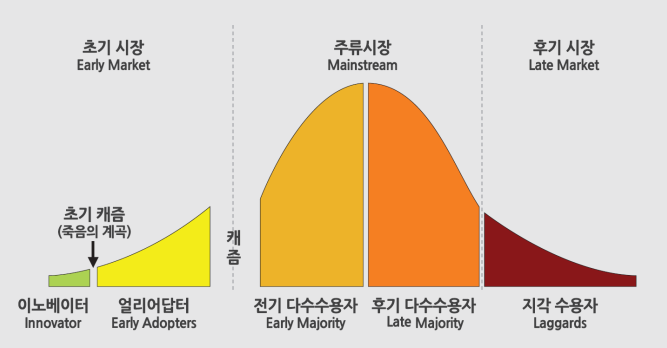
This 1943 paper1 went on to reshape sociology. In 1962, Ohio State University sociologist Everett Rogers, inspired by this research, published Diffusion of Innovations. Rogers divided the process by which new ideas or technologies spread through society into five groups.
- Innovators: 2.5% of the population. People fascinated by the technology itself
- Early Adopters: 13.5%. Visionaries who recognize the technology’s strategic value
- Early Majority: 34%. Pragmatists who want a proven product
- Late Majority: 34%. Conservative users who move only after something becomes mainstream
- Laggards: 16%. The group that resists change until the very end This model explained the diffusion of major 20th-century technologies like radio, television, and the telephone remarkably well. As adopter groups passed the baton to one another in sequence, the market traced an S-curve toward saturation. For decades, this model held up almost like a formula.
But in the 1980s, something strange started happening. Information technology products—computers, software—kept showing the same pattern: demand would suddenly collapse right at the transition from early adopters to the early majority.
Related issues
🔒 How Child Safety Laws Are Building an Internet ID System
Child protection is real, but should the fix mean embedding everyone's identity into the operating system?
🔒 US Cyber Strategy Shrinks from 39 Pages to 7
Why a strategy that hits harder but defends less isn't just America's problem
🔒 When Silicon Valley Talks 'Taste,' What's It Really Hiding?
Is 'knowing what to build' really the same thing as taste, or something else entirely?
Your take shapes the next issue
Reply with your experience or perspective — the best responses feed into future issues.
Sign in to commentAny registered reader can comment — it takes 10 seconds.