
What Happens When You Measure Journalism by Data
Bezos didn't bring restructuring to The Washington Post—he brought Amazon's entire operating philosophy
Opening
Dear subscriber, something interesting happened on March 13th. Jeff Bezos invited Washington Post executives to his home in Washington, D.C. Next to the coffee station sat a broken lock from the Watergate break-in, on display. Two 90-minute sessions, with lunch in between. So far, this sounds like a typical media owner’s town hall.
But the way the meeting started was unusual. Every attendee sat in silence reading a distributed memo—a detailed document about the Post’s business trajectory and its use of data. If you’ve ever worked at Amazon, this scene will feel familiar. It’s Amazon’s “six-page memo” meeting culture, transplanted whole.
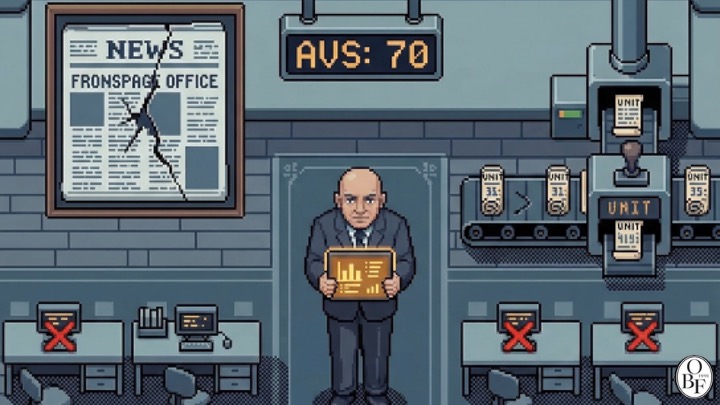
Bezos isn’t simply trying to cut costs at a newspaper. He’s transplanting the operating philosophy that built Amazon—data-driven decision-making, relentless efficiency, a culture of “prove it with metrics”—into a 148-year-old news organization. And two concepts have emerged from that process: “cost per story unit” and “Audience Value Score.” Today I want to talk about why these two metrics matter, and what happens when you apply them to journalism.
Where $300 Million Disappeared in Three Years
Let’s start with the numbers. The Washington Post ran a loss every year from 2022 through 2025. In 2025 alone, losses exceeded $100 million, bringing the three-year cumulative loss to roughly $300 million (about ₩400 billion). Bezos paid $250 million to acquire the paper in 2013—meaning the Post has now lost more money than it cost to buy.
The structural problem can be compressed into one sentence: costs went up while output went down.
Jeff Diomofrio, the former CFO now serving as acting CEO, laid out these figures for staff at the town hall:
- Article output down 42% compared to 2020
- Newsroom costs up 16% over the same period
- Output per reporter down 36%
- Total pageviews for news and opinion down 48%
- In some areas, thousands of dollars spent to publish a single article
Diomofrio summed it up in a line that could have come straight out of an Amazon slide deck: “Costs went up, output went down. Cost per story unit has doubled since 2020.”
It’s worth pausing on the phrase “story unit.” The moment you call an article a “unit,” journalism enters the vocabulary of manufacturing. It means tracking the production cost of a single article the way a factory tracks the cost of producing one product.
Related issues
🔒 If AI Must Pay Taxes, How Much Should It Owe?
The era of taxing labor is ending—the real question is what comes next.
🔒 Give AI Agents a Prepaid Card, Not Your Credit Card
The age of handing AI agents a 'wallet' has begun. The real challenge isn't technology — it's designing trust.
🔒 How a Crayfish Bot Is Reshaping China's Tech Stack
China's 'crayfish-raising' craze is no fad—it's shaking up cloud, messaging, and AI model markets all at once.
Your take shapes the next issue
Reply with your experience or perspective — the best responses feed into future issues.
Sign in to commentAny registered reader can comment — it takes 10 seconds.