
Magnificent Seven Name Fades, Its Market Weight Doesn't
The new label Wall Street is drafting already includes Anthropic, OpenAI, and SpaceX.

Opening
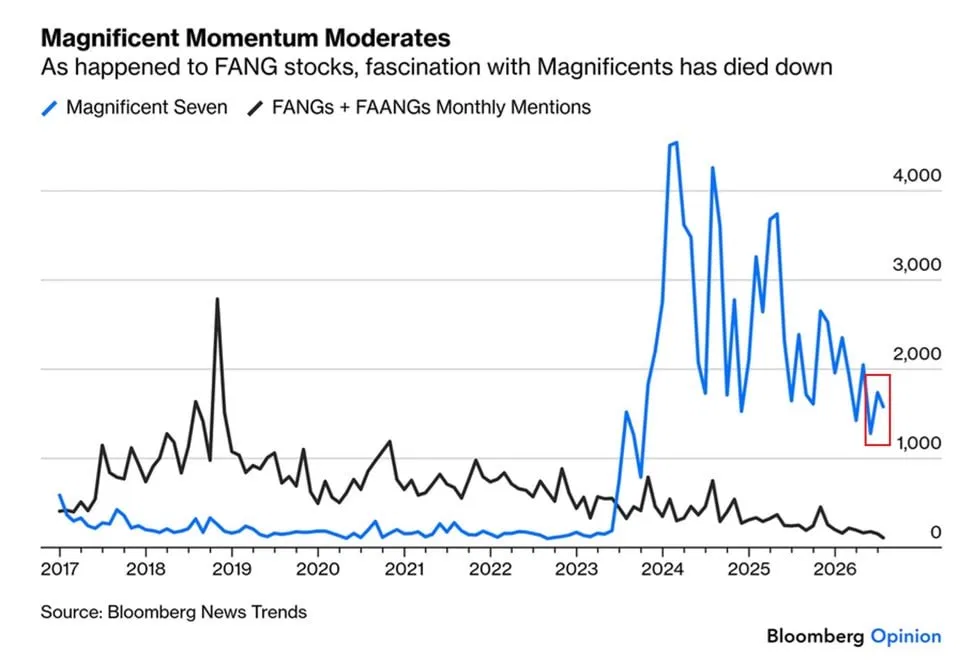
Reader, I counted how many times the phrase “Magnificent Seven (M7)” showed up in Bloomberg Terminal news articles, and the recent monthly count came to about 1,400. That’s down 70% from the peak of roughly 4,300 in Q1 2024.
But over the same stretch, these seven companies’ share of the S&P 500 hasn’t shrunk at all. It’s still hovering around a third. We’re saying the name less, yet the size hasn’t budged.
Let me give you the conclusion up front. The name is disappearing not because interest has cooled, but because the seven no longer move as a single body. And Wall Street is already drafting the next label — one that already includes companies you still can’t buy, like Anthropic and OpenAI.
Fragment 2/10
This Is the Second Time We’ve Seen This
Let me lay out the numbers first. The source is Bloomberg News Trends1, and John Authers introduced this chart in his July 29 column.
Monthly mentions of the “Magnificent Seven” peaked at roughly 4,300 in Q1 2024 and now sit at around 1,400—close to the lowest level since Q4 2023.
Before going further, let’s flag a limitation in this data. The count only covers articles that appear on the Bloomberg Terminal. So this isn’t a measure of “public interest”—it’s a measure of the words financial journalists use. It doesn’t capture how often the term shows up on YouTube or in online communities. But for today’s story, that narrow scope is actually useful. It shows what words the people who have to explain the market every single day are choosing to drop.
What’s interesting is that this isn’t the first time. The previous generation’s labels, FANG and FAANG, traced the exact same curve. They peaked at roughly 2,800 mentions a month in Q4 2018, then fell to about 500 by early 2020—an 82% drop.
Here’s a question worth checking: after FANG mentions fell 82%, did those five companies collapse?
No. Meta, Amazon, Apple, Netflix, and Alphabet kept leading the market afterward. Four of those five were simply carried over into today’s Magnificent Seven. The lifespan of a label and the lifespan of a company were two separate things.
So why did the name die? That’s the crux of today’s issue.
A Label Is Only Information When Seven Things Move as One
For a single tag to usefully bundle several stocks together, one condition has to hold: they actually have to move together. Only then does a sentence like “the Mag 7 rose” carry any information.
Look at the 2026 scorecard, and that condition breaks down.
According to Morningstar’s tally as of July 13, Microsoft was down 20.4% year-to-date. Over the same period, Apple was up 16.9%, and Alphabet was up 12.7%. Inside a single basket, the spread between the top and bottom was 37 percentage points. On a trailing-one-year basis per Yahoo Finance, Alphabet more than doubled while Meta and Microsoft each dropped double digits.
 In this state, if you ask “how did the Mag 7 do?”, there’s no answer to give. It depends on whether you mean Alphabet or Microsoft, and the two stories are opposites. The label isn’t compressing information anymore — it’s started erasing it.
Even looking at the group as a whole, the same pattern holds. Per Vanguard’s analysis, while the S&P 500 rose about 9% in 2026, the Mag 7 fell 1%. MAGS, the Mag 7 ETF, has returned a cumulative 158% since its April 2023 launch, but looking at 2026 alone, it’s down 4%. An early-July Bloomberg report even noted that the Mag 7 has trailed 300 of the S&P 500’s constituent stocks this year — a group of 300 that includes names like Dollar Tree and Hubbell.
Journalists aren’t using this term less because interest has faded. It’s because the term can no longer explain what’s actually happening in the market. Mention volume looks less like a sentiment indicator these days and more like an explanatory-power indicator.
The Nifty Fifty Died ‘One at a Time’ section looks accurate. Let me output the corrected fragment.
The Nifty Fifty Died ‘One at a Time’
The first place this pattern showed up was in the United States, half a century ago. Let’s take a quick trip back to the 1970s.
From the late 1960s, American institutional investors started using a phrase: the Nifty Fifty2. It referred to a group of 50 large growth stocks—Coca-Cola, IBM, Xerox, Polaroid, McDonald’s, Disney, and the like. The phrase carried a deep conviction with it. These stocks even earned the nickname “one-decision stocks,” meaning once you bought them, you never had to think about price again.
The valuations reflected that conviction. At the end of 1972, their average price-to-earnings ratio was 41.9x—more than double the S&P 500’s roughly 19x. Polaroid alone traded at 91x.
Everything flipped starting in 1973. The Bretton Woods system collapsed, inflation surged, and the oil shock hit, sending the broader market into decline. At first, the Nifty Fifty actually held up—institutional buying kept propping them up. But when they finally broke, they broke far harder than the market did. While the S&P 500 fell about 48% from its peak, Polaroid dropped 91%, Disney 87%, Avon 86%, McDonald’s 72%, and Xerox 71%.
A line a Forbes columnist wrote about this era is still quoted today: that the Nifty Fifty were “led out and shot one by one.” I think the key word in that sentence isn’t “shot”—it’s “one by one.” They didn’t die as a group; they died scattered, as individual stocks. First the label lost its meaning, and only then did each company’s own circumstances come to light.
Let me also bring in the counterargument. In a 1998 paper, Jeremy Siegel argued that if you had held the Nifty Fifty long-term, they performed roughly in line with the market overall—meaning their prices at the time weren’t actually absurd. So two interpretations coexist to this day: “the companies were great but the price was the problem” versus “even the price was justified over the long run.”
Both interpretations are consistent with today’s argument. Either way, the common thread is that the group label failed to predict the fate of any individual company. The name “Nifty Fifty” effectively fell out of use by the mid-1970s, but Coca-Cola and McDonald’s went on to grow for another half-century after that.
Where Did the Attention Go
Let me circle back to 2026. Where did the attention that the label could no longer contain end up going?
Vanguard has identified 45 companies that could be called the “AI complex” — infrastructure builders, power companies, semiconductor firms. This basket has doubled in value this year. And notably, none of the Magnificent Seven — Alphabet, Amazon, Meta, Microsoft, Oracle — are among these 45.
This lines up exactly with what I covered last week: the scissors of intelligence’s unit cost falling while GPU rental rates rise. Back then, I framed it as margin migrating from models to infrastructure — and what you’re seeing now is the stock-price version of that same migration. Where the label points and where the money flows have come apart.
 Let me note something here for balance. Reading this as “big tech’s era is over” would be an overreach. The Magnificent Seven still make up about 33.8% of the S&P 500, and their projected earnings growth is more than double that of the other 493 companies. Morgan Stanley, Goldman Sachs, and JP Morgan have all recently taken the position that this group’s slump is overdone. Dominance hasn’t disappeared — what’s disappeared is the assumption that it comes as one bundle.
The Next Nametag Contains a Company You Can’t Buy
So Wall Street is busy coining new names. This is a very old habit, and if you lay out the genealogy, you can see the rhythm.
| Nametag | Period | Story it bundled |
|---|---|---|
| Nifty Fifty | 1960s–70s | Blue-chip growth stocks you buy once and hold forever |
| Four Horsemen | Late 1990s | Dot-com infrastructure (MS, Intel, Cisco, Dell) |
| FANG / FAANG | 2010s | Internet platforms |
| BAT | 2010s | Chinese internet (Baidu, Alibaba, Tencent) |
| GRANOLAS | 2020 | European large-caps |
| Magnificent 7 | 2023– | Big Tech and AI |
| BATMMAAN | 2024–25 | Mag 7 plus Broadcom, expanded |
| MANGOS / FAB 10 / AI Big 10 | 2026 | The post-Mag 7 AI race |
What stands out most is the lifespan of the bottom two rows. BATMMAAN circulated briefly in 2024 and vanished before most people had even learned to pronounce it. And in 2026, there isn’t just one candidate — three are competing at once.
The three lineups differ slightly in composition.
- AI Big 10 (Bank of America): Mag 7 plus Broadcom, AMD, and Micron. This combination stays entirely within public markets
- FAB 10: Mag 7 plus SpaceX, OpenAI, and Anthropic
- MANGOS: Meta, Anthropic, Nvidia, Google, OpenAI, SpaceX
What’s new is that the latter two include private companies. SpaceX solved half this problem by listing on Nasdaq on June 12. It was the largest IPO ever, raising roughly $75 billion at $135 a share, and it closed up 19% on its first day at $160.95. Vanda Research read the listing as a signal that investor attention is shifting away from the Mag 7 and toward FAB 10.
That leaves OpenAI and Anthropic. Both companies are rumored to be considering a listing, but for now, you can’t buy shares in either. And yet Yahoo Finance already has pages for OPAI.PVT and ANTH.PVT, separate tickers3 created specifically for private companies.
I think this ticker is the single most symbolic object in this whole story. A quote page appeared for a company you can’t buy — before the company itself was buyable. It means the narrative is running ahead of the product. Every nametag from the Nifty Fifty to the Mag 7 was, at bottom, a list of things you could buy. The 2026 list is the first to cross that line.
Korean investors have already stepped outside the label
This shift happened faster and rougher in Korea.
According to the Korea Securities Depository, domestic investors’ US stock holdings fell from $204.1 billion in May to $166.8 billion on July 28. That’s three consecutive months of decline, a drop of 18.2%.
But look at what was actually being bought and sold, and the picture changes. The top settlement amount in July was SOXL, a 3x leveraged semiconductor ETF4, followed by Micron, SanDisk, and SK Hynix depositary receipts. That’s almost the same list as Vanguard’s “AI complex.” In other words, Korean retail investors have already stepped outside the label.
The way they stepped out, though, was different. SOXL’s share price rose 4.6x, from $47.24 on January 2 to $266.71 on June 30, and ₩71 trillion (~$51.4 billion) worth was traded in the first half of the year alone. The turnover rate reveals the real character of this trade. In the first half, SOXL’s settlement amount was 6.7 times its end-of-June holding value, while Tesla — the top holding — was only 0.4 times. One is an asset people hold; the other is a tool for day-trading.
Here’s the summary: the direction was right, but the instrument was 3x leveraged. Because 3x leveraged products track daily returns by design, even Direxion, the fund manager itself, advises against holding them long-term.
What happens when a label becomes a product
Korea’s market offers a case that shows the life cycle of a name even more vividly: metaverse ETFs.
When metaverse mania was hot in 2021–2022, related ETFs poured out — 11 of them by the end of the first half of 2022. But once thematic interest cooled, net assets shrank, and under domestic regulations, staying under ₩5 billion (~$3.6 million) in total net assets for more than a month makes a fund subject to delisting5. As funds were cleared out one after another through 2025, only 4 remained.
Here’s the most interesting part. Of the 7 that disappeared, 3 weren’t actually liquidated — they survived by dropping “metaverse” from the ETF’s name and inserting a different word. Samsung Asset Management’s “KODEX China Metaverse Active” became “KODEX China AI Tech Active.”
The underlying stocks barely changed — only the signboard was swapped. Few examples show more clearly that a label isn’t a tool for explanation but a tool for selling. The scene in the US where MANGOS, FAB 10, and AI Big 10 compete simultaneously is the same kind of phenomenon. In Korea, that competition simply played out in a much more visible form: swapping ETF signboards.
For the record, this piece is an analysis of industry structure and market narrative, not grounds for investment decisions on any particular stock or product. If you’re curious about the figures, please check the original sources below directly.
Oswald’s Lens
I’ve dealt with category naming a lot while building GTM strategies, and there’s one thing I’ve confirmed over and over. The moment a category gets a name is the moment that category is at its most homogeneous. A name only forms when several things look like one thing. And from the moment the name is attached, the companies inside it start going their separate ways. The name stays fixed while the reality keeps moving, so the longer time passes, the less the name explains the reality.
That’s why I think of labels as lossy compression. When the compression ratio is high, a label is a convenient tool; when variance grows, it becomes a device that discards information. The fact that there’s now a 37-percentage-point spread within the Mag 7 means that when you decompress it, the original doesn’t come back.
The question I often throw at students when I teach data sits in the same place: “Who made this grouping, and by what criterion?” “Magnificent Seven” is a phrase Michael Hartnett of Bank of America wrote in a research note in 2023, which Jim Cramer then spread on air. It was never a statistical classification to begin with — just a name coined for convenience. But once an ETF gets built and an index gets created around it, the naming becomes a unit of asset allocation. A line drawn for convenience becomes a channel for money.
That’s why we also have to look at the incentives of whoever is doing the naming. For sell-side analysts and asset managers, a new label is essentially a new product. The Korean metaverse ETFs that survived by simply swapping their signboards are the most honest evidence of that incentive. The fact that three candidate names are circulating simultaneously right now does signal that the market is unsettled — but it also means the name itself is a product being sold.
As a practitioner, the standard I use is simple. When I see a grouping name, the first thing I check is the dispersion inside it. If the dispersion has widened, that name is no longer an explanatory tool — it’s a marketing tool. And this isn’t just about stocks. The same thing happens with in-house projects that get lumped together under a single word. If eight tasks with completely different characters are bundled under the name “AI adoption,” then at some point a report written under that name stops explaining reality. There comes a moment when a number like “70% progress” stops meaning anything at all.
What’s needed at that point isn’t a better name — it’s the decision to split the name apart. That’s exactly what Wall Street is doing right now. The only difference, if there is one, is that Wall Street is selling a new name at the very same time it’s splitting the old one.
Closing
Let me sum this up in four lines.
First, mentions of the Magnificent Seven have dropped 70% from their peak, but their share of the S&P 500 is still around a third. Interest hasn’t cooled — the name has just lost its explanatory power.
Second, FANG went through the identical 82% decline, and the Nifty Fifty walked the same path half a century ago. The name dies as a bundle; the companies go their separate ways one by one.
Third, the next label’s candidates already include companies you can’t buy yet. The fact that pre-IPO ticker pages exist before the IPO itself is the proof.
Fourth, in Korea this life cycle has already been observed in the form of ETF signboard swaps. Where “metaverse” dropped out, “AI” moved in.
If you try just one thing this week, Reader, pick one bundled name that keeps showing up in your reports or meetings. Then check with actual numbers whether the items inside it are really moving in the same direction. If they’re not, that name has already stopped doing its job.
💬 Have you seen a bundled name inside your company outlive the substance it once described? Tell me in the comments what the word was and when you first felt it no longer fit. If enough cases come in, I’ll write a follow-up issue on “the moment a name starts getting in the way of actual work.”
💬 Tell me in the comments about a bundled name that outlived its substance. I’ll work it into the next issue. 📨 If you have a colleague in investing or strategic planning, please forward this piece to them.
References & Further Reading
Primary sources
- John Authers, “The Magnificent Seven Are Riding Into the Sunset”, Bloomberg Opinion, 2026.7.29. Link ··· This is where today’s piece started. The original mention-count chart is here.
- Jared Blikre, “From FAANG to MANGOS: Wall Street is searching for the next Magnificent 7”, Yahoo Finance, 2026.6.20. Link ··· The source material for the lineage table in the body. It even lays out the story bundled under each label.
- “This week’s earnings scrambled everything we knew about investing in the ‘Magnificent Seven’”, CNBC, 2026.7.31. Link ··· The article that introduces Vanguard’s 45-company “AI complex” analysis.
- “4 Charts on the Not-so-Magnificent Seven”, Morningstar, 2026.7. Link ··· The source for the return-dispersion data by stock. Even just these four charts make the divergence tangible.
- Financial News (Korea), “Seohak-gaemi wallets have closed too — overseas market trading volume hits a low for the year”, 2026.7.30. Link ··· Data on custody-balance trends and the top settled stocks in July. (“Seohak-gaemi” is Korean slang for retail investors trading overseas markets, literally “ants studying abroad.”)
- KB, “Leveraged whales among seohak-gaemi retail investors bought and sold ₩71 trillion (~$51.4B) worth of 3x semiconductor ETFs in H1 this year”, 2026.7.6. Link ··· Source for the 6.7x-versus-0.4x turnover comparison. A good example of distinguishing holding from trading.
- Sisa Journal-e, “Metaverse ETFs quietly exit the stage, one after another”, 2025.7.17. Link ··· Covers the shrinkage from 11 funds to 4, and the detail that 3 of the 7 delisted funds survived by changing their names.
Background
- Gary Smith, “The Nifty-Fifty Re-Revisited”, Pomona College. Link ··· Covers the Nifty Fifty’s valuations, its decline, and even Siegel’s counterargument, all in one paper. This is the backbone of today’s history section.
- “S&P 500’s Weight In Mag 7 Stocks Passes 30%”, Forbes, 2026.6. Link ··· Background on the concentration figures. Also contains the counter-argument that “concentration is still justified.”
- SpaceX, “Announces Pricing of Initial Public Offering”, 2026.6.11. Link ··· The original listing-terms document. Confirms the per-share price and number of shares issued.
📝 Glossary

Footnotes
-
Bloomberg News Trends: A feature on the Bloomberg Terminal that counts how many times a given word appears across news articles. It’s a gauge of what the market is talking about — not a gauge of stock prices or earnings. ↩
-
Nifty Fifty: An unofficial name for roughly 50 large-cap growth stocks favored by U.S. institutional investors from the late 1960s through the early 1970s. Since it was a customary list rather than a formal index, the exact roster varies slightly from source to source. ↩
-
Private-company ticker: An identifier code attached to a company that isn’t publicly listed. Yahoo Finance appends
.PVTto show pricing from private transactions. This doesn’t mean ordinary retail investors can actually buy shares at that price. ↩ -
3x leveraged ETF: A product designed to track three times the daily return of an underlying index. Held over a long period, repeated ups and downs can cause its return to diverge sharply from three times the index’s cumulative return. ↩
-
Small-ETF delisting requirement: In Korea, once an ETF has been listed for more than a year, if its net asset value stays below ₩5 billion (~$3.6M) for more than a month, it becomes subject to termination and delisting. Unlike a stock delisting, however, investors are still paid back the net asset value minus fees. ↩
Related issues
 Issue #201Business
Pay-Per-Post Turns Communities Into Content Mills
A 570,000-person experiment found that the deciding factor is cashability, not size.
 Issue #199Business
My Book Sold for $656 in AI Royalties
The next contract might not even offer that royalty at all.
 Issue #198Business
The Contract Google Can Exit in 90 Days
SpaceX's earnings were flawless—except for the fine print in its contracts.
Your take shapes the next issue
What resonated most in this issue, or where has your experience been different?