
Laid-Off Workers Share One Surprising Trait
Gallup surveyed 23,717 U.S. workers and found it wasn't skill that predicted layoffs — it was attitude.
Opening
Dear reader, a little while ago Gallup released the results of a survey of 23,717 American workers. The headline was provocative: “Tech employees who don’t use AI are three times more likely to be laid off.” From Bloomberg to The Boston Globe, everyone picked up this number and ran with it.
But as I read it, a different question came to mind. Were people really laid off because they didn’t use AI — or did the kind of person who doesn’t use AI already have some other trait in common? To cut to the conclusion: what Gallup actually measured wasn’t “AI ability” but attitude toward change.
The Numbers Gallup Found
In February of this year, Gallup ran a web survey of 23,717 American adults. It’s a probability-based random sample with a margin of error of ±0.9 percentage points. Of these, 660 were currently unemployed after being laid off, and Gallup asked both employed and laid-off respondents how often they used AI at work.
The results were fairly stark. 62% of laid-off employees were non-users of AI, meaning they used it once a year or less. Among currently employed workers, that figure was 50%. Conversely, the share of frequent users — people who use AI several times a week or more — was 28% among the employed and 22% among the laid-off. Gallup reported that this gap persisted even after adjusting for age, education, industry, and timing of the layoff.
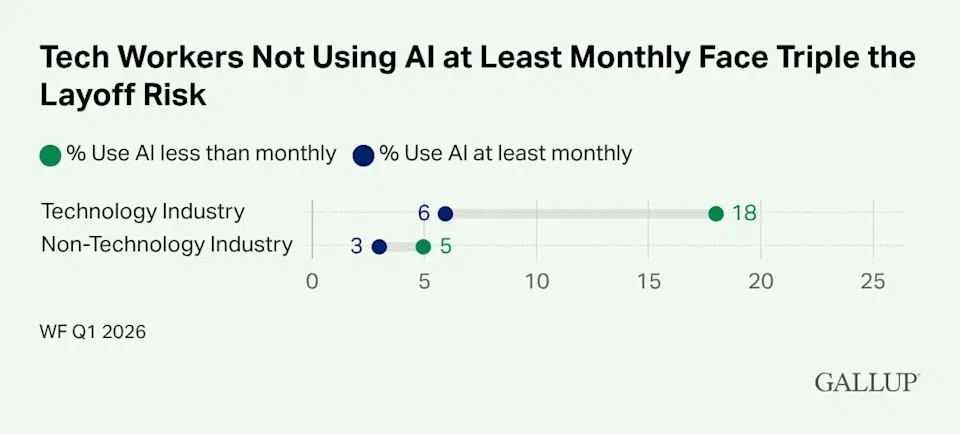
The gap was especially extreme in tech. Among tech employees who use AI at least once a month, the layoff rate was 6%. Among tech employees who use it less than that, it was 18% — exactly three times higher. Non-tech industries showed a difference in the same direction (3% vs. 5%), but nowhere near as dramatic.
This needs to be read in a broader context. Across the U.S. as a whole, the share of employees who say their employer is cutting staff rose from 8% in Q2 2022 to 21% in Q1 2026 — nearly a threefold increase. The share who say their employer is still hiring (34%) is still higher, but this is the highest the perceived-downsizing rate has ever been since Gallup began tracking it.
What stands out is that the tech sector itself is disproportionately exposed to layoffs. Tech workers made up 13% of all laid-off respondents, even though tech accounted for only 6% of all employed respondents. In other words, tech employees are being laid off at roughly twice the rate of the labor market overall. Fully remote workers showed a similar pattern: 25% of laid-off respondents were fully remote, versus just 13% of employed respondents.
Looking at these numbers alone, the conclusion “if you don’t use AI, you get laid off” seems to follow naturally. But another number from the same survey puts the brakes on that clean interpretation.
What’s Hiding Behind the Number “1%”
Gallup asked laid-off employees, in an open-ended question, why they thought they’d been let go. Only 1% cited AI or automation as the cause. The most common reasons were organizational restructuring (15%), cost-cutting (11%), and economic downturn (11%), followed by government budget cuts (5%), business closures (5%), and internal politics (5%).
Looking at 1% alone, AI seems to have almost nothing to do with layoffs. But place it next to what was happening in the same week, and the picture changes completely.
Jack Dorsey’s Block cut 40% of its workforce this February — from 10,000 employees down to fewer than 6,000. Dorsey stated the reason directly: “because of the rapid acceleration of AI.” And just last week, Block disclosed that its internal AI tool, BuilderBot, now handles 15% of all production code changes. It performs 200,000 tasks a day and automatically merges roughly 1,500 pull requests1 a week. Block’s 2026 profit forecast was revised up 54% year over year. The result of cutting people and scaling up AI showed up in the numbers.
Block isn’t alone. Google CEO Sundar Pichai said in April that about 75% of new code is now AI-generated. Spotify co-CEO Gustav Söderström said in February that some of the company’s top engineers haven’t written code by hand since last December. Microsoft CEO Satya Nadella has also said that 20-30% of the company’s code is now written by AI.
Gallup itself was aware of this gap. The report states that “explanations like restructuring and cost-cutting may themselves reflect the influence of AI.” In other words, employees are told “restructuring,” but the force that triggered that restructuring is, in no small number of cases, AI. The number 1% may be a smokescreen that leads us to underestimate AI’s indirect influence.
The scale isn’t small either. In Q1 2026 alone, roughly 78,000 to 80,000 tech workers worldwide were laid off. According to Nikkei Asia, nearly half of those are estimated to be related to AI or automation. That’s more than 2.5 times the 29,845 recorded in the same period of 2025, and a sharp increase from 57,269 in Q1 2024 as well.
Korea still has few cases of large-scale layoffs explicitly justified by AI, the way the U.S. does. There has been testimony from a labor union alleging that Google Korea is cutting mid-level staff to free up budget for AI investment, but this hasn’t spread across the industry as a whole. Instead, a different kind of signal is showing up in Korea. As of March 2026, entry-level job postings at large and mid-sized companies were down 45% year over year. In a survey of 650 HR managers, “stronger preference for experienced entry-level hires” ranked as the No. 1 HR issue. KDI (Korea Development Institute) estimates that about 3.41 million employed people in Korea — 12% of the total — are highly susceptible to being replaced by AI technology. The filter is shifting not at the layoff stage but at the hiring stage. Layoffs make news; quiet shifts in hiring criteria don’t.
What AI Usage Frequency Actually Measures
Let’s go back to the Gallup data. The interpretation that “using AI protects you from layoffs” is intuitive, but there’s an important trap here. Gallup’s data shows correlation, not causation.
Gallup itself acknowledged this near the end of its report. Whether the difference in AI usage frequency reflects a difference in skill, a difference in job type, or some other factor not yet measured requires further verification. The survey adjusted for age, education, and industry, but variables like “curiosity,” “adaptability,” and “speed of learning” are difficult to control for through a questionnaire.
So does the difference between people who use AI every day and people who don’t really come down to “tool proficiency”? I found a clue in a different dataset.
Gallup published a separate report in April of this year. In that report, the strongest predictor of AI usage frequency wasn’t an individual’s technical competence. It was whether their manager actively championed AI adoption. Employees at organizations where managers actively supported AI were 7.4 times more likely to use AI in their daily work than those at organizations where managers didn’t. Yet fewer than 1 in 3 employees said their manager actively supported AI use.

What does this mean? It means AI usage frequency is more strongly tied to how the organization a person belongs to manages change than to that person’s individual technical ability.
ManpowerGroup’s 2026 Global Talent Barometer2 points in the same direction. The share of employees who use AI regularly rose 13 percentage points year over year, to 45%. But at the same time, confidence in using the technology fell 18%. People are using AI, but their conviction that they’re using it well has actually declined. The share of employees worried about losing their job to automation within two years also rose, to 43%, up 5 percentage points from the previous year.
Across the entire U.S. labor market, the share of people who use AI every day is still only 8-10%. The group using it most actively is leaders and white-collar remote workers. When people who don’t use AI are asked what the biggest barrier is, 38-43% cite data privacy and security concerns. In many cases, the real reason isn’t “I don’t know how” but “I’m not sure I’m allowed to.”
In the end, what Gallup captured wasn’t “does this person know how to use AI.” It was the difference in attitude between people who try a new tool the moment it appears and people who wait and watch. And companies, whether consciously or not, have started using that attitude as a filter for hiring and firing.
What’s interesting is that this filter doesn’t discriminate by generation. In a separate Gallup survey of Gen Z (1,572 respondents, ages 14-29), the share using AI was similar to the previous year, but skepticism toward AI actually rose. 69% said they trust work done without AI more. Being a digital native doesn’t automatically mean embracing AI. Capacity to accept change is a function of attitude, not age.
Oswald’s Lens
Honestly, looking at this Gallup data gave me a strong sense of déjà vu.
There’s a pattern I’ve seen over and over while building go-to-market strategy. Whenever a new channel, tool, or methodology is introduced, the gap between “people who adopt it” and “people who don’t” looks, at first, like a gap in performance. But over time, it becomes clear that it was never a gap caused by the tool — it was a gap in how quickly people accept change.
It was the same when CRM first spread. Sales teams that used CRM performed better not because CRM worked some kind of magic. It’s because the teams willing to adopt CRM already had a habit of managing customer data systematically. A tool amplifies capability that already exists — it doesn’t create capability that doesn’t.
I think AI follows the same structure. When companies today favor “employees who use AI,” it’s not solely because of the productivity gains AI itself delivers. They’re reading a signal: “Is this person someone who moves when change arrives?”
Amazon’s Math: Cutting 30,000 Jobs While Hiring 10,000The cracks revealed by employees who gamed the AI usage leaderboardBut there’s a trap here too. Once capacity to accept change becomes a criterion for layoffs, there’s a risk that organizations start using employees’ non-use of AI as grounds for termination — without ever properly supporting AI adoption themselves. Many employees who don’t use AI aren’t failing to use it because they “don’t know how”; they can’t use it because the organization never gave them guidelines or tools. The data showing that manager support creates a 7.4x difference in AI usage rates also means that a large part of the responsibility lies not with the individual, but with the organization.
Closing
Gallup’s data on 23,717 people tells us three things. First, people who don’t use AI are more exposed to layoffs, especially in tech. Second, but this isn’t a story of “using AI saved you” — it’s a signal that attitude toward accepting change has become a new currency in the labor market. Third, the responsibility for accepting change isn’t solely the individual’s; it depends heavily on what kind of environment the organization has built.
The next time “adopting an AI tool” comes up on your team’s meeting agenda, I’d recommend checking, before you look at how good the tool is, “how does our team respond to change?” And that question shouldn’t be aimed only at individual team members — you should also ask whether leaders and managers are building an environment that makes change possible.
💬 Have you started using AI tools at work recently? If you have, tell us in the comments what got you started — and if you haven’t, what’s holding you back.
References & Further Reading
Primary sources
- Mary Page James & Ryan Pendell, “U.S. Workers Continue to Report Downsizing”, Gallup Workplace, June 18, 2026. This is the core data source for today’s issue — the chart of layoff probability by AI usage frequency is the key piece.
- “Rising AI Adoption Spurs Workforce Changes”, Gallup Workplace, April 13, 2026. This is where the data showing manager support creates a 7.4x gap in AI usage rates comes from.
Background
- “Block Builderbot Handles 15% of Production Code”, GNCrypto News, June 17, 2026. Covers the state of Block’s AI coding tool alongside the context of its 40% layoff.
- “Nearly 80,000 tech workers have already lost their jobs in 2026”, TechRadar, 2026. Summarizes the scale of global tech layoffs in Q1 2026 and their connection to AI.
- “Has AI swallowed mid-sized companies’ office jobs too?”, Kyunghyang Shinmun (a South Korean newspaper), April 23, 2026. Covers shifts in Korea’s hiring market, including the 45% drop in entry-level postings.
- “AI and Changes in the Labor Market”, KDI Economic Information & Education Center. Analyzes AI’s replacement potential for 3.41 million employed people in Korea.

The author, Kwangseob Ahn, is a professor of business administration at Sejong University and lead consultant at OBF (Oswarld Boutique Consulting Firm). He teaches statistics and data analysis — business data management and business analytics — while leading GTM and AI strategy consulting in the field, designing the seam between technology and business. He has published academic research on a memory architecture for AI dialogue systems (HEMA) and runs Daily Arxiv, a daily curation of global AI papers. He holds a master’s from Korea University’s Graduate School of Technology Management and a KMBA. He is the author of Homo Brainless: The People Who Outsource Their Thinking.
Footnotes
-
Pull request: a step where a developer’s code is submitted for a colleague’s review before being merged into the team’s official codebase — similar to posting “please check if this code looks okay.” ↩
-
Global Talent Barometer: an annual global labor market survey published by ManpowerGroup. It measures workers’ AI adoption rates, job satisfaction, confidence in their skills, and more. ↩
Related issues
Korea's 710,000 'Resting' Youth Would Be Patients in Britain
44% of UK youth not working cite health issues as the reason—Korea's data tells a different story.
The Hidden Bill for 588,000 Remote Workers' Mental Health
They loved working from home — but 588,000 Americans didn't see this mental health bill coming.
Polymarket Faked Bets to Rack Up 140 Million Views
A prediction market sold FOMO instead of transparency.
Your take shapes the next issue
Reply with your experience or perspective — the best responses feed into future issues.
Sign in to commentAny registered reader can comment — it takes 10 seconds.