
Meta's Plan: Build a Refinery for Spare AI Compute
If tokens are the new oil, the real prize isn't selling crude—it's refining it.
Opening
Subscriber, an interesting story just broke. Bloomberg reports that Meta is building a cloud business to sell its excess AI compute to outside customers. The announcement alone sent the stock up as much as 8% in premarket trading.
But the moment I read it, I couldn’t help thinking back to a scene from just a few months ago. Not that long ago, Meta was so short on compute that it was telling employees to ration their AI tokens. A company that said it didn’t have enough suddenly has a surplus to sell—something doesn’t add up.
Let me get straight to the point. This isn’t simple business diversification. It’s a signal that compute is shifting from “a resource I use” to “a product I sell to others.” And the real battle in this shift isn’t about selling compute at all—it’s about who can extract more profit from it.
A Declaration That There’s Extra to Sell
The cloud business Meta is reportedly considering has two branches.
The first resembles Amazon Web Services’ “Bedrock.” Bedrock is a gateway that lets you access multiple AI models with just a few clicks. Meta is reportedly planning something similar: selling developers access—and charging usage fees—to the various models running on its data centers, including its own model, “Muse Spark.” For startups or developers who can’t easily get their hands on high-performance GPUs, running models on Meta’s proven infrastructure is a pretty attractive proposition. Just as you rent apps through the cloud, we’re now entering an era where you rent AI models the same way.
The second is leasing out the raw compute itself. Instead of a model, you’re renting an entire “seat at the table” for computation. This is what so-called neoclouds1—companies like CoreWeave—have been doing. Since it’s selling “raw computation” with no model layered on top, the barrier to entry is low, but so is the margin, and competition is fierce. Meta is reportedly pursuing this through an internal group called “Meta Compute.” Names attached to it reportedly include infrastructure chief Santosh Janardhan, superintelligence-lab figure Daniel Gross, and even the company’s president, Dina Powell McCormick—a heavyweight lineup. If this materializes, Meta goes from being an advertising company to a new entrant charging head-on into a market dominated by AWS, Microsoft Azure, and Google Cloud. It’s also a card Meta can play to reduce its dependence on ad revenue.
The market reacted immediately. On the day of the announcement, the stock rose as much as 8.6% in premarket trading before giving back some of the gain. Zuckerberg, in fact, had already laid the groundwork back in May at the shareholder meeting, saying that if the company decides it built more data centers than it needs, selling the surplus compute is an option. He added that companies come knocking almost every week asking to borrow Meta’s infrastructure.
Wait, Didn’t You Say You Were Short?
Let’s return to the paradox from earlier.
Earlier this year, Meta was in a compute famine. When Google couldn’t meet its own demand, it restricted Meta’s access to Gemini models, backing up internal AI work. Things got bad enough that Meta asked employees to cut back on AI token consumption. And right now, Big Tech worldwide is pouring more than $700 billion into AI infrastructure this year alone—almost double the $400 billion spent last year. Semiconductor analyst Dylan Patel expects more than 20 gigawatts of new data-center capacity to come online in 2026 alone, and over 30 gigawatts in 2027. Yet models have been growing faster than infrastructure can be built, so the story until now has always been one of scarcity.
So how did a “surplus” suddenly appear? Two things converged. One is that training efficiency improved, letting the same resources accomplish more work. The other is that Meta, anticipating future demand, had aggressively overbuilt from the start. In the short term, that leaves room to spare. What’s interesting is that Meta itself has been a “whale tenant,” signing massive compute deals with CoreWeave, Google, and Oracle. So the picture is: borrow from others while simultaneously selling to others—proof of just how much compute has become a commodity traded like water.
What’s even more interesting is that at the very same town hall where the surplus-compute story surfaced, Zuckerberg admitted that AI agent development hadn’t accelerated as fast as expected over the past four months. And yet AI chief Alexander Wang said the next-generation model, “Watermelon,” is being trained with roughly 10 times more compute than the current model and has already caught up to GPT-5.5-level performance on major benchmarks. On one hand, they say compute is surplus. On the other, they’re about to pour 10 times more into the next model.
Meta isn’t even the first to do this. Earlier this year, after Elon Musk’s SpaceX acquired xAI, it leased out its massive Memphis data center to Anthropic and struck a deal with Google as well. Bloomberg Intelligence estimates this strategy could push xAI’s revenue to $50 billion by 2028 and $100 billion by 2030. Selling surplus compute has already become an established business model. And underneath all these moves lies a common pressure: investors asking when, exactly, the hundreds of billions poured into infrastructure will actually turn into returns. Selling compute is the fastest answer companies have on hand.
The Real Battle Is Over the “Refining Margin”
Dylan Patel says “tokens are the new oil.” He means that the tokens AI produces—the output of computation—will become the most important raw material in the economy going forward. Let’s push this analogy a bit further.
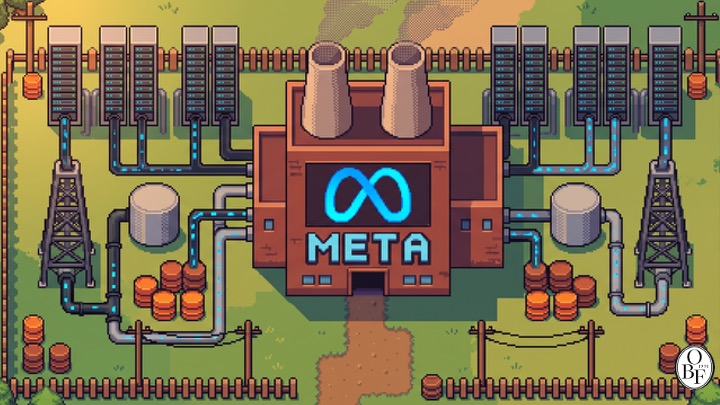
If oil is the raw material, there’s a world of difference in margin between simply pumping and selling crude versus refining it into gasoline. Compute works the same way. The neocloud model—leasing out crude compute as-is—has thin margins and brutal competition. The Bedrock model, by contrast, layers models and software on top to sell something “ready to use,” which carries much higher added value. That Meta is weighing both approaches at once means it’s trying to sell everything from crude oil to gasoline.
The layers of refinement are splitting even more finely. Patel sees the inference market dividing into two camps. Latency-critical work—coding assistants, real-time conversation—commands roughly a 4x premium for fast responses. Non-urgent work, like bulk document processing, opts for cheaper but slower service. That’s exactly why today’s AI services charge more for “fast mode” than the default mode. The same computation can be priced completely differently depending on how it’s refined and packaged for sale.
But here’s where another one of Patel’s insights becomes crucial. He argues that the real key to maximizing inference performance isn’t a single chip or a single piece of software—it’s co-design2, designing silicon, software, and models together from the start. Tweaking a single layer in isolation gets you a few-fold improvement at best; optimizing all three together can widen the gap to as much as 100x. Translate that into the refinery analogy and you get this: more and more companies will start selling surplus compute, but the ones that survive will be those refining crude oil the cheapest and most efficiently. In other words, the real fight in this competition isn’t “who sells compute” but “who extracts more value from the same compute”—value capture3.
Nvidia’s own calculus is baked into why so many sellers are popping up. As the company holding the GPUs, Nvidia is better off if resources spread evenly across upstart clouds like CoreWeave and various AI labs, rather than being monopolized by a handful of hyperscalers. The more fragmented the buyer side, the less risk of being at the mercy of any single large customer. So the number of players selling compute is likely to keep growing. Meta’s move is just one scene in that larger unfolding story.
Where does that leave Korea in this picture? As it happens, on the 29th of last month, Korea revealed its own hand: the government’s “Three Megaprojects” plan. It commits ₩800 trillion to semiconductors in the Seonam region (southwestern Korea), ₩550 trillion to AI data centers (8.4 gigawatts in phase one, 18.4 gigawatts at completion), and national resources to “physical AI”—robots and other systems that operate in the physical world.
China Optimizes, Japan Commands, Korea Bets ₩800 TrillionChina = efficiency, Japan = command, Korea = physical layerTranslated into the refinery analogy, this becomes clear. Korea isn’t just betting on supplying a core component of the refining equipment (HBM4); it’s betting on building the land the refinery sits on and the drilling rigs themselves. HBM is already a rock-solid strength—Samsung Electronics and SK hynix control most of global supply, and 2026 volumes are already sold out—and now Korea wants to add the “land” of data centers and the “body” of robots on top of that. Since US Big Tech has comparatively little data or attention on the physical domain, this is a far smarter bet than trying to go head-to-head on foundation models.
That said, there’s one empty square in this plan that keeps nagging at me: refining technology—the software and model-orchestration layer that would command that body. As we’ve seen, the real margin comes not from crude oil but from refining, yet nowhere in this ₩800 trillion plan for facilities and land is there a clear answer to “how will we compose and direct this intelligence?” That’s the software layer… and it leaves open the risk that while we build the body and the heart ourselves, the brain that actually moves it ends up outsourced to foreign technology.
Oz’s Lens
Honestly, I don’t take the “selling the surplus” framing entirely at face value.
There’s a pattern I’ve seen often while working on market-entry strategy: when a company announces a decision, the stated rationale and the real motive often diverge. Is Meta really selling because compute is genuinely surplus—or is it preparing an answer in advance to investors asking, “When on earth does all that massive investment turn into money?” I think the latter carries far more weight.
Seen this way, today’s stock jump makes a lot more sense. First, it signals that training efficiency has improved, freeing up spare capacity. Second, turning that spare capacity into revenue opens up upside on return on invested capital (ROIC). Third, if the cloud business takes off, it gives Meta both the justification and the ammunition to invest even more aggressively going forward. The market wasn’t reacting to the fact that “Meta is selling its surplus”—it was reacting to the narrative that “Meta now holds a card to recoup its infrastructure spending.”
So what I’m really watching in this story isn’t Meta alone. It’s the broader trend of more and more companies starting to see compute not as “a resource to use” but as “a product to sell.”
From a go-to-market angle, I’d add this: as a raw material becomes more commonplace, the money always migrates up a layer—toward “refining” and “distribution.” That’s why I pay less attention to how many GPUs a domestic company has secured, and more attention to what it refines from them, and how well. Compute itself will become increasingly indistinguishable from anyone else’s. I write a newsletter every week that reads across tech, economics, and the humanities, and structural shifts like this one always redraw winners and losers. This will be no different.
Closing
Boiling today’s story down to three lines:
First, compute is shifting from “a resource I use” to “a product I sell to others.” Second, the real battle isn’t selling it—it’s the refining capability to extract more value from the same compute. Third, Korea has bet ₩800 trillion on the “body”—semiconductors and data centers—but the “refining (command) layer,” where the margin actually lives, remains empty.
If tokens are the new oil, we’re still in the early days of oil-field development. The next protagonist will be whoever holds the refining technology. I’ll pick up the co-design thread again next Thursday.
If you’ve ever wrestled with cloud or GPU costs, I’d love to hear from you: if Meta starts selling compute, would you consider switching away from AWS, Azure, or Google Cloud? What would be the deciding factor—price, reliability, quality? Let me know in the comments.
💬 If Meta starts selling compute, would you consider switching—and what would be the deciding factor? Let me know in the comments. · 📨 If you have a colleague interested in AI infrastructure, please share this issue with them.
References & Further Reading
Primary sources
- Bloomberg, “Meta Is Building a Cloud Business to Sell Excess AI Compute”, Jul 1, 2026: The original source for today’s story. Lays out the two business models and the internal team driving them.
- Reuters, “Meta building cloud business to sell excess AI capacity, Bloomberg News reports”, Jul 1, 2026: A good source for Zuckerberg’s May shareholder-meeting comments alongside the stock’s reaction.
- Sequoia Capital, Dylan Patel (SemiAnalysis) interview, 2026: The original source for “tokens are the new oil,” the 100x co-design claim, and the compute-crunch logic. The backbone of today’s framing.
Background
- SemiAnalysis, “AI Value Capture: The Shift to Model Labs”, 2026: A piece on who actually captures value in compute. Recommended if you want to dig deeper into the “refining margin” concept.
- ZDNet Korea, THE ELEC report on domestic CSPs’ GPU/data-center leasing strategy, 2026: The original source for the ₩800 trillion semiconductor plan, ₩550 trillion AI data-center plan, and physical AI figures. The basis for the Korea section of this issue.


The author, Kwangseob Ahn, is a professor of business administration at Sejong University and lead consultant at OBF (Oswarld Boutique Consulting Firm). He teaches statistics and data analysis — business data management and business analytics — while leading GTM and AI strategy consulting in the field, designing the seam between technology and business. He has published academic research on a memory architecture for AI dialogue systems (HEMA) and runs Daily Arxiv, a daily curation of global AI papers. He holds a master’s from Korea University’s Graduate School of Technology Management and a KMBA. He is the author of Homo Brainless: The People Who Outsource Their Thinking.
Footnotes
-
NeoCloud: an upstart cloud provider that specializes exclusively in renting out GPU compute for AI workloads. CoreWeave is the leading example. Unlike traditional full-service clouds, think of these as places that rent out nothing but “a seat for computation.” ↩
-
Co-design: designing chips (hardware), software, and AI models together from the outset, rather than separately. Tweaking each in isolation tends to yield only a few-fold efficiency gain, but optimizing them jointly is reported to unlock far larger improvements. ↩
-
Value Capture: the share of value created in an industry that actually flows to you as profit. Similar to how selling the same product yields different margins depending on whether you’re selling raw material or a finished good. ↩
-
HBM (High Bandwidth Memory): a specialized memory designed to move data extremely fast. It relieves the “data-movement speed” bottleneck in AI computation, making it nearly essential in high-performance AI chips. Samsung Electronics and SK hynix supply most of the world’s HBM. ↩
Related issues
🔒 Selling Fear to Job Seekers
How one careful Stanford paper about a single hiring tool got stripped of context, step by step, and repackaged as AI panic.
 Business
🔒 Amazon's Math: Cut 30,000, Hire 10,000
Employees gaming an internal AI usage leaderboard exposed the cracks in that logic.
🔒 Silicon Valley Lines Up for Picks and Shovels
The hottest YC startups aren't building AI agents — they're building the testing, security, and audit layers underneath them.
Your take shapes the next issue
Reply with your experience or perspective — the best responses feed into future issues.
Sign in to commentAny registered reader can comment — it takes 10 seconds.