
Data Centers Aren't Stalling for Money or Chips
A power bottleneck is quietly hastening the exit from the GPU era.
Hello, dear reader — this is OZ Talking. On April 15th, the Maine State Legislature passed the nation’s first state-level data center construction moratorium1. Not in Silicon Valley, not in Virginia where data centers are already clustered — but in Maine, the state known for lobster and coastline.
State Representative Melanie Sachs, who sponsored the bill, said she initially thought, “Maine isn’t even a data center candidate site — will anyone even care?” But after introducing the bill, she learned two large data center projects were already moving into her own state, and the legislation passed quickly.
‘Anti-Data-Center Backlash’ Halts or Delays ₩200 Trillion (~$144B) in Construction in Q1 AloneAnti-data-center backlash halted or delayed ₩200 trillion (~$144B) in construction in the first quarter aloneAnd this isn’t just a Maine story. 30 to 50% of the data centers slated to come online in the US in 2026 are expected to be delayed or canceled, and similar moratorium bills have been introduced in at least 12 states. In 2025 alone, Big Tech poured roughly $400 billion into AI infrastructure. And still, things are grinding to a halt.
“We Must Halt Data Center Construction” — A Signal Flare for an All-Out AI Regulation Fight in WashingtonAs conflict over AI regulation intensifies in American politics, Senator Bernie Sanders (I-VT) has introduced a bill to fully halt new data center construction until AI regulations are in place…It’s not because there’s no money, and it’s not because Nvidia can’t make chips. The reason is far simpler, and far harder to fix: electricity.
But what I find more interesting is something else. This power bottleneck is currently blocking the construction of massive GPU farms built for training — even as the AI industry is rapidly shifting toward the “age of inference.” What’s stuck right now and what will soon be needed are two different things.
Opening
In 2025 alone, the world’s largest companies poured roughly $400 billion in capital expenditure into AI infrastructure — the equivalent of nine Manhattan Projects or two Apollo Programs, spent in a single year on data center construction alone.
Yet something strange is happening. According to a recent report from market intelligence firm Sightline Climate2, of the 16 gigawatts (GW)3 of data center capacity that was supposed to come online in the US in 2026, only 5GW is actually under construction. The remaining 11GW has been “announced” only — not a single shovel in the ground. 2027 looks even worse: of the 21.5GW announced, only 6.3GW is under construction.
Most coverage reads this as a harbinger of an AI bubble collapse. I see it differently. What’s actually stalled isn’t money or ambition — it’s transformers, transmission lines, and local residents. And beneath this lies a structure more interesting than it appears.
Most of the data centers stuck right now are ultra-dense GPU farms built for training. But the AI industry itself is rapidly shifting its center of gravity from “training” to the “age of inference (agents).” Inference infrastructure has entirely different requirements. What’s blocked today and what will soon be needed aren’t the same thing.
Today I want to cover two things: (1) why transformers, transmission lines, and local residents have simultaneously ground AI infrastructure to a halt, and (2) why it’s likely that by the time this bottleneck clears, the industry will already be demanding a different kind of infrastructure.
🔌 Order One Transformer, Wait Five Years
“Because there are no transformers.”
That’s the AI infrastructure bottleneck of 2026 in one sentence. It’s not an exaggeration — order a single transformer today and delivery literally takes 24 to 48 months, sometimes up to five years. Before 2020, this was a part you’d get in a few months.
A transformer converts high-voltage electricity into a voltage a data center can actually use. Without one, there’s simply no way to bring power in from a power plant. So why has it suddenly become so scarce?
The reason is structural. Transformers can’t be mass-produced. Each one requires custom design and skilled technicians building it by hand. Supplies of key raw materials — grain-oriented electrical steel4 and copper — have also tightened. According to consulting firm Wood Mackenzie, the 2025 supply shortfall for generator step-up transformers reached 100% — meaning supply isn’t meeting demand at all.
The deeper problem is that the US imports about 80% of its transformers, mainly from China, Korea, Mexico, and Canada — and tariff disputes have tangled the situation further. Demand for generator step-up transformers grew 274% between 2019 and 2025. Some 25% of renewable energy projects worldwide are being delayed by transformer lead times5.
Against this backdrop, the World Resources Institute (WRI) found that power infrastructure shortages are extending data center construction timelines by 24 to 72 months. In other words, you can get chips delivered in six months, but preparing the building to house them and the power to connect them takes at least two years — and up to six.
This is producing a side effect of its own — what the industry calls the bullwhip effect6. With parts in short supply, companies are ordering far more than they actually need. The logic is, “if we don’t get in line now, we’ll be pushed back another year,” so they stockpile preemptively. As a result, transformers are piling up in warehouses of data centers that aren’t even finished yet, and GPUs that can’t be powered on sit as inventory. On the surface it looks like demand is exploding, but actual utilization can’t keep pace — a distorted picture.
⚡ Local Residents Have Become a Variable in AI Infrastructure
The second obstacle is people. More precisely, voters who open their electricity bills.
The Maine case mentioned earlier is emblematic. Behind the swift passage of the anti-data-center bill in the Maine legislature was a sentiment captured plainly by State Representative Amy Roeder: “Residents are suffering under electricity bills running hundreds of dollars a month. Siting a resource-hungry data center in the middle of that feels irresponsible.”
This isn’t a Maine-only story. As of early 2026, data center moratorium bills have been introduced in at least 12 states — Virginia, Michigan, Wisconsin, New York, Ohio, Louisiana, and others. One particularly striking case happened in Festus, Missouri. Anti-data-center sentiment erupted so strongly that half of the eight-member city council was voted out. Residents of Ohio are pursuing a ballot measure to permanently ban large data centers outright, and in Michigan, resident backlash killed a $1 billion project reportedly tied to Meta.
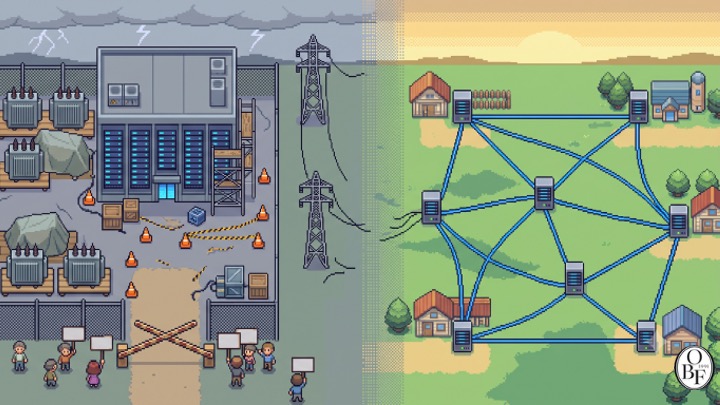
Olivia Wang, an analyst at Sightline Climate, put it this way: “Community opposition has become a real driver of project attrition.” In other words, it’s no longer a peripheral variable.
Why is this backlash erupting now? The numbers make it clear. A single hyperscale7 data center typically draws 300MW of power. The largest facilities go up to 3GW — enough to power 3 million American households. When a facility like this moves into a region, existing residents’ electricity bills inevitably rise, because the cost of expanding transmission capacity gets spread across all ratepayers.
In other words, the moment a single data center moves in, local residents end up splitting the infrastructure cost of an AI service they don’t even use, right there on their monthly power bill. Add water usage, noise, and environmental impact, and local politicians find it genuinely hard to find a reason to say yes. Once voters figure this out, they’re not going to stay quiet.
⚙️ Data Centers Are Stealing Power From Their Own Suppliers
Here a still more interesting structure emerges. Residents aren’t the only ones competing with data centers for electricity — the steel industry is too. And the strange part is that steel happens to be an essential material for building data centers in the first place.
A report released last week by the Steel Manufacturers Association (SMA) confronted this contradiction directly. It found that data centers’ insatiable power demand is driving up steel companies’ electricity costs by tens of millions of dollars a year. As a result, SMA has warned about a high-stakes competition for the same resource — electricity — with data centers, which happen to be one of steel’s biggest new customers.
Why is steel so sensitive to electricity? It’s a surprisingly little-known fact, but about 70% of steel produced in the US is made using electric arc furnaces (EAF)8. This method melts scrap steel with electricity to make new steel, which makes the plant itself a massive power consumer. So when a data center soaks up electricity in the same region, steel plants’ production costs take a direct hit.
Here’s the structure in a nutshell. Building a data center requires steel — for transformers, structural frames, piping. But once that data center starts running, it steals the very electricity that the steel plants need to make more of it. It’s a self-cannibalizing loop where the customer strangles its own supplier. If the transformer shortage is a bottleneck in the supply chain, this is a deeper contradiction — a supply chain eating itself.
🏭 Can’t Build a Power Plant, Can’t Wait Either
So couldn’t data center companies just build their own power plants? Some actually are — installing natural gas turbine generators on-site.
The problem is natural gas prices have recently doubled — the single biggest line item in operating costs, doubled. Geopolitical risk stemming from Iran has only added to the volatility in energy prices.
There’s an even more serious problem. A case I found genuinely fascinating: near Santa Clara, where Nvidia’s headquarters sits, there are two fully completed data centers — servers already installed — sitting completely offline because the local utility hasn’t been able to connect them to power. The buildings exist. They just can’t open because there’s no electricity.
And this trend is only going to intensify. US data center power demand is projected to nearly double, from 80GW in 2025 to 150GW in 2028, and in some regions, the queue for new large-load grid connections stretches out 5 to 7 years.
To summarize the structure: the chips are there. The money is there. The land is secured. But (1) there are no transformers, (2) transmission expansion is stalled, (3) generation capacity is short, (4) local residents are opposed, and (5) existing industries like steel are competing for the same electricity. If even one of these doesn’t get resolved, the data center doesn’t run.
What’s interesting is that none of this is a technology problem — it’s a physical and institutional one. No matter how fast Nvidia makes chips, no matter how loudly Jensen Huang insists we need more compute, if a transformer takes 30 months to build, it takes 30 months. Steel doesn’t care about earnings calls, and copper doesn’t care about the Stargate project.
And there’s one more ironic effect here. Rising energy prices accelerate GPU depreciation. When electricity is cheap, even old GPUs are worth running — their efficiency may be poor, but power itself is cheap. But once electricity gets expensive, you hit a point where the power bill outpaces the rack rental cost. At that moment, even cutting-edge hardware that cost millions of dollars just last year effectively becomes e-waste. The power bottleneck isn’t just a supply-side problem — it’s shortening the lifespan of infrastructure that’s already running.
That covers the “why did data centers stall” question. But the question I’m really interested in is this: by the time this bottleneck clears, will the infrastructure being built right now still be what the market needs?
💡 Oz’s Lens
Take a closer look at the data centers stuck in limbo right now, and there’s an interesting common thread: as I mentioned, they’re ultra-dense GPU farms built for training. Power density soaring up to 1MW per rack, massive centralized clusters — designed for the purpose of “building one enormous model at a time.”
But the industry has already moved on. The share of inference9 workloads jumped from 33% in 2023 to 66% in 2026, and is projected to account for 70% of AI compute by 2030. That means the center of gravity is shifting from the “age of GPUs” to the “age of CPU+DRAM.”
Agent inference has fundamentally different requirements. Per-rack power drops to a much lower 30 to 150kW10, and instead of centralized clusters, it needs to be geographically distributed close to users. Rather than expensive HBM-equipped GPU clusters, a combination of high-capacity DDR5 server DRAM11** and efficient CPUs wins on total cost of ownership. It’s not Nvidia’s B200 but AMD’s EPYC CPUs and Samsung/SK Hynix’s DDR5 that become the new face of AI infrastructure.**
There’s a pattern I’ve seen repeatedly while building go-to-market strategy: early in a technology’s adoption, “the most powerful infrastructure” wins; once the market matures, “the most efficient infrastructure” wins. And what genuinely unsettles me is that the timing of the power bottleneck clearing (2028-2030) nearly coincides with the timing of the shift toward inference hitting full swing. By the time the training-focused GPU farms that took five years to build finally get finished, the market is likely to already be demanding different infrastructure. In a world where power has gotten expensive, the whole premise of “training one giant model at a time” loses its economics. Energy constraints, in other words, are about to reshape the architecture itself.
Closing
Let me wrap up.
First, the real bottleneck in AI infrastructure in 2026 isn’t money or chips — it’s power infrastructure and community acceptance. A five-year wait for transformers, delayed transmission expansion, resident backlash, and a tug-of-war over electricity with existing industries like steel are all working simultaneously. The self-cannibalizing structure — where data centers steal power from the very steel plants that make their components — makes clear this bottleneck isn’t a simple supply-and-demand problem.
Second, this bottleneck won’t be resolved within a few quarters. It requires both physical manufacturing capacity and institutional consensus, which will take at least 3 to 5 years.
Third, within that 3-to-5-year window, the AI industry will likely shift from the “age of GPU training” to the “age of CPU+DRAM inference.” In other words, by the time the ultra-dense training GPU farms being built right now are finished, what the market wants may well be distributed, low-density inference infrastructure.
To understand the AI industry going forward, I think we’ll need to watch transformer lead times, state-level power policy, and server DRAM price trends more closely than Nvidia’s earnings reports. It sounds strange, but it’s true. In the next issue, I’ll dig into how this shift is already shaking up the memory chip market.
I put out a weekly newsletter that analyzes technology, economics, and the humanities side by side. If the most surprising part of today’s issue for you was the self-cannibalizing steel structure, I’d love to know how data centers’ power demand is showing up in your own industry — whether through electricity bills, component sourcing, or some entirely different channel.
💬 Tell me in the comments where “AI-driven power costs” first became visible in your industry. I’ll fold your answers into the next issue. 📨 If someone around you would find this useful, please share it.
References & Further Reading
Primary sources
- Sightline Climate, Data Center Outlook: Half of 2026 Pipeline May Not Materialize, February 2026. A primary source tracking actual construction progress across the 2026 data center pipeline. The core evidence behind this newsletter.
- Catherine Boudreau, “Up to half of the world’s data centers may be delayed this year”, Latitude Media, February 2026. The most thorough breakdown of the Sightline report.
- Ian Goldsmith & Zach Byrum, “Powering the US Data Center Boom: The Challenge of Forecasting Electricity Needs”, World Resources Institute, September 2025. A structural breakdown of the uncertainty in power demand forecasting and the “phantom load” problem.
- McKinsey & Company, The next big shifts in AI workloads and hyperscaler strategies, December 2025. The most persuasive account of the infrastructure implications of the training-to-inference shift. The core evidence behind today’s “Oz’s Lens” section.
- Deloitte, Why AI’s next phase will likely demand more computational power, not less, 2026 TMT Predictions. The source for the inference workload share projections.
- The Wall Street Journal, “AI Data Centers Have Been Great for the Steel Industry. Now, a Power Crisis Looms.”, 2026. Covers the electricity competition between the steel industry and data centers, citing the SMA report to illustrate the self-cannibalizing structure. (Paywalled)
Background
- POWER Magazine, “Transformers in 2026: Shortage, Scramble, or Self-Inflicted Crisis?”, January 2026. A detailed industry-side dissection of the causes behind the transformer supply crisis.
- CNN, “Data centers are spreading around the country. Now, data-center bans are, too”, April 2026. A solid rundown of the background behind the Maine moratorium case. The source for this newsletter’s opening.
- Ed Zitron, Where’s Your Ed At newsletter. The critic who first spotlighted the Sightline Climate data. Lays out systematic skepticism about the AI bubble.

The author, Kwangseob Ahn, is a professor of business administration at Sejong University and lead consultant at OBF (Oswarld Boutique Consulting Firm). He teaches statistics and data analysis — business data management and business analytics — while leading GTM and AI strategy consulting in the field, designing the seam between technology and business. He has published academic research on a memory architecture for AI dialogue systems (HEMA) and runs Daily Arxiv, a daily curation of global AI papers. He holds a master’s from Korea University’s Graduate School of Technology Management and a KMBA. He is the author of Homo Brainless: The People Who Outsource Their Thinking.
Footnotes
-
Moratorium: A system that fully suspends a specific activity or business for a set period. Here, it refers to a measure banning new data center construction for a defined time. ↩
-
Sightline Climate: A US market intelligence firm covering climate and energy technology. It tracks the actual on-the-ground construction progress of data center projects. Its “Data Center Outlook” report, published in February 2026, has become a key industry reference. ↩
-
Gigawatt (GW): A unit of power capacity. 1GW is roughly enough to supply electricity to 1 million American households. A single large nuclear power plant generates about 1 to 1.4GW. ↩
-
Grain-Oriented Electrical Steel: A specialty steel used in transformer cores. Its low magnetic loss has a decisive effect on transformer efficiency. Only a small number of manufacturers worldwide can produce it. ↩
-
Transformer Lead Time: The time between ordering a transformer and receiving it. It used to run a few months, but as of 2025, 24 to 48 months is typical for large power transformers. ↩
-
Bullwhip Effect: Just as the tip of a whip swings with more amplitude than the handle, order-quantity fluctuations amplify as you move upstream through a supply chain. Orders that exceed real demand accumulate, eventually leading to inventory gluts or sudden demand cliffs. ↩
-
Hyperscaler: A collective term for companies operating cloud infrastructure at massive scale, like Amazon AWS, Microsoft Azure, and Google Cloud. The name comes from the sheer scale of their data center construction. ↩
-
Electric Arc Furnace (EAF): A method that melts scrap steel with the heat of an electric arc to produce new steel. It emits less carbon than coal-fired blast furnaces but relies far more heavily on electricity. About 70% of US steel production uses this method, making it especially sensitive to electricity prices. ↩
-
Training vs. Inference: Training is the stage where an AI model is first built, requiring repeated processing of enormous datasets and consuming huge amounts of power. Inference is the stage where a finished model answers a user’s query — each individual computation is far lighter, but the total adds up as the number of users grows. ↩
-
Power Density per Rack (kW per rack): The amount of power a single server rack in a data center consumes. A typical server rack uses around 10kW, AI training racks run 100 to 160kW, and next-generation systems can reach 1MW (1,000kW). The higher the density, the harder cooling becomes. ↩
-
DDR5 Server DRAM: The latest generation of standard server memory. Where HBM (High Bandwidth Memory) is a premium memory that sits right next to the GPU, DDR5 is general-purpose server memory used alongside CPUs. Demand is surging as inference workloads grow. ↩
Related issues
Meta's Plan: Build a Refinery for Spare AI Compute
If tokens are the new oil, the real prize isn't selling crude—it's refining it.
🔒 Selling Fear to Job Seekers
How one careful Stanford paper about a single hiring tool got stripped of context, step by step, and repackaged as AI panic.
 Business
🔒 Amazon's Math: Cut 30,000, Hire 10,000
Employees gaming an internal AI usage leaderboard exposed the cracks in that logic.
Your take shapes the next issue
Reply with your experience or perspective — the best responses feed into future issues.
Sign in to commentAny registered reader can comment — it takes 10 seconds.