
The SaaS Stock Crash Isn't Really About AI
Software is shifting from a divergence phase to convergence—survival favors those who deliver action, not summaries.
Opening
Dear subscriber, if you’ve checked your stock portfolio recently and happen to be holding software names, you’ve probably let out a sigh. The iShares Expanded Tech-Software Sector ETF (IGV) has fallen about 30% from its September 2025 peak. Over the same period, the Nasdaq 100 (QQQ) has stayed roughly flat, while the semiconductor ETF (SMH) has actually climbed 30%. Software is the one category taking the beating.
The headlines are unambiguous: “AI is killing SaaS.” Wall Street even coined a new term for it—“SaaSpocalypse” (SaaS + Apocalypse). But I think this narrative is only half right. AI pulled the trigger, sure, but the bullet was already loaded. Today I want to talk about what that pre-loaded bullet actually was.
The surface: what happened
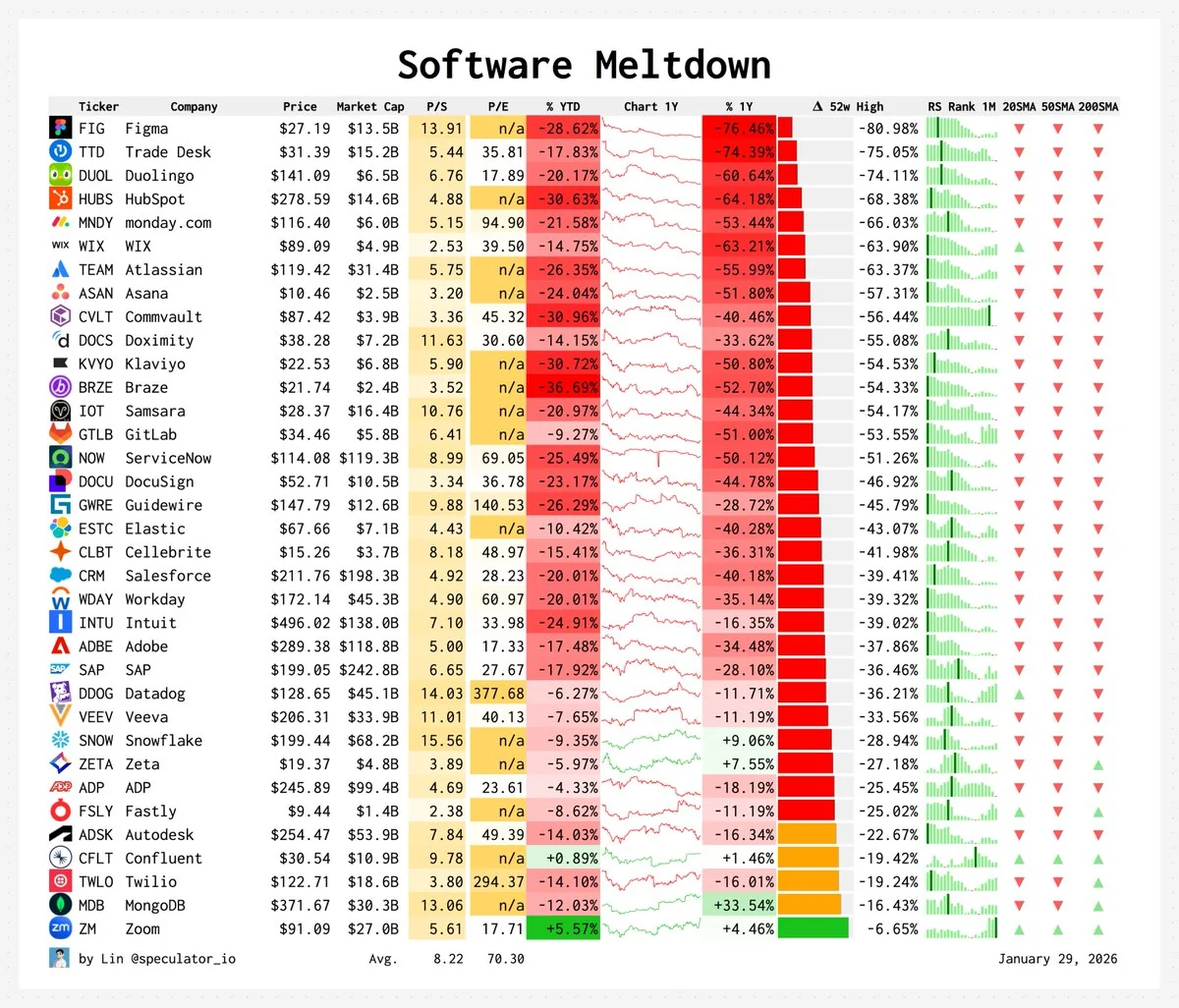
From mid-January through early February this year, roughly $1 trillion in market cap evaporated from software stocks. The S&P North American Software Index dropped 15% in January alone—its worst monthly decline since the 2008 financial crisis.
The immediate trigger was a wave of AI agent product launches. Anthropic released Claude Cowork as a research preview in January and shipped the full enterprise version in late February. It connects directly to Google Drive, Gmail, and DocuSign—reading files, drafting emails, even reviewing contract clauses. OpenAI showed off its own enterprise agent, Frontier, around the same time. The market’s read was simple: “If AI agents can directly do the work that enterprise software used to do, that software is finished.”
Legal software company CS Disco, data analytics firm Thomson Reuters, and even the London Stock Exchange Group (LSEG) all suffered double-digit declines. Among Wall Street traders, the phrase going around was reportedly, “Get me out—just sell everything.”
Related issues
🔒 Why Wrong Pundits Sell Memberships, Not Apologies
Failing to predict the market is human; refusing to admit it turns analysis into a cult.
🔒 Silicon Valley Is Quietly Running on Chinese AI
It's not about cost—it's a signal that AI's center of gravity is shifting
🔒 South Korea's R&D Spending Can't Win the Talent War
Why the world's No. 2 R&D spender by GDP share just fell outside the global top 25 in talent competitiveness.
Your take shapes the next issue
Reply with your experience or perspective — the best responses feed into future issues.
Sign in to commentAny registered reader can comment — it takes 10 seconds.