
The Four-Year Pledge SanDisk Extracted From Its Customers
Customers guaranteed $16.5 billion before a single chip shipped.
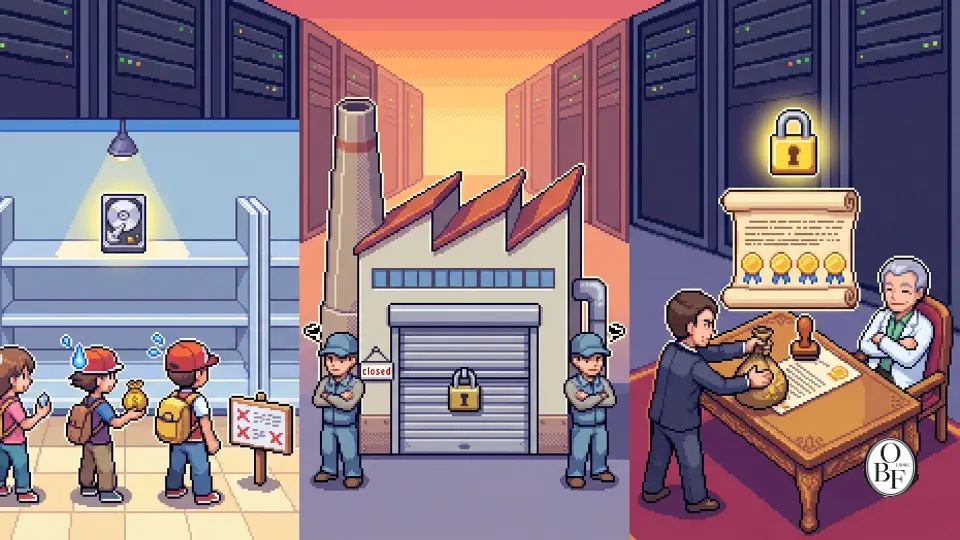
Opening
I tried to add another drive to the NAS I’d bought last year, but I closed the browser tab the moment I saw the price. Hard drive and SSD prices have been climbing steadily since early this year. You already know the reason: AI data centers are buying up the entire supply that hits the market.
That much you’ve probably heard before. But yesterday (August 5th), Western Digital and SanDisk reported earnings on the same day, and buried in those reports was something far stranger. Even with demand exploding like this, both companies said they have no plans to build new factories. And customers, fully aware of that, are signing four-year contracts anyway.
Let me give you the conclusion up front. What’s happening right now isn’t a memory supercycle. It’s an attempt to paper over the memory cycle itself—a cycle that has repeated for 40 years—with contracts. And the market still isn’t buying it.
Yesterday’s Numbers
Let’s start with earnings. Both companies posted record results.
Western Digital’s quarterly revenue came in at $3.75 billion, up 44% year-over-year, with gross margin at 54.4%—up 13.1 percentage points in a single year. EPS was $3.56, roughly double.
SanDisk’s numbers are even more dramatic. Quarterly revenue of $8.97 billion, up 372% year-over-year. Gross margin of 84.6%. To put how abnormal that number is in perspective: a NAND company just posted margins on par with a software company. Within that, datacenter revenue hit $2.98 billion, up 1,298% year-over-year. On a supplied-bits1 basis, the datacenter share jumped from 12% to 38% in a single year.
There’s something worth flagging here. Hard disks and NAND were traditionally predators to each other—“SSDs get cheaper, hard disks die” has been a recurring prophecy for 20 years now. But this quarter, both hit all-time highs simultaneously. Western Digital’s nearline2 exabyte shipments grew 23%, while SanDisk’s datacenter SSD business grew 13-fold at the same time.
This means it’s not substitution—it’s expansion. AI didn’t carve up the existing storage market; it stacked a new layer on top. High-performance flash handles training, large-capacity enterprise SSDs handle inference, and hard disks still handle the ever-growing pile of raw data. As Western Digital’s management emphasized on the call, roughly 80% of hyperscale data still lives on hard disks.
And yet, right after this stellar earnings report, Western Digital’s stock dropped about 16%. SanDisk has also seen a single-day drop of 13% recently. This is where today’s real story begins.
The $93.9 Billion Memorandum
I almost feel it’s a shame to call the contract structure SanDisk just unveiled an “NBM.” The company calls it a “New Business Model,” but what it actually reads like is closer to a memorandum of commitment.3
Let me lay out the numbers.
- Signed with 8 customers spanning data centers and OEMs
- Weighted-average contract term of over 4 years (a typical long-term memory supply agreement runs around 1 year)
- Minimum contracted revenue at the floor price: $93.9 billion
- Gross margin of over 80% even at that floor price
- Remaining Performance Obligations (RPO) of $91 billion
- And $16.5 billion in financial guarantees
- About 50% of FY27 shipment bits and about 66% of FY28’s are already committed
$93.9 billion is roughly ₩130 trillion. But this isn’t the ceiling — it’s the floor. It’s what comes in if everything sells at the minimum price; if market prices land above that, actual revenue climbs higher. Given that contracts typically cap the upside, this runs in the opposite direction.
And the last two figures are the crux of it. A $16.5 billion — or ₩23 trillion — financial guarantee means customers didn’t just say “we’ll buy this much.” They put money on the table. SanDisk CFO Luis Visoso explained the structure this way in a meeting with JPMorgan: if a customer breaks the contract, funds flow to SanDisk immediately — either directly or through a third-party financial institution — according to pre-set criteria.
“There’s no litigation, no negotiation. It’s just a very simple process.”
Western Digital’s side tells the same story. Management said customers are actually asking first for long-term supply agreements running through 2029, 2030, and 2031. That means reserving today the hard disks they’ll use five years from now.
For the memory industry, this is a genuinely unfamiliar scene. The industry’s basic grammar has always put suppliers in the weaker position. When a boom hits, everyone expands capacity together; when the flood of supply arrives, prices collapse; and customers scoop things up cheap at the bottom — that’s been the rhythm for 40 years. In fact, the NAND market shrank 40% year-over-year in 2023, falling to $36.7 billion, and even in early 2025 prices buckled again under oversupply. That was just a year and a half ago.
Visoso’s diagnosis of the structural cause is spot on. Suppliers invest with a 10-year horizon, but NAND prices settled every quarter. That mismatch in timing was the root of the cycle. What today’s contracts are trying to do is eliminate exactly that mismatch.
But They’re Not Building New Plants
This is the most interesting part.
Here’s the demand outlook. By SanDisk’s internal estimate, the NAND market will exceed $300 billion this year and reach roughly $500 billion next year — a 67% jump in a single year. Western Digital, meanwhile, expects exabyte demand to grow more than 25% annually.
Normally, when forecasts like this come out, the next sentence is about capacity expansion. But both companies said the opposite.
Western Digital said it would meet demand without adding unit capacity, relying instead purely on higher-capacity, higher-density conversion. It’s rolling out 40TB ePMR starting this quarter, with 44TB HAMR4 coming in the first half of next year and 50TB in the second half. The number of drives won’t increase — only the capacity packed into each one will.
SanDisk went a step further. To protect the reliability of supply under its contracts, it said it will deliberately build up more inventory in FY27 — and as a result, its sellable bit growth rate will drop to the mid-teens percent. That’s the low end of the company’s own stated long-term target range (mid-to-high teens percent). In a market where demand is expected to rise 67%, supply is set to grow only around 15%.
You could call this discipline. You could call it something else. I think both framings are correct. It’s partly a lesson learned by management teams scarred by the 2023 crash, and partly the natural behavior of a market left with only a handful of suppliers. NAND is effectively controlled by 5 to 6 companies, and nearline hard disks by effectively just 3.
But let me be honest about the counterargument too. Some hyperscalers, including Meta, along with the QLC5 camp, are arguing that “the time has come for high-capacity SSDs to replace hard disks.” Their logic is that QLC already wins on total cost of ownership once you factor in power and operating costs. The counter-counterargument is that QLC’s write-endurance limits and the broader NAND supply shortage hold it back. This debate isn’t settled yet.
Oz’s Lens
So why did the stock price drop, Reader?
Let me run a quick calculation. Citi’s price target for SanDisk is 9 times CY27 expected EPS. Reverse-engineer that multiple, and Citi’s implied view of next year’s EPS comes out to roughly $233 per share. But divide that by the current stock price, and you get less than 6 times next year’s expected earnings.
What does that mean? The market is essentially saying: “Fine, I’ll grant you next year’s earnings. But the year after that, it all falls apart.”
On one side, there’s a four-year contract and a $16.5 billion guarantee. On the other, a multiple under 6x. One of these is wrong.
I think it’s the market that’s wrong. More precisely, I think the market is looking at an old map. For context, I’ve always treated memory as a consumable good with a shelf life of maybe 2 years — 4 at the very most.
While building GTM strategies, I’ve had the chance to look closely at supply contracts across various industries, and I kept noticing one recurring pattern: the moment a customer demands a long-term contract first, the bargaining power in that market has already shifted. Normally, a long-term contract is something the supplier begs for, to lock in revenue stability. It’s a completely different story when the customer is the one proposing four years upfront — and even drafting the penalty clauses themselves. That’s a signal of “I’m terrified I won’t be able to secure supply.”
And this kind of signal doesn’t usually disappear on a quarterly timescale. In my experience, once this structure forms, it tends to hold for roughly 5 years. The contract itself physically locks in that timeframe.
Of course, I could be wrong. No matter how long a contract runs, a floor is a floor, and if a moment comes when it’s cheaper for the customer to eat the penalty and walk away, the agreement becomes just paper. There are also forecasts that things will look different by the end of 2027. Still, I believe the real news of this quarter wasn’t the margin or the revenue — it was the shape of the contract. Numbers rise and fall with the cycle, but a change in contract structure means the grammar of the industry itself is changing.
⚠️ Note: this piece is an analysis of industry structure. It is not investment advice on any specific stock. The price targets and multiples cited here are used only as indicators of how the market currently views this industry.
Closing
Let me sum this up in three lines.
First, hard drives and NAND hit all-time highs at the same moment. AI didn’t replace storage — it stacked a new layer on top of it.
Second, Sandisk landed 8 contracts averaging 4 years each, backed by $16.5 billion in commitments, and Western Digital is now booking contracts through 2031. For the first time in 40 years, an industry that settled by the quarter is trying to lock its cycle into paper.
Third, and yet both companies refused to expand capacity. That bill eventually flows down through cloud costs into AI service pricing — and into my own NAS quote. Storage stands directly opposite the conventional wisdom that “AI gets cheaper over time.”
 The next fork in the road comes next week. On the night of Thursday, August 13 (Korea time), Sandisk holds its Investor Day. How much more concrete the contract structure and target financial model get there will serve as the first scorecard for whether today’s story holds up. I’ll take a look and write it up afterward.
If you’ve noticed cloud storage costs or server quotes at your company jumping noticeably this year, let me know in the comments — which line item, and by how much. And if nothing’s changed for you yet, that’s important data too. Given that infrastructure contract cycles differ, the timing of when this hits will vary. If enough cases come in, I’ll write a follow-up on “how long it actually takes for a price hike to reach the end user.”
💬 Have your cloud/server costs risen this year? Which line item, and by how much? Let me know in the comments. 📨 If you have a colleague who manages infrastructure or data costs, please pass this along.
📎 References & Further Reading
Primary sources
- Sandisk Corporation, “Sandisk Reports Fiscal Third Quarter 2026 Financial Results”, 2026.4.30. ··· This is where the term NBM first appears in an official document. It’s also where the company itself used the phrase “multi-year agreements plus committed financial commitments.”
- TIKR, “SanDisk Locked In $42 Billion in Contracts: What Management Told JPMorgan”. ··· This is the source for the CFO’s remarks quoted in today’s piece, as well as the explanation of the floor/ceiling structure. If you want to understand the contract mechanics, I’d recommend reading the middle section of this piece.
- Investing.com, “Western Digital Q4 FY26 slides: margins soar but shares tumble 16%”, 2026.8. ··· This piece covers the gap between the earnings results and the stock’s reaction — it lays out why the stock dropped despite the strong numbers.
- Businesswire, “Sandisk Announces Investor Day on August 13, 2026”, 2026.7.8. ··· This is the announcement of next week’s Investor Day. The webcast is free, so if you’re interested, feel free to watch it yourself.
Background
- StorageNewsletter, “2023 NAND Flash Market Declining Y/Y at 40% on $36.7 Billion”, 2024.4.5. ··· The most recent concrete evidence of just how brutal memory cycles can be. Worth keeping these numbers in mind as you read the current situation.
- The Register, “NAND flash prices plunge amid supply glut, factory output cut”, 2025.2.17. ··· An article from barely a year and a half ago, showing the exact opposite phase of the same industry.
- Data Center Dynamics, “Storage wars: Is this the end for hard drives in the data center?”. ··· This goes deep into the QLC-replacement debate that I only touched on briefly. Start here if you want to see the opposing view to today’s piece.
- The Register, “AI blamed again as hard drives are sold out for this year”, 2026.2.20. ··· This covers the hard drive sellout earlier this year — the prehistory of today’s story.
Related past issues worth reading together
- The Machine You Can’t Build Even With the Blueprints: ASML ··· Covers “the thing money can’t buy” in the semiconductor industry. Connects with today’s refusal-to-expand story along the axis of supply constraints.
- A World of Paper Millionaires: San Francisco’s Barter Economy ··· A story about contracts and exchange surrounding AI infrastructure. Worth reading alongside today’s story about written agreements.
📝 Glossary

Footnotes
-
Bit-based shipment volume: The memory industry measures sales not by unit count or dollar value, but by the amount of information stored, in bits. Selling the same number of units at higher capacity per unit increases bit shipments — making this the most accurate way to gauge actual volume. ↩
-
Nearline hard drives: High-capacity hard drives that store data not accessed frequently but that needs to be available immediately when it is. Think of them as the layer in a data center that holds original data and backups. ↩
-
NBM / Long-Term Agreement (LTA): A contract that fixes in advance the volume and price range a customer will purchase over the coming years. Typically structured with a floor and a ceiling, so that no matter how far prices fall, they can’t drop below the floor. ↩
-
HAMR (Heat-Assisted Magnetic Recording): A technology that momentarily heats the surface of a hard disk with a laser to write data more densely. It lets manufacturers pack more capacity onto a disk of the same size — the key lever for growing capacity without building new factories. ↩
-
QLC: A method of storing 4 bits in a single NAND cell. It fits more data into the same area, making it cheaper, but its write endurance is shorter, so it’s not well-suited to data that’s rewritten frequently. ↩
Related issues
 Issue #182Business
No Solo Unicorn Yet, but Solo Millionaires Have Doubled
The prophesied one-person unicorn never arrived, but payment data reveals a new way to grade solo-founder success stories.
 Issue #181Business
$800 Billion: The World's Most Famous Wrong Number
It undercounts global AI spending by $200 billion while overcounting America's by exactly the same amount.
 Issue #180Business
Why I'd Log 50 Hours for a 30-Minute Job
It's not personal integrity that's broken — it's the billing unit.
Your take shapes the next issue
What resonated most in this issue, or where has your experience been different?