
Your Customer Is No Longer Human
When a product's real user shifts, the entire way you build it has to change with it
Opening
Let me ask you something. Last week, did you read a website’s documentation the old-fashioned way — opening a browser yourself, clicking through menus, scrolling down the page?
My guess is that you’re doing that less and less. Instead, you’re probably telling an AI “summarize this doc for me,” or connecting a file directly through the ‘Work with’ feature in the ChatGPT desktop app. I know I am.
This March, a single sentence Andrej Karpathy posted on X (formerly Twitter) went viral: “It’s 2025 and most content is still written for humans instead of LLMs. 99.9% of attention will soon be LLM attention, not human attention.” He added: “Every doc, every piece of content should now be written for LLMs first — a single markdown file, ready to slot into a context window.”
9 months ago, I wrote something similar: “If your primary customer is now an LLM, how should this feature change?” At the time, it felt like I was getting ahead of things. Looking back now, I think I was actually behind. Today, let’s talk about exactly how far this shift has come, and what it means.
A World Machines Read: From UI to Protocol
2025 was called the year of the AI agent. And it wasn’t just talk — a string of standardized protocols for agent-to-agent communication actually emerged.
First, there’s MCP (Model Context Protocol)1, unveiled by Anthropic in November 2024. It standardizes how AI models access external tools and data, and within 1 year of launch, OpenAI, Google DeepMind, and Microsoft had all adopted it. MCP server downloads exploded from roughly 100,000 right after launch to over 8 million by April 2025, and today there are more than 5,800 registered MCP servers. In December 2025, MCP was donated to the Linux Foundation’s newly formed “Agentic AI Foundation,” cementing it as an industry-wide standard rather than the property of any single company.
Next, there’s the A2A (Agent-to-Agent) protocol, announced by Google in April 2025. If MCP is “how AI accesses tools,” A2A is “how AI agents talk to each other.” More than 50 technology partners joined at launch, and by version 0.3 in July, over 150 organizations were supporting it. It too was donated to the Linux Foundation. It’s telling that enterprise software companies like Salesforce, SAP, and Atlassian rushed to join — this isn’t an experiment anymore. It’s hardening into business infrastructure.
What happens when these two protocols combine? Imagine a company’s inventory-management agent checking stock levels in its own database through MCP, then automatically requesting a purchase order from a supplier’s agent through A2A. The entire process of a human looking at a screen and clicking disappears. Even I’ve been doing this lately — using the Notion MCP in Claude to automatically create and edit documents.
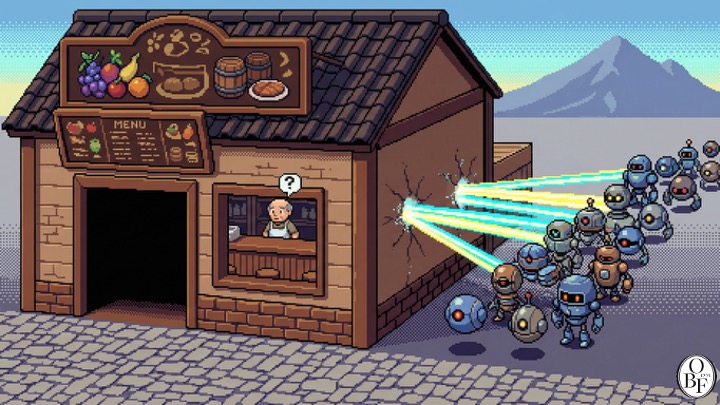
In Karpathy’s words, LLMs want scraping, not browsing. Clean text structure instead of complex menus. Concise data instead of animation. cURL2 instead of clicks. Flashy UI was built for human eyes — to a machine, it’s just noise.
Related issues
🔒 Forget Monetization to Actually Make Money
Monetization isn't a starting point — it follows once you've actually built something of value.
🔒 Your Strategy Document: Have You Tried Inverting It?
Real strategy isn't discarding the bad option—it's giving up one good option for another.
🔒 How Rice Farming Rewired the Way We Think
A decade of evidence — from a Science cover study to a Starbucks chair experiment — links the crops our ancestors grew to how we behave today
Your take shapes the next issue
Reply with your experience or perspective — the best responses feed into future issues.
Sign in to commentAny registered reader can comment — it takes 10 seconds.