
Bloomberg Terminal Is Ugly and Clunky—Everyone Still Uses It
Iran's parliament speaker tweeted a Bloomberg command—by accident?

Opening
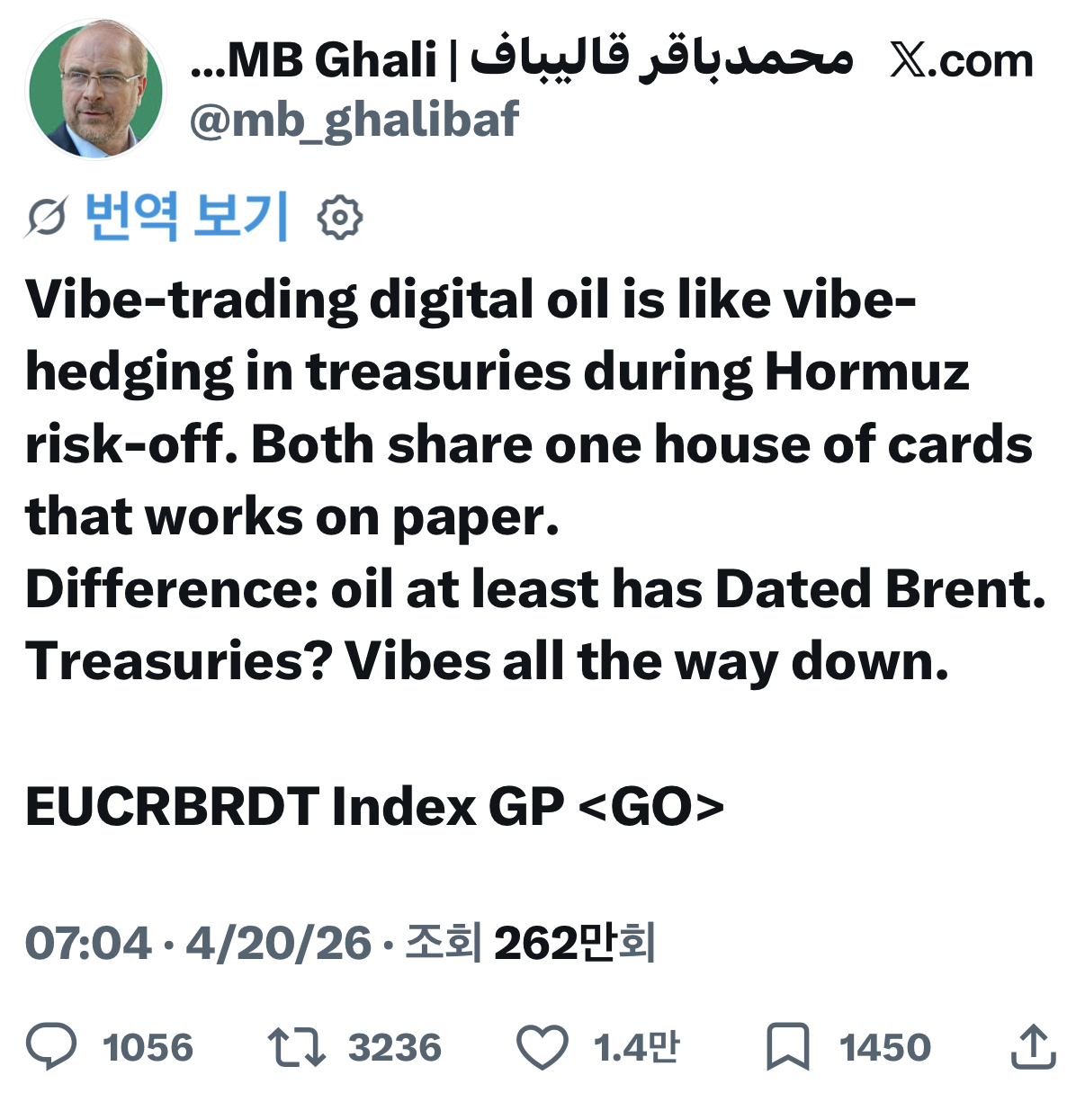
Hello, subscriber. This is Oz’s Knowledge Talking. A tweet on X (formerly Twitter) recently sent a shock through the trading floors. The poster was none other than Mohammad Bagher Ghalibaf, Speaker of Iran’s parliament. The tweet itself was a short, mocking comparison of the oil market to the bond market — but the real story was in the last line.
“EUCRBRDT Index GP
At first glance it reads like an indecipherable code, but it’s actually a Bloomberg Terminal command. The implication was that a senior official from a sanctioned country was casually operating inside the very heart of Western financial infrastructure. The existing suspicion that Iran was quietly raking in huge sums from oil trading suddenly felt a lot closer to confirmed.
But I want to look at this from a different angle. Just what is the Bloomberg Terminal, that one line of command could set off this much noise? Why was Iran’s parliament speaker using it in the first place? And why, 44 years on, can the financial industry still not let go of this “clunky, expensive” machine?
Today, let’s follow these questions.
🛢️ What That One Line Actually Means
Let’s break the command down piece by piece.
EUCRBRDT is the ticker1 for the Bloomberg European Dated Brent Forties Oseberg Ekofisk (BFOE) Crude Oil Spot Price. The name is a mouthful, but in plain terms, it’s the spot2 price index for North Sea Brent crude3. It’s registered as an official time series on the European Central Bank (ECB)‘s data portal — a core benchmark of the global oil market.
Index marks this ticker as, well, an index rather than a stock or a bond — a market qualifier4. On a Bloomberg keyboard, this is exactly what the yellow keys (GOVT, CORP, EQUITY, INDEX, and so on) are for.
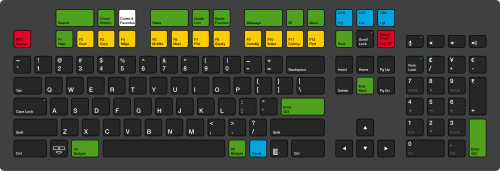
GP stands for Graph Price — the command to pull up a price chart for that ticker.
And the final
Put together, the line reads:
“Pull up the spot price chart for Brent crude.”
Here’s the problem: this isn’t a command just anyone can casually try. The Bloomberg Terminal is a closed system that costs upward of $30,000 a year to access. And the fact that a senior Iranian official — sanctioned by the U.S. Treasury’s Office of Foreign Assets Control (OFAC)5 — appeared to be fluent enough in this command syntax to slip it into a tweet reads, all too neatly, as circumstantial evidence of sanctions evasion or oil-trading activity.
Of course, other explanations remain on the table — a staffer tweeting on his behalf, someone on his team drafting it, and so on. But the suspicion itself has already outgrown the realm of mere suspicion.
And this is where the real story begins. What exactly is this Bloomberg Terminal, with its cryptic command language?
💻 The Machine Once Called “Bl-daeri” — What Is the Bloomberg Terminal, Really
The Bloomberg Terminal is a financial information workstation used daily by roughly 350,000 finance professionals worldwide. It’s an all-in-one platform that handles real-time market data, news, analytics, messaging, and order execution — all on a single screen.
The story goes back to 1981. Michael Bloomberg, then a partner at Salomon Brothers, was let go after the firm was acquired by Phibro Corporation. He got no severance, but he walked away with roughly $10 million from his equity stake. With that money he founded a company called Innovative Market Systems (IMS). In December of the following year, the first terminal — “Market Master” — was installed at Merrill Lynch’s offices. That was the beginning of the Bloomberg Terminal.

At the time, bond traders needed anywhere from several minutes to tens of minutes, armed with paper and a calculator, just to plot a single yield curve6. Bloomberg’s terminal processed the same task in real time with a few keystrokes. By 1991, roughly 10,000 terminals were already installed worldwide, and in 1990 the launch of Bloomberg News cemented the machine as an integrated platform combining “data + news + analysis” on one screen.
Today, Bloomberg L.P. is valued at roughly $150 billion (as of 2025), with more than 85% of total revenue coming from terminal subscriptions. Michael Bloomberg himself has become one of the world’s richest people, with a Forbes-estimated net worth of about $106 billion (April 2024) — an empire built on a single machine.
Why Koreans Called It “Bl-daeri”
In Korea’s financial industry, there’s long been a habit of calling the Bloomberg Terminal “Bl-daeri” — literally “Bloomberg assistant manager” — because the terminal’s annual subscription fee was roughly equivalent to the annual salary of an assistant manager (daeri, a mid-level rank at Korean firms). In other words, it’s a pointed joke: “For the price of hiring one more person, you could buy one machine instead.”
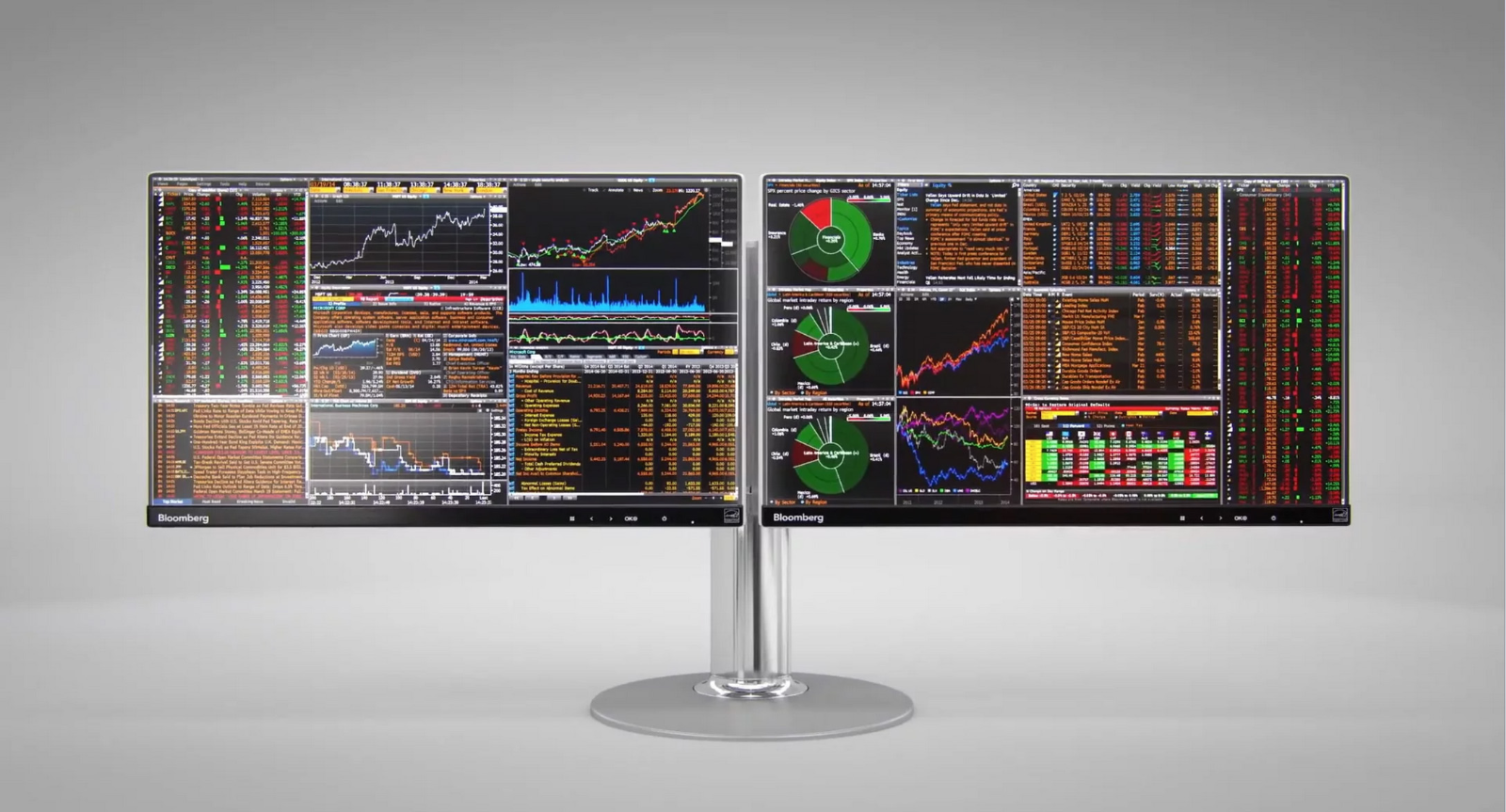
The comparison still holds. As of 2026, a single-seat annual subscription to the Bloomberg Terminal costs $31,980 (about $2,665 a month). Multi-seat contracts bring the per-seat price down to $28,320, with a minimum two-year term standard. These figures are confirmed by Bloomberg L.P.’s own materials and multiple research firms. Incidentally, among Korean YouTubers who cover overseas stocks, some subscribe to the Bloomberg Terminal out of their own pocket to broadcast with it — see this channel, for example. (I’m personally a fan of the channel host, who goes by Oseon.)
There are additional costs on top of that: a dedicated Bloomberg keyboard (about $300), installation fees ($500–$1,000), and data add-ons — all of which push the effective first-year cost to roughly $34,000–$35,500 per seat. For 10 seats, that’s about ₩250 million a year; for 50 seats — the scale of a mid-sized asset manager — it’s over ₩1.1 billion a year in fixed costs.
⌨️ Why Nobody Has Beaten It in 44 Years — The Four-Layer Structure of Lock-in
Here’s where an interesting question arises. The fact that a $30,000-a-year subscription service is still selling briskly in 2026 can’t simply be explained by “it’s expensive because it’s good.” Countless cheaper, sleeker-looking alternatives have shown up over the years, and yet Bloomberg is still sitting comfortably inside its moat. Honestly, the Bloomberg Terminal is ugly (my personal opinion) and has a brutal learning curve. You have to study just to use it, and even that studying isn’t easy. And still, nobody switches.
FactSet charges $12,000–$50,000 per seat annually — 40–60% cheaper than Bloomberg — and LSEG’s (formerly Refinitiv) Eikon runs $14,000–$22,000. An upstart like Godel Terminal claims to deliver “80–95% of Bloomberg’s functionality” for $118 a month. And yet Bloomberg raised its subscription price by about 60% over the 16 years since 2010, and its customer base grew larger in that same span, not smaller.
To explain this, we need to peel Bloomberg’s moat apart into four layers.
Handling real-time data across some 330 global exchanges — stocks, bonds, currencies, commodities, derivatives, alternative assets, all on a single platform — is, frankly, something competitors can replicate too. This layer is copyable, as long as you have the money.
The story changes from here. The Bloomberg Aggregate Bond Index (“The Agg”) is a bond index that hundreds of trillions of dollars in global assets benchmark7 against. It’s the very index asset managers cite when reporting to clients: “we outperformed the Agg by X basis points8.” To stop referencing an index calculated by Bloomberg’s methodology would mean rewriting thousands of contracts and prospectuses — a switching cost on that scale.
And here’s the crux of it. Bloomberg’s chat service, IB, is essentially Wall Street’s version of KakaoTalk (Korea’s dominant messaging app). As of 2015, some 200 million messages a day were flowing through 15–20 million chat rooms, and the scale has only grown since. One piece even called the Bloomberg Terminal “the most expensive social network in the world.”
Back in the early 2000s, there was a saying on Wall Street: “Either you were on Bloomberg, or you weren’t.” People reportedly exchanged Bloomberg IDs instead of business cards. More important still: a quote9 exchanged in that chat becomes a binding order on the spot, and an executed trade routes automatically into the back office and straight through to settlement. Negotiation and execution both happen inside the same chat window.
This is where the classic network effect10 kicks in. If my counterparty is on IB, I need to be on IB too. The moment I leave IB, I fall out of that liquidity pool. This isn’t a matter of habit — it’s structural lock-in11.
The Bloomberg Terminal has more than 30,000 functions. DES (Security Description), GP (Graph Price), MOST (most active securities), PORT (portfolio analysis), MSG (messaging) — all two-to-four-letter codes. Learning to use them fluently takes weeks at a minimum, and years to master.
That’s why, in finance, “knowing how to use Bloomberg” is itself a career credential. The muscle memory a ten-year bond trader has built into their fingers isn’t something you migrate to a new platform by retraining a person — you’re resetting ten years of that person. For a firm, that reset cost is far scarier than a $30,000 annual subscription fee.
Here’s an interesting twist. The Bloomberg Terminal’s UI is famously unpleasant to use — orange text on a black background, a command-line interface, almost no mouse use, a dedicated keyboard required. In 2026, the style is still nearly unchanged.
But in my view, that very unpleasantness is building yet another layer of the moat. If anyone can pick something up easily, anyone can drop it just as easily. The steeper the learning curve, the less likely people who’ve already climbed it are to climb back down. A barrier to new entrants becomes an asset for existing users.
🧠 Will Bloomberg Miss the AI Moment? Not a chance.
Periodically, the claim resurfaces that Bloomberg is about to be replaced in the age of AI. And it’s true that if you paste a 10-K filing into ChatGPT and ask for a summary, you get a pretty decent answer. But Bloomberg has already been moving.
In April 2023, Bloomberg unveiled BloombergGPT, its own finance-specific large language model. It has 50 billion parameters12, trained on 363 billion tokens13 pulled from 40 years of Bloomberg’s own accumulated financial documents, plus another 345 billion tokens of general datasets. Bloomberg didn’t release it as a standalone chatbot, though — instead, it was designed to be woven directly into the terminal’s existing features.
Starting in 2024, a generative-AI-powered earnings call summary feature rolled out first, and in November 2025 an AI research tool that analyzes multiple documents at once and builds comparison matrices was unveiled, targeting a year-end launch. About 400 in-house Bloomberg analysts reportedly took part in the training process, tuning the summaries to focus on what “investors actually want to know” — guidance14, capital allocation, hiring plans, supply chain issues, and the like.
A quote from Amanda Stent, Bloomberg’s head of AI strategy, stands out: she calls it “evolution, not revolution.” A company that’s been running machine-learning-based sentiment analysis15 since 2009 is now responding to generative AI by folding it into existing workflows rather than launching something separate. Bloomberg’s four stated principles for AI target the exact anxieties finance professionals have: protection (no data sales), transparency (source links provided), reproducibility, and robustness.
The point worth underlining here is that no matter how good an AI feature is, it means little if it lives outside Bloomberg. Bond pricing, counterparty chat, benchmark indices — they all already live inside Bloomberg, so there’s no reason to reach for an external tool just for AI summaries. Bloomberg understands this structure, and it’s building AI into the terminal, not around it.
Oz’s Lens
What we learn here is that the moat of a truly powerful product isn’t built from features — it’s built from data relationships.
Bloomberg has held near-monopoly status for 44 years not because its data is great or its UI is elegant. It’s because “other people” are inside it. My counterparty, my analyst friend, my former colleague — they’re all in there, which means I need to be in there too. That’s not a product. That’s infrastructure.
One thing worth adding, from a data perspective: people often say “couldn’t you just scrape all the public data?” But Bloomberg’s real value was never in public data. Evaluated bond pricing16, dealer runs17, the whispers of liquidity passing through IB chat — none of that can be scraped off the web. It’s proprietary data generated by the collective activity of the market’s participants.
What makes this Ghalibaf tweet incident so interesting is that, paradoxically, it proves Bloomberg’s reach. If even a senior official from a sanctioned nation has to get his information from inside this system, that tells you Bloomberg is the lingua franca — the shared infrastructure — of the financial world. A shared language is hard to abandon even when it’s expensive; shared infrastructure is hard to replace even when it’s slow.
The reason a 44-year-old black screen still moves Wall Street, in the end, comes down to this: the people are there.
Closing
Let me sum up today’s issue in three lines.
- Ghalibaf’s tweeted “EUCRBRDT Index GP” is the Bloomberg Terminal command that pulls up a Brent crude price chart. The fact that a senior official from a sanctioned country appeared to have access to this system amplified suspicions of oil-trading activity.
- The reason the finance industry can’t quit the Bloomberg Terminal, despite its $30,000-plus annual cost, isn’t features — it’s the network. The IB chat that serves as the financial world’s lingua franca, global benchmark indices, and the years users have sunk into mastering 30,000 functions all combine to form the moat.
- Even in the AI era, Bloomberg is responding with an “evolution, not revolution” strategy. Through BloombergGPT and AI tools built directly into the terminal, it’s treating AI not as an outside threat but as one more layer to stack on top of its existing moat.
Once you understand the terminal, phrases that used to just float past you in financial news start reading differently. “Got in touch over IB,” “the price moved the moment it hit the Bloomberg screen,” “40bp of outperformance versus the Aggregate” — you start to see that these are all the same ecosystem’s language. I hope today’s issue served as a small window into that language.
Someday, I’d like to cover the flip side of this story in the newsletter — the strategies of the challengers trying to breach Bloomberg’s fortress: FactSet, LSEG, and the AI-native upstarts. Attempts to replace a lingua franca have always failed so far, and yet people keep trying.
References & Further Reading
Primary sources
- Iran International, “Ghalibaf mocks US ‘blockade,’ warns of higher gas prices”, April 2026. — The most concise source for understanding the context of Ghalibaf’s recent activity on X.
- NBC News, “Iran’s Speaker Ghalibaf takes on Trump on social media”, April 2026. — Explains well how Ghalibaf criticizes Trump’s “jawboning” of markets while making his own market-moving comments.
- European Central Bank Data Portal, “Bloomberg European Dated Brent Forties Oseberg Ekofisk (BFOE) Crude Oil Spot Price”. — Confirms that the EUCRBRDT ticker in question is registered as an official ECB oil price index.
Background
- Wikipedia, “Bloomberg Terminal”. — The most systematic overview available, from the terminal’s 1982 launch through its keyboard layout and function system.
- CB Insights, “Twilight of the Terminal: The Disruption of Bloomberg L.P.”, 2021. — An excellent report breaking down Bloomberg’s five moats: data, chat, news, research, and platform.
- The Terminalist (Substack), “Bloomberg’s 7 Powers & Why the Terminal dominates financial markets”, 2024. — Explains, from a former industry insider’s view, how IB chat became “the most expensive social network in the world.”
- Ranjan Roy, “I Only Date Guys With Bloomberg Terminals”, Medium, 2016. — A vivid essay documenting Wall Street’s IB chat culture in the 2000s. The title is a bit provocative, but the essay itself is earnest.
- Bloomberg Press Release, “Introducing BloombergGPT, Bloomberg’s 50-billion parameter large language model”, April 2023. — The official announcement laying out the design principles and training data composition of the finance-specific LLM.
- IT Brew, “Inside the Bloomberg Terminal’s AI”, November 2025. — The interview where Bloomberg’s “evolution, not revolution” AI framing originated.

The author, Kwangseob Ahn, is a professor of business administration at Sejong University and lead consultant at OBF (Oswarld Boutique Consulting Firm). He teaches statistics and data analysis — business data management and business analytics — while leading GTM and AI strategy consulting in the field, designing the seam between technology and business. He has published academic research on a memory architecture for AI dialogue systems (HEMA) and runs Daily Arxiv, a daily curation of global AI papers. He holds a master’s from Korea University’s Graduate School of Technology Management and a KMBA. He is the author of Homo Brainless: The People Who Outsource Their Thinking.
Footnotes
-
Ticker: A short code identifying a financial instrument — a stock, bond, or index. Apple’s ticker is AAPL; Samsung Electronics’ is 005930. Every instrument has a unique one. The Bloomberg Terminal identifies global assets using more than 300,000 tickers — think of it like a license plate. ↩
-
Spot (price): The price for buying or selling something right now. The opposite concept is futures, where you agree in advance to trade “at this price, three months from now.” A spot crude price reflects the actual transaction price for delivery today, so it captures market conditions most immediately. ↩
-
Brent Crude: Oil produced in the North Sea (between the UK and Norway), used as the reference price for roughly two-thirds of all crude oil traded globally. Along with WTI (the U.S. benchmark), it forms one of the world’s two major oil benchmarks. The “BRDT” in EUCRBRDT stands for Brent. ↩
-
Market qualifier (Yellow Key): The yellow keys along the top of a Bloomberg keyboard. They’re divided into categories like GOVT (government bonds), CORP (corporate bonds), EQUITY (stocks), INDEX (indices), and CMDTY (commodities), specifying which market an instrument belongs to when the same name might exist across several. For example, typing “VOD LN Equity” refers to Vodafone as listed on the London stock exchange. ↩
-
OFAC sanctions: Economic sanctions imposed by the U.S. Treasury’s Office of Foreign Assets Control. Entities designated under these sanctions are cut off from the U.S. financial system, effectively excluded from the dollar-based global financial network. Many senior Iranian government officials fall under this designation. ↩
-
Yield curve: A line connecting the yields of bonds with different maturities. The x-axis shows maturity (3 months, 1 year, 10 years, 30 years…) and the y-axis shows yield. Normally, longer maturities carry higher yields, producing an upward-sloping curve; when short-term rates rise above long-term ones — an “inversion” — it’s typically read as a recession signal. It’s the most basic analytical tool for a bond trader. ↩
-
Benchmark: A reference line against which asset management performance is measured — as in “my fund returned +1.5% versus the Aggregate Bond Index.” Change the benchmark, and you have to rewrite the entire performance-measurement methodology and every report sent to investors, which makes the switching cost enormous. ↩
-
Basis point (bp): A tiny unit for expressing differences in interest rates or yields. One basis point equals 0.01% (one hundredth of a percent). Bond markets need units smaller than a percentage point, since yields are often quoted to two decimal places. “40bp of outperformance” means beating the benchmark by 0.4%. ↩
-
Quote: The price a counterparty offers to buy or sell at. In Bloomberg’s IB chat, a dealer’s quote becomes a binding order the moment it’s given — say “buy me some” over the messenger, and an actual contract is executed. ↩
-
Network effect: The phenomenon where a product or service becomes more valuable as more people use it. The telephone is the classic example — useless if only one person has it, essential once everyone does. Bloomberg’s IB chat forms a powerful moat for the same reason: if my counterparty is there, I need to be there too. ↩
-
Lock-in: A structure that makes it hard for users to leave a particular product or service. There’s technical lock-in (incompatible data formats), network lock-in (everyone else is there), and learning lock-in (new tools take a long time to master), among others. Bloomberg is a rare case that combines all three. ↩
-
Parameters & tokens: The two units that come up most often when describing AI models. Parameters are the internal “dials” an AI adjusts through training — 50 billion parameters means 50 billion such dials are tuned to produce an answer. Tokens are the smallest unit of text an AI processes. In English, roughly one word equals 1–2 tokens; in Korean, roughly one syllable equals 1.5–2 tokens. 363 billion tokens is roughly equivalent to about 2.7 million pages of A4 text. ↩
-
Same as above. ↩
-
Guidance: A company’s own forecast for next quarter’s or next year’s results, issued alongside quarterly earnings — for example, “we expect Q4 revenue to grow 8–12% year over year.” Markets treat guidance as a signal of a company’s visibility into its own future, so guidance that comes in below expectations often triggers sharp stock drops. ↩
-
Sentiment analysis: A technology that automatically extracts positive, negative, or neutral sentiment from text — news articles, social media posts, corporate filings, and the like. “Apple posted record-breaking results” reads as positive; “rate hikes have frozen investor sentiment” reads as negative. Aggregated in real time, this kind of analysis is used in strategies designed to react to news faster than human traders can. ↩
-
Evaluated pricing: An estimated price for bonds — especially corporate and municipal bonds — that don’t trade actively or transparently on public markets. If the last actual trade was days ago, how do you know today’s price? Bloomberg estimates a daily closing price using models built from comparable bond trades, rate changes, credit rating shifts, and similar inputs. It’s data asset managers rely on daily to calculate fund valuations. ↩
-
Dealer runs: Price lists that bond dealers at securities firms send major clients every morning, indicating “we’ll buy or sell at these prices today.” Since the bond market has no centralized order book the way stock markets do, these dealer runs effectively function as the market price. Bloomberg’s IB chat is the core channel through which dealer runs circulate. ↩
Related issues
 Issue #84Business
Apple's Caviar Store Forgot How to Sell Cheese
Vision Pro's failure wasn't about the product — it was the cost of gutting retail's soul in the name of 'efficiency.'
 Issue #83Business
The Sea's Toll Booths: A History of Maritime Passage Fees
The sea was never free by nature—'freedom of navigation' was forged through centuries of war and negotiation.
 Issue #75Business
Harvey's $11B Bet: Can Law Survive Without Billable Hours?
A $1 trillion legal industry's hourly billing model is buckling under AI-driven efficiency gains.
Your take shapes the next issue
What resonated most in this issue, or where has your experience been different?