
Training Can't Fix Your Brain's Multitasking Bottleneck
New research overturns the long-held belief that practice lets us truly handle two tasks at once.
Opening
Hello, dear reader. This is Oswarld’s Knowledge Talking.
Today I want to talk about psychology. The word “multitasking” is treated almost like a survival skill for Korean office workers. Checking Slack messages while writing up meeting notes, skimming materials for the next meeting while drafting an email — that’s daily life for many. Many people believe this is possible because of “skill.” And in fact, cognitive psychology1 has long held, as its mainstream view, that “with enough practice, two tasks can be processed almost simultaneously.”
But a study published this year directly overturns this 30-year-old belief. The bottom line: no matter how long you train, the brain’s “bottleneck” never disappears. And this finding is more than academic curiosity — it carries significant implications now, at a moment when AI has begun replacing cognitive labor2.
Twelve Days of Training, and the Collapse of the “Perfect Time-Sharing” Hypothesis
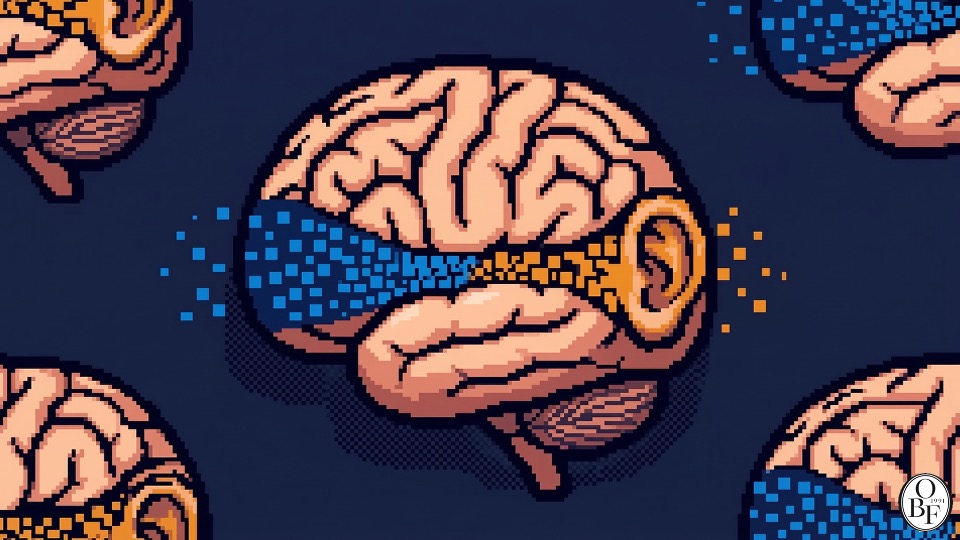
This study was conducted by Professor Torsten Schubert’s team at Martin Luther University Halle-Wittenberg in Germany. It was a joint research effort with FernUniversität in Hagen (Distance University of Hagen) and MSH Medical School Hamburg, and it was published in the Quarterly Journal of Experimental Psychology.
The experimental design is fairly intuitive. Participants were asked to simultaneously perform a visual-manual task (indicating with their right hand the size of a circle briefly shown on screen) and an auditory-verbal task (saying aloud whether a simultaneously heard tone was high, medium, or low). In other words, two tasks that used entirely different sensory channels.
The key lies in the training period. Participants repeated this dual-task3 for up to 12 days. As a result, reaction speed improved and errors decreased — a pattern consistent with prior research. Earlier studies called this phenomenon “virtually perfect time sharing” and interpreted it as evidence that the brain had achieved true parallel processing4 of the two tasks.
But Schubert’s team took things a step further. After training, they artificially altered the time required for the response selection stage5 of the tasks. In simple terms, they introduced a very small change into a well-trained routine.
The results were dramatic. Lengthening the bottleneck stage of the shorter task also lengthened the reaction time of the longer task — but the reverse did not hold. This is a clear signal that the two tasks were still passing through a single bottleneck sequentially. Practice hadn’t “eliminated” the bottleneck; it had simply made the processing before and after the bottleneck so fast that the bottleneck became invisible.
Professor Schubert explains it this way: the brain is remarkably good at optimizing the sequence of two processes so they don’t interfere with one another. But this optimization has limits, and the moment conditions become even slightly more demanding, the cognitive system quickly tires and errors increase.
Related issues
🔒 Why "Software Eats the World" Has Expired
As AI makes software abundant, economic power is swinging back toward the physical world of hardware.
🔒 A 17-Year-Old's 3-Day Farm Game Beat Fortnite
The gaming industry's value chain is flipping upside down, with teenagers driving the shift.
🔒 $250 Billion in AI Spending, So Why Isn't It in the Data?
AI's technical capability and its economic payoff are running on two different clocks.
Your take shapes the next issue
Reply with your experience or perspective — the best responses feed into future issues.
Sign in to commentAny registered reader can comment — it takes 10 seconds.