
The Agency That Stole a Logo, and a Word Called 'GEO'
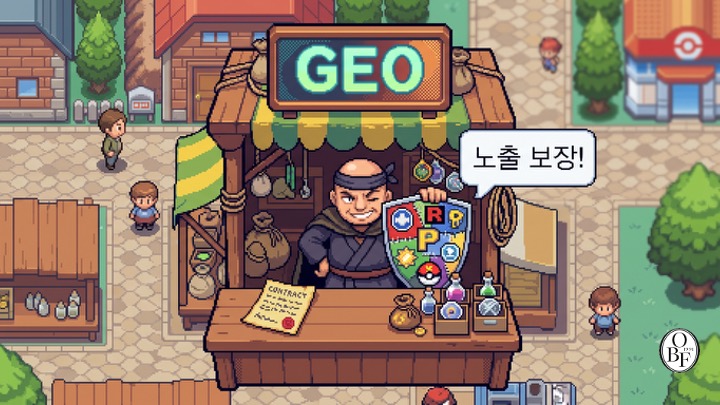
'Guaranteed exposure' and 'algorithm domination'—these two phrases are the scam signal.
Opening
Mr. A stumbled across a promotional post from an AI marketing agency on LinkedIn. On the agency’s own website, though, he found the logo of the financial group he works for, displayed as a “client case study.” Mr. A manages vendor relationships for his group, so he knows their partners inside and out — and this was a company he’d never seen before. When he asked which subsidiary they’d worked with and whether they’d gotten permission to use the logo, what he got back wasn’t an explanation. It was a block.
You, too, may have received a pitch for ‘GEO1 services’ at some point recently — the sales pitch promising to get your brand featured in ChatGPT or Perplexity’s answers. But why is it that right now, logo theft and phrases like “guaranteed exposure” are all surfacing at once?
Let me give you the conclusion up front. GEO is a real strategy. But the moment words like “guarantee,” “domination,” or “only one slot left” get attached to it, that’s not optimization — it’s a scam signal. Today, I want to lay out the criteria for telling the two apart.
What’s Happening Right Now
On the 4th, a post from someone in the marketing industry went viral for the wrong reasons. It described a GEO agency that had displayed major corporate logos on its website like a client portfolio — and when asked whether it had actually worked with those companies, gave no answer. The agency later quietly deleted some of the logos. The author’s phrasing nailed it: “They used the trendy new term GEO as a shield to build a plausible-looking package that fools anyone who doesn’t know better.”
This isn’t an isolated case. A newsletter run by a well-known marketing community in Korea published similar reports. The sales pitches follow the same pattern: agencies flaunt credentials — “our team is from elite universities, so we’ve mastered AI logic,” “we have connections with core engineers at Naver, Korea’s dominant search portal” — while pressuring prospects into paying upfront with lines like “prices go up soon” or “we only have 1 slot left.”
The cleverest part is how they report results. Some agencies reportedly type a specific brand name into a generative AI repeatedly, then open a fresh chat window, screenshot the response that mentions the brand, and submit it as a “monthly performance report.” The problem is that generative AI answers can vary wildly depending on how a user phrases a question, the conversation’s context, and personalization settings. A single screenshot isn’t proof of performance — it’s just that one person’s screen.
There’s an even scarier structure at play. In some reported cases, an agency builds up content on a domain it owns itself, and if the client doesn’t complete a full 2-year contract, the entire domain and content disappear — or the client has to buy them out separately. You paid for the content, but you never actually owned it.
There’s a reason these tactics work especially well in GEO. In an early-stage market, who you’ve worked with — your references — is trust itself. And because GEO results are hard to verify directly, a single big-name logo on a website generates more credibility than it deserves. Logo theft isn’t just bravado — it’s the single most effective bait in this market.
Why Now, of All Times
Let me clear up one misconception here. GEO itself isn’t a scam. If anything, it’s the opposite: search habits are genuinely changing, and that’s exactly why real money and real con artists are flooding into this market at the same time.
A Single Search Box Is Rewriting the Food ChainThe apex predator is restructuring its own ecosystemLet’s look at the numbers. As of H1 2026, about 68% of Google searches end without a click.2 AI now summarizes the answer above the search results, so there’s often no need to click a link at all. In searches where an AI Overview appears, that no-click rate climbs to 83%, and Google’s AI Mode has surpassed 1 billion monthly users. Meanwhile, organic traffic to many sites has dropped 15-25%. Korea is no exception: more people are using ChatGPT as a search engine outright, and Perplexity has become the No. 2 most-used generative AI app in the country.
Naturally, companies are getting nervous. If people are asking AI instead of typing into a search box, then brands need to manage how they show up inside that AI’s answers. The demand is real — and that’s exactly why the agency pitches are multiplying, too.
The problem is that GEO is still an early-stage market. SEO3 has had more than 20 years to build up measurable metrics — search rank, traffic, click-through rate, conversion rate. GEO, by contrast, varies from model to model, and even the same question can produce a different answer every time. This is called non-determinism4, and it’s precisely this property that makes the phrase “we guarantee exposure” fundamentally impossible to deliver on. Add personalization on top, and proving performance with a single screenshot becomes even more absurd. (And honestly — doesn’t the word “guarantee” already sound suspicious on its own?)
Here’s an analogy. SEO is like a test everyone can check on the same screen — “we moved you to rank 3 for this keyword.” Selling “guaranteed exposure” in GEO, on the other hand, is like promising a perfect score on a test where every test-taker gets different questions and the grading criteria are never published. The moment someone insists that’s possible, they either don’t understand the test — or they understand it perfectly and are selling you a lie anyway.
In short: real demand plus a measurement standard that doesn’t exist yet. That gap is exactly the space where hype-driven sales pitches, logo theatrics, and upfront-payment pressure move in.
What Real GEO Actually Looks Like
So what does proper GEO actually look like? 2 years ago — in June 2024, to be exact — I wrote about this exact topic. Back then, I emphasized just 3 things: credibility, readable structure, and distributed publishing. Cite reliable statistics and sources clearly, break up your writing with subheadings, and spread your content across communities and social media, too.
Search Engine Optimization → Search Engine Generated-Results Optimization?Generative search engines (Google SGE, Bing Chat, Perplexity, and others) are spreading fast. These engines find multiple web pages in response to a user’s question and …Interestingly, academic findings don’t stray far from this either. A paper titled “GEO,” from researchers at Princeton and Georgia Tech, found that content with citations, statistics, and expert quotes saw visibility in generative AI answers rise by as much as 40% or more — though the effect varied by domain. In other words, there’s no secret technique in GEO for “mastering the algorithm.” It’s essentially about making trustworthy content in a form AI likes to cite. The roots are the same as basic SEO: registering your site with Google Search Console, keeping a clean sitemap, and getting mentioned in credible channels.
Create & capture demand in the AI Search era — Think with GoogleGoogle’s Official Digital Marketing Publication. See how to create and capture demand in the era …One more thing: the distributed-publishing principle I emphasized 2 years ago still holds. Generative AI doesn’t just look at your homepage — it draws broadly on Reddit, Quora, and community posts. Being mentioned naturally in credible channels carries more weight than any “secret setting.” The flip side is that this takes time. And that’s another reason “guaranteed in a short period” sounds so suspicious when applied to something as slow-moving as search optimization.
Once you hold onto this perspective, fraudulent sales pitches become surprisingly easy to filter out. Here are 5 questions worth asking whenever you get a GEO agency pitch.
- Do they use the word “guarantee”? “Guaranteed exposure” or “guaranteed ranking” is fundamentally impossible because of non-determinism. The moment a guarantee is promised, that’s red flag number one.
- Can they explain the actual scope of work? If they can’t specify “what, on which channels, how” and just repeat trendy buzzwords, that’s dangerous.
- Can their references be verified? If all they have is a logo — no contact person, no contract, no confirmed scope of work — that may just be logo theater.
- Are they pressuring you to prepay or act urgently? “Only one slot left” or “prices go up soon” isn’t the language of optimization — it’s the language of sales pressure.
- What do they use to prove results? A single fresh-chat screenshot isn’t evidence. Check whether they present reproducible metrics — citation frequency, AI-driven traffic — and before signing, make sure to confirm who actually owns the domain where your content accumulates.
Honestly, these 5 questions are just the basics of data-driven marketing — what’s usually called performance marketing. If an agency is selling you exposure and data but can’t answer any of this, that’s not mere suspicion anymore. That’s close to certainty that it’s a scam.
Oswald’s Lens
I’ll admit, I’m writing this with somewhat mixed feelings. When I first introduced GEO on this blog 2 years ago, I was a little excited about the possibility that even small blogs with weak domain authority could get a shot. I don’t think that optimism was wrong. But in the meantime, the same concept has become a shield and a lure for certain people.
From my experience building go-to-market strategies, this is a very familiar pattern. The forecast that “technology will change the world” is usually right. But the people selling you the timing and path of that change almost always exaggerate ahead of the curve. The big-picture shift of search moving toward AI is real. But “so pay us upfront right now” is an entirely different claim.
As I see it, what con artists are really selling isn’t GEO. It’s anxiety. The market is visibly shifting, but there’s no measurement standard yet — so they dig into that unease and sell you one plausible-looking screenshot. Which makes the defense surprisingly simple: set the anxiety aside and go back to first principles. Good content and clear sourcing — those old fundamentals — have become the litmus test for filtering out con artists today.
Closing
Here’s today’s story in 3 lines.
- The shift of search toward AI answers is real. So is the demand for GEO.
- But words like “guarantee,” “domination,” or “exclusive slot” are scam signals exploiting the ambiguity of an early-stage market.
- The key to protecting yourself isn’t a secret trick — it’s principle. Go back to credibility, structure, and verifiable performance metrics.
If you ever receive a GEO agency pitch, feel free to copy the 5 questions above and throw them straight at the other side. If they stumble on 3 or more, I’d urge you to think twice before signing anything.
And I’m curious about one thing: have you recently received a GEO or AI marketing agency pitch with a line that made you think, “Wait, that sounds off”?
💬 Share the agency lines that struck you as odd in the comments. 📨 If a colleague is weighing a GEO proposal, forward this piece to them.
References & Further Reading
Primary sources
- Pranjal Aggarwal et al., “GEO: Generative Engine Optimization,” KDD ‘24 (ACM SIGKDD), 2024. : The experimental finding that adding sources, statistics, and quotes lifts visibility by over 40% is the core evidence behind today’s piece. It’s the academic proof that there’s no magic in GEO.
- “Set Up a Meeting With a GEO Agency? Hold On a Second!,” i-boss Q Letter. : A well-organized rundown of real cases in Korea, including fake screenshot reports and domain lock-in. Worth reading before any agency meeting.
- Reporter Jang, “Suspected Fraud Cases Involving Generative AI Search Optimization (GEO) Agencies,” related news report, 2025. : The report containing the logo-theft case from today’s opening.
Background
- Google, “SEO Starter Guide.” : GEO’s roots ultimately trace back to SEO fundamentals. Everything from Search Console registration to sitemaps starts here.
- “In 2026, Less than One Third of Google Searches Still Send a Click,” SparkToro, 2026. : The source of the 68% no-click figure, and why search is shifting toward AI answers.
- Kwangseob Ahn, What Is GEO (Generative Engine Optimization)? (2024) : The piece where I first laid out GEO 2 years ago. Read alongside today’s issue, it shows how the same concept gets used differently over time.

The author, Kwangseob Ahn, is a professor of business administration at Sejong University and lead consultant at OBF (Oswarld Boutique Consulting Firm). He teaches statistics and data analysis — business data management and business analytics — while leading GTM and AI strategy consulting in the field, designing the seam between technology and business. He has published academic research on a memory architecture for AI dialogue systems (HEMA) and runs Daily Arxiv, a daily curation of global AI papers. He holds a master’s from Korea University’s Graduate School of Technology Management and a KMBA. He is the author of Homo Brainless: The People Who Outsource Their Thinking.
Footnotes
-
GEO (Generative Engine Optimization): A strategy for optimizing your content so that generative AI systems like ChatGPT or Gemini cite or reference it when composing an answer. Unlike SEO, which aims for “ranking high in search results,” GEO aims for “being cited in an AI’s answer.” ↩
-
Zero-click search: A search that ends without the user clicking any link. This has surged as AI increasingly summarizes the answer above the results. ↩
-
SEO (Search Engine Optimization): The long-established practice of optimizing content to rank higher on the results pages of search engines like Naver or Google. GEO’s fundamentals trace directly back to this. ↩
-
Non-determinism: The property whereby a generative AI can give a different answer every time, even to the exact same question. This is what makes a promise of “guaranteed exposure” fundamentally unworkable. ↩
Related issues
The Price of Not Looking at China Properly
Two large-scale studies show Western scientists barely cite Chinese papers — and Korea has the same blind spot in batteries and chips.
The Houseplant That Talked to Me
The moment we can speak to something, we start a relationship with it.
Empty Strollers and ₩380 Trillion
The country with the OECD's cheapest child care has the world's lowest birth rate — cost was never the real bottleneck.
Your take shapes the next issue
Reply with your experience or perspective — the best responses feed into future issues.
Sign in to commentAny registered reader can comment — it takes 10 seconds.