
Empty Strollers and ₩380 Trillion
The country with the OECD's cheapest child care has the world's lowest birth rate — cost was never the real bottleneck.

Opening
Hello, dear subscribers — this is Oswarld’s Knowledge Talking. Last week, The Economist published a chart comparing child-care costs across 36 OECD countries. Having lived in Korea and heard “raising a kid costs way too much” countless times from friends and older colleagues, I couldn’t believe my eyes when I saw the name of the country at the very bottom of the chart.
It was Korea. The country with the cheapest child care in the entire OECD: South Korea.
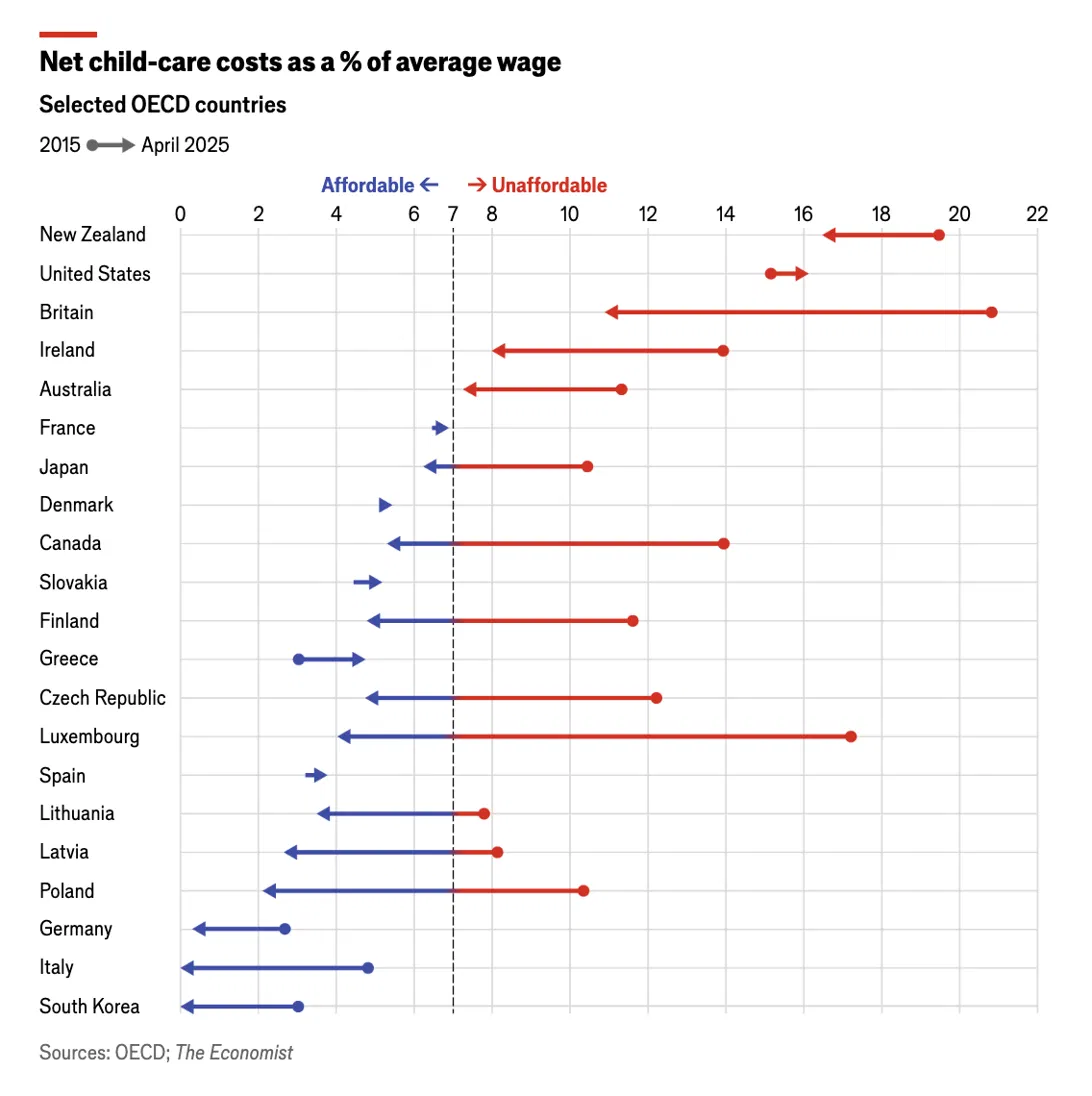
For a dual-earner couple on average wages, Korea’s net child-care cost is effectively free — tied with Italy and Malta for the lowest level among the 36 OECD countries. But here’s the strange part. The country where child care is cheapest also has the lowest birth rate in the world.
Let me give you the conclusion up front: the formula “people can’t have kids because child care is too expensive” is flatly contradicted by the OECD data.
🌍 A Child-Care Cost Map of 36 Countries: What the Data Shows
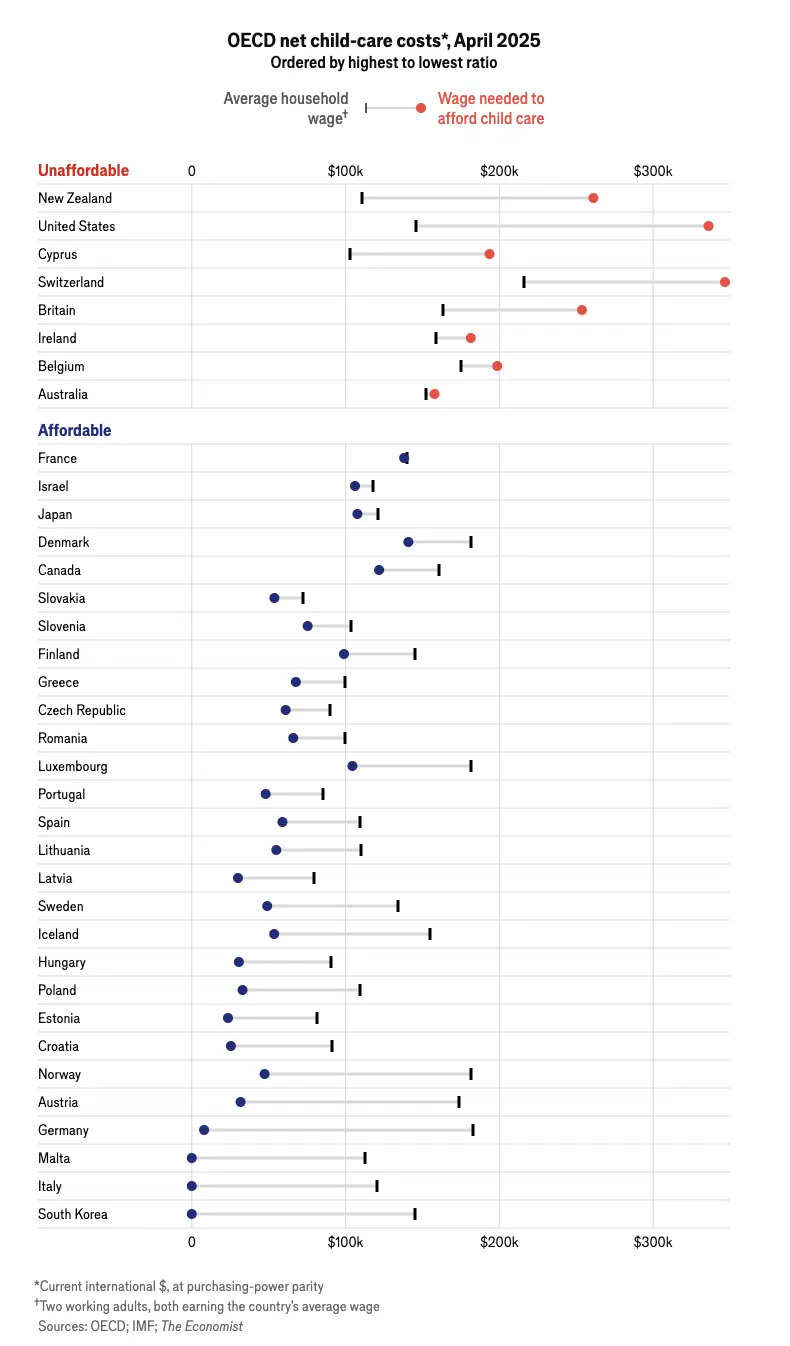
The Economist used a benchmark set by the US government. If a household can keep child care at 7% or less of its gross income, it counts as “affordable”; anything above that is “unaffordable.” The comparison assumed a dual-earner couple on average wages with 2 children under 3 in full-time day care, and measured net child-care costs after government subsidies across 36 countries.
The results were stark.
8 countries were classified as unaffordable. The most expensive is New Zealand. A dual-earner couple there earns an average household income of about $111,000 (PPP1-adjusted), yet to keep child care within 7% of income they would need to make $261,000. In other words, they would have to earn 2.3 times their current income just to afford it. The US is in a similar spot — more than 2 times the average income is required — though state-level variation is large, since states like California, New York, and Massachusetts offer European-style benefits. Switzerland has the OECD’s highest average wages, but child care is priced to match, landing it in the unaffordable group. The UK came in 5th, though recent subsidy expansions are gradually easing the real burden.
At the opposite end sits Korea. In Germany, subsidies are so generous that a household earning just $8,010 a year can afford child care, and in Korea, Italy, and Malta, net child-care costs at the average income are effectively zero.
And one more thing worth noting: over the past 10 years, child-care costs fell relative to wages in 30 of the 36 countries. Only 6 countries saw them rise. As rich-country governments poured money into pro-natalist policies2, child care genuinely became cheaper.
🔄 The Paradox: Mothers in Expensive Countries Have More Babies
Here is where the data flips intuition on its head.
According to The Economist’s analysis, women in the 3 countries with the most expensive child care have more children over their lifetimes than women in the 3 cheapest. New Zealand’s total fertility rate3 is about 1.6 — in the country with the most expensive child care in the world.
And Korea? 0.80 (as of 2025). The country with the world’s cheapest child care has a birth rate less than half that of the world’s most expensive.
This isn’t just a Korean story. Even in countries that slashed child-care costs, evidence of a meaningful rise in fertility is thin. There is research showing that child-care subsidies modestly raise women’s labor-force participation, but almost none showing they push couples to decide, “Then let’s have one more child.” If anything, The Economist notes that a new generation of socialist-leaning politicians is winning voter support by pledging fully free child care. There is a gap between policies voters like and policies that actually work.
Put the numbers side by side and the paradox sharpens. New Zealand parents spend about 20% of household income on child care, yet the fertility rate is 1.6. US parents spend more than 15% of income on child care, and fertility is about 1.6. Korean parents, meanwhile, face a net child-care burden of effectively 0% — and fertility is 0.80. The UK recently expanded child-care subsidies substantially for parents earning under £100,000 a year, but no effect of that policy on fertility has been confirmed yet.
The claim that “people can’t have kids because child care is too expensive” simply doesn’t hold up against the data.
🇰🇷 The ₩380 Trillion Report Card
Let’s talk more about Korea.
From 2006 to 2023, the Korean government spent a cumulative ₩380 trillion (~$270 billion) on low-birth-rate countermeasures. In 2025 alone, ₩88.5 trillion was budgeted, of which ₩28.6 trillion went to programs directly tied to raising the birth rate. By simple arithmetic, that works out to about ₩60.7 million of budget per child born since 2006.
A caveat is needed here, though. Korea’s “low-birth-rate budget” includes salaries for civilian military employees, Green Smart School construction (₩1.8 trillion), and even professional sports talent scouting (₩2.2 billion). It also covers safe traffic environments for children, youth tech-startup promotion, and university humanities programs. The National Assembly Budget Office itself pointed out that “the budget includes items with no direct relevance to low-birth-rate policy or with low effectiveness.” This contrasts with how international bodies like the OECD classify only direct child-care and birth support as low-birth-rate spending. Genuinely direct support amounts to about 40% of the total. The ₩380 trillion figure is, in a sense, a “budget illusion.”
Even so, child-care costs undeniably came down. Day care for ages 0–2 is fully government-funded, and the parental benefit rose to ₩1 million per month for age 0 and ₩500,000 per month for age 1. As the OECD data shows, Korea reached the world’s lowest level in pure child-care costs.
And the result? The total fertility rate actually fell, from 1.13 in 2006 to 0.72 in 2023. There was hopeful news early this year when the monthly figure rebounded to 0.99, but demographers see this as a catch-up effect from marriages and births delayed during COVID. There is also a structural factor: the 1990s-born echo-boom generation is now at prime childbearing age. Professor Sojung Lim of the sociology department at SUNY Buffalo warned that “unless these structural causes are resolved, the current birth rebound will be short-lived.”
Let’s step back one more pace. In the 1960s–80s, Korea’s economic conditions were incomparably worse than today. The very concept of child-care infrastructure didn’t exist, and housing conditions were nowhere near comparable. Yet the total fertility rate was in the 4–6 range. Far more children were born in an era when economic conditions were overwhelmingly worse. History, too, proves that cost is not the decisive variable in childbearing. People have children when they can see a future — not because costs went down.
⚖️ The Perception Trap: Where the Real Bottleneck Lies
So why do people say “it’s too expensive to have kids”?
An intriguing clue comes from Germany. By the OECD’s measure, Germany’s child-care burden ranks near the very bottom of the 36 countries. Subsidies are so large that child care is nearly free. Yet in a recent survey, 55% of Germans said “having children is hard to afford.” Of those, 48% said government support was insufficient.
In a country where child care is nearly free, more than half feel it’s “expensive.” This is not a contradiction. It means the “cost of raising children” that parents perceive is not the same thing as the day-care bill.
The “cost” parents talk about bundles in housing, private tutoring, and above all opportunity cost — a total cost that includes career interruption, delayed promotions, and shrinking social ties. In Korea, “child care is expensive” really means something closer to “the sum total of everything it takes to raise a child is unbearable.” The average apartment sale price in Seoul exceeds ₩1 billion, and private-education spending passed a monthly average of ₩440,000 as of 2025. Even if the day-care bill drops to ₩0, this cost structure doesn’t change. In a survey of 1,000 workers by the advocacy group Workplace Gapjil 119, the policy ranked most needed to address the low birth rate was “mandatory parental leave for both parents” (20.1%). Expanded cash support (18.2%) came after. Parents want “time” and “stability” more than “money.”
Meanwhile, countries that expanded free child care rapidly have reported unexpected side effects. Quebec, Canada introduced $5-a-day universal child care4 starting in 1997, and according to an NBER5 study (Baker, Gruber, Milligan, 2005), enrollment surged — but children’s behavioral and health indicators actually worsened. Anxiety levels rose 60–150%, and motor and social development declined 8–20%. It was the result of quality failing to keep pace with rapid expansion.
Lowering child-care costs is necessary. But it is not sufficient.

Oz’s Lens
In my years of building corporate strategy, I’ve seen the same pattern over and over.
When customer surveys put “the price is too high” at the top of the churn reasons, most companies start with discount promotions. But even after cutting prices, conversion often doesn’t budge. Because when customers say “it’s expensive,” what they really mean, most of the time, is “I don’t feel this is worth the price.” The problem isn’t price; it’s perceived value. Sure, cheaper is nice. But making things cheap is usually not the heart of the matter.
I believe Korea’s low-birth-rate policy has fallen into exactly this trap. Faithful to survey results saying “we don’t have kids because child care is expensive,” the government cut child-care costs — all the way down to the world’s lowest level. And the birth rate didn’t rise.
What people really wanted to say was, “The total cost of raising a child in this society is unbearable.” Child care is only one part of that. The ₩380 trillion was an investment answering stated needs. It never sufficiently reached the latent needs: housing stability, a genuinely workable balance of career and child-rearing, relief from educational competition, and parenting without career interruption.
What the data ultimately tells us is this: lowering costs is only a starting point — it does not change the structure of the decision to have a child.
Closing
The picture in the OECD’s 36-country data is clear.
Child-care costs genuinely fell in most rich countries over the past 10 years. Birth rates did not rise. The fact that women in the most expensive countries have more children than women in the cheapest ones proves that cost is not the key variable. Korea is the most dramatic case of this paradox: the world’s lowest child-care costs, ₩380 trillion of investment, and the world’s lowest birth rate. That these 3 things coexist is itself proof of the limits of the existing approach.
The answer lies beyond child-care costs.
What do you think? When deciding whether to have a child — or one more — is the biggest factor child-care cost, or something else entirely? Let me know in the comments.
References & Further Reading
Primary sources
- The Economist, “Child care is becoming more affordable”, June 2026. : The core data source for today’s newsletter. The 36-country OECD child-care cost chart upends intuition.
- Baker, M., Gruber, J., & Milligan, K., “Universal Childcare, Maternal Labor Supply, and Family Well-Being”, NBER Working Paper No. 11832, 2005. : The study analyzing the child-development effects of Quebec’s universal child care. Essential reading on the unintended consequences of child-care expansion.
Background
- Ilyo Shinmun, “₩380 Trillion Spent for ‘0.72’ — Where Did the Low-Birth-Rate Budget Go?”, April 2024. : An analysis of the composition and execution of Korea’s low-birth-rate budget. The case of “professional sports talent scouting” being counted as low-birth-rate spending helps explain the budget illusion.
- CNN, “Population crisis: South Korea is finally having more babies but can it last?”, February 2026. : Expert analysis of the background and limits of Korea’s fertility rebound.
- The Asia Business Daily, “₩88.5 Trillion Low-Birth-Rate Budget Confirmed — Policy Efficiency Reviews Begin”, July 2025. : A rundown of the 2025 low-birth-rate budget and the restructuring debate around it.

The author, Kwangseob Ahn, is a professor of business administration at Sejong University and lead consultant at OBF (Oswarld Boutique Consulting Firm). He teaches statistics and data analysis — including business data management and business analytics — at the university, while leading GTM strategy and AI strategy consulting in the field, designing the interface between technology and business. He has published academic research on memory architecture for AI dialogue systems (HEMA) and runs Daily Arxiv, a project curating global AI papers every day. He completed a master’s program at Korea University’s Graduate School of Management of Technology and its KMBA. He is the author of Outsourced Minds: Homo Brainless.
Footnotes
-
PPP (Purchasing Power Parity): A method of adjusting currency values to reflect each country’s price level. If a Big Mac costs ₩5,000 in Korea and $5 in the US, then $1 is converted as ₩1,000. It compares actual living standards more accurately than plain exchange rates. ↩
-
Pro-natalist Policy: The umbrella term for government policies aimed at raising the birth rate, including child-care subsidies, birth grants, expanded parental leave, and housing support. ↩
-
TFR (Total Fertility Rate): The average number of children a woman is expected to have during her childbearing years (ages 15–49). Roughly 2.1 is needed for a population to sustain itself naturally; at 0.80, Korea is below half that threshold. ↩
-
Universal Childcare: A system providing child-care services to all families regardless of income. Quebec launched it in 1997 at 5 Canadian dollars a day; it was hugely popular politically, but the debate over its effects on child development continues. ↩
-
NBER (National Bureau of Economic Research): A private, nonprofit US economic research institution. It holds global authority in dating business cycles and in economic-policy research, and has produced numerous Nobel laureates in economics. ↩
Related issues
 Issue #130AI & Tech
Venezuela's Quake Alert Came From Phones, Not Seismometers
How Google turned billions of smartphone accelerometers into the world's largest earthquake early warning network.
 Issue #125AI & Tech
Three of the Big Four Caught Citing Fake Sources
Only 5 of 45 footnotes in KPMG's agentic AI report were real — and the root cause is organizational, not technological.
 Issue #122AI & Tech
Killing the World's Deadliest Animal With Code
Why Google is breeding 32 million mosquitoes to release in the US
Your take shapes the next issue
What resonated most in this issue, or where has your experience been different?