
A World Rich on Paper, a Barter Deal in San Francisco
Only 20% of new global wealth is real investment—today's San Francisco deals are what fills that gap.
Opening
Dear reader, two scenes played out just two days apart this week.
The first scene is on a balance sheet. On July 23rd, the McKinsey Global Institute (MGI) updated its accounting of the world’s total wealth. Global household wealth hit an all-time high of $570 trillion. Over the past year alone it grew by $40 trillion — more than 20 times Korea’s entire GDP, created in a single year. But of that increase, only 20% came from real investment: building factories, putting up houses, installing equipment. Nearly 60% was simply the price tag changing on assets that already existed — what MGI calls “paper wealth.”1
The second scene is at a construction site. On July 24th (local time), President Lee Jae-myung, Samsung’s Lee Jae-yong, SK’s Chey Tae-won, Hyundai Motor Group’s Chung Euisun, and Naver’s Lee Hae-jin gather with Nvidia’s Jensen Huang, OpenAI’s Sam Altman, Anthropic’s Dario Amodei, and Broadcom’s Hock Tan at The Midway, a concert venue in San Francisco. According to a Bloomberg news alert, this gathering could serve as the occasion for finalizing a “very large” long-term memory supply deal between Samsung Electronics and SK Hynix, along with more than half of the 8GW first-phase AI data center plan taking concrete shape.
Seen separately, these are two pieces of economic news. Overlaid, they’re one story. Here’s the conclusion up front: the world just got rich on paper, and the construction contracts that turn that paper into something real are being signed in San Francisco. Today I’ll connect these two scenes into a single structure. It’s a bit long, but if you read to the end, half of this year’s economic news will resolve into a single picture.
Scene 1: The World’s Books Have Swollen to Five Times the Real Economy
First, what exactly does the MGI report measure? A national economy is normally measured by GDP — one year’s worth of income. But just as you’d size up a wealthy person by their assets rather than their salary, MGI has been building a global balance sheet since 2021. This update is an estimate based on a sample of 23 countries that together account for 70% of world GDP.
Let’s start with the numbers. In 2025, the world’s total assets grew to roughly $1.8 quadrillion. But financial assets — deposits, loans, bonds, equities — are, from a global vantage point, both someone’s asset and someone’s liability, so they cancel out. Strip all that away, and what’s left is the world’s net worth — the wealth generated by real assets like real estate, machinery, infrastructure, and intellectual property — which now exceeds $600 trillion. That’s 5.1 times the world’s annual GDP.
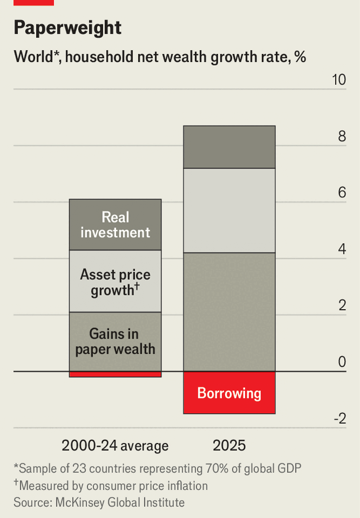 The problem isn’t the level — it’s the composition. Looking at the long-term average from 2000 to 2024, paper wealth accounted for about a third of household wealth growth. But look at 2025 alone, and that ratio jumps to nearly 60%. The share created through real investment shrank to just 20%. Wealth is growing fast, but the share of that growth coming from real assets is actually shrinking.
Nothing illustrates this more dramatically than the U.S. stock market. The market cap of U.S.-listed equities has climbed to 3.7 times U.S. GDP. Even at the dot-com bubble’s peak in 1999, that ratio never reached 2. The cyclically-adjusted price-to-earnings ratio2 sits near an all-time high of 37.7. More than half of the market-cap gains since 2021 have come from the Magnificent Seven — the seven AI Big Tech giants. MGI notes that for this valuation to be justified, “corporate profits need to keep growing faster than GDP over the long run” — and U.S. corporate profits already sit at 9.2% of GDP, more than 1.5 times the pre-2000 average of 5.9%. For that profit share to grow even further, labor’s or government’s share would have to keep shrinking — and at some point, that stops being an economic question and becomes a political one.
There’s one more thing worth watching. Debt — borrowing — has become a much more visible part of 2025’s wealth growth. Liabilities are a negative item in household net-worth calculations, but rising asset prices have outpaced rising debt, making the ledger look bigger than it is. Global debt already sits near an all-time high of 2.6 times GDP. A combination of rising prices and rising debt propping each other up is a pattern that has rarely ended well in financial history.
Four Paths to Closing the Gap
If the books have swollen to 5.1 times the real economy, that also means an adjustment still lies ahead — one where the books and reality meet again. MGI maps out four scenarios for how that could happen.
Path 1: Productivity acceleration. The real economy grows fast enough to catch up with the books. If GDP expands, today’s asset prices get justified after the fact. It’s the only one of the four paths where everyone wins, and MGI points to AI-driven productivity gains as the engine for this scenario. Today’s valuations are, in effect, the entire world’s bet on this path.
Path 2: A return to secular stagnation. Asset prices stay elevated, but growth doesn’t show up. If people keep favoring saving over spending, rates stay low, valuations stay high, and the economy just simmers. It’s essentially the 2010s, extended. Wealth on paper holds up, but the future that wealth can actually buy keeps getting thinner.
Path 3: Inflation. Prices rise and erode the real value of the books. Nominal figures stay the same while real wealth quietly melts away — the path where people notice the adjustment last. By MGI’s estimate, this path would wipe out roughly $95,000 in real per-capita wealth in the U.S.
Path 4: Balance-sheet reset. Asset prices collapse, and the books come down to meet reality. This is the fastest and most painful adjustment. Globally, stock prices are zero-sum, so even a crash leaves the world’s real assets untouched — but the loans, spending, and retirement plans built on top of those assets as collateral are not untouched at all.
At this fork in the road, there’s really one variable that matters. For Path 1 to happen, expectations about AI have to convert from stock-price paper into actual productivity. And for expectations to become productivity, there’s a physical stage they have to pass through: data centers, semiconductor fabs, power grids. The bridge connecting the world of the books to the world of the real economy is, in the end, the construction site.
And that construction-site story is the second scene.
Scene 2: The Day Letters of Intent Become Contracts
Let’s rewind a month. On June 29th, the “3 Mega-Projects National Briefing” was held at the State Guest House at Cheong Wa Dae [the presidential compound]. It laid out an ultra-long-term investment plan: ₩2,655 trillion (~$2.0 trillion) from Samsung Electronics and ₩2,100 trillion (~$1.6 trillion) from SK, totaling ₩4,755 trillion (~$3.6 trillion). The three-tier structure: semiconductors provide the computational foundation, AI data centers scale up computing power, and physical AI carries the results onto the factory floor. On data centers alone, the plan calls for laying 15GW of capacity nationwide by 2035. That means data centers alone would consume power equivalent to 11% of Korea’s entire generation capacity as of the end of 2021.
But that announcement was just an “intent.” Which company would be the customer, on what land it would be built, where the electricity would come from — all of that was left blank.
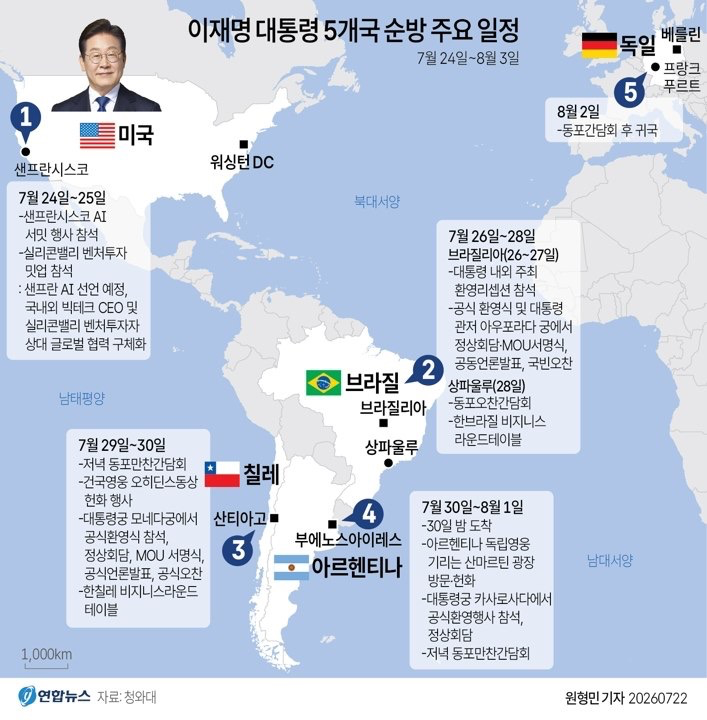 This San Francisco visit is where those blanks get filled in. Combining the briefing from Kim Yong-beom, Chief Policy Officer at the presidential office, with Bloomberg’s reporting, three things could emerge from this visit.
First, a long-term memory supply agreement between Samsung Electronics/SK Hynix and U.S. Big Tech. It would lock in HBM3 and DRAM supply over a multi-year horizon, and Kim went so far as to say the scale “could be even bigger than the previous ₩4,700 trillion.”
Second, joint investment in AI data centers. Of the government’s planned 8GW first-phase capacity, more than half — over 4GW worth of projects — could take shape during this visit, according to observers.
Third — and this is the most important part. Bloomberg reports that, unlike previous announcements, these memoranda will name specific customers, sites, and Korean engineering partners. Instead of “we intend to invest heavily in AI,” it will say “who is building what, where, and with whom.” That’s precisely the difference between a letter of intent and a contract.
But the shape of this deal is a little unusual. It isn’t inbound investment, and it isn’t an export contract. Korea puts up chips and capital; the U.S. puts up electricity, land, and GPU allocations. It’s the most primitive kind of transaction, being conducted by 2026’s most cutting-edge industry: a barter.
Why a Barter: Each Side Holds the Other’s Bottleneck
The reason this deal works is simple. Over the past two years, the AI infrastructure bottleneck has shifted, and the keys to that new bottleneck are split between Korea and the U.S.
In 2023–2024, the bottleneck was GPUs. How many Nvidia chips a company was allocated determined its fate. But starting in the second half of 2025, the bottleneck split into two.
One is memory. Last October, OpenAI signed a letter of intent with Samsung Electronics and SK Hynix for its Stargate project, covering up to 900,000 wafers a month of DRAM — equal to 40% of global DRAM production capacity. SK Hynix is essentially sold out through this year already. In the HBM market, SK Hynix holds 62% share, and together with Samsung, the two Korean firms control about 80%.
The other is power. The U.S. has the GPUs and the capital, but not the grid to plug data centers into. New data centers face years-long queues for grid interconnection, and land with secured power has become a scarce asset in its own right. So the card the U.S. can play is “sites with available power.” Land and electricity have become assets on the negotiating table.
That gives us a trade sheet.
What Korea offers: 80% of the world’s HBM production capacity, long-term supply commitments, capital for joint data center investment, and engineering firms with a track record of fast construction.
What the U.S. offers: sites with secured power, GPU allocations (last October’s APEC pledge from Jensen Huang of 260,000 units was the preview), and the market position of being the world’s largest AI demand center.
It’s a barter because these are things money can’t buy. The U.S. can’t speed up HBM capacity expansion just by having money, and Korea can’t jump the queue on the U.S. power grid just by having money either. Since neither side’s currency works on the other, they’re trading real assets for real assets.
Overlay this with the China story I’ve covered all this week, and the picture gets sharper. China is pouring state and Big Tech capital into DeepSeek, heading toward a self-contained ecosystem. The U.S., on the opposite side, is binding its allies’ real assets into its own infrastructure. Korean memory and capital flowing into U.S. data centers means Korea’s square on the supply-chain map moves one notch deeper into the U.S. camp.
But since the announcement hasn’t happened yet, let me flag three things worth watching.
First, is there enough power for both countries? Many observers note that the domestic 15GW plan’s success hinges on power infrastructure. Some estimates suggest the Yongin cluster alone would need power equivalent to 6-7 nuclear reactors. And now, securing power for U.S. data centers has been added to the negotiating table too. How capital and power get allocated between the domestic share and the U.S. share is the real challenge in this package.
Second, long-term supply contracts cut both ways. Memory is one of the most volatile industries in history. Right now, near the peak of a supercycle, a long-term contract looks like a safety net — but depending on how the pricing terms are structured, it could also end up handing the boom’s profits over to customers in advance. If an announcement mentions only “volume” without a “pricing structure,” read that as a sign that part is still under negotiation.
Third, the distance between an MOU and a contract. Much of this announcement is likely to take the form of memoranda of understanding. An MOU that names a customer and a site carries far more weight than a blank one — but breaking ground and delivering product are still separate matters. I’ll be watching how much “implementation machinery” is attached to this announcement, more than the size of the numbers.
Overlaying the Two Scenes: A Race Between Betting and Building
Now let’s lay the two scenes on top of each other.
What inflated the world’s wealth on MGI’s books is expectation about AI. The Magnificent Seven’s stock prices are the price tag on that expectation. But for that expectation not to end up as mere paper, we need the real-productivity gains that Path 1 requires. And that productivity can only be built on the physical substance of data centers, fabs, and power grids.
 Everything being contracted in San Francisco — the Korea-U.S. data center package, the ₩4,700 trillion mega-project, even the ₩11 trillion DeepSeek raised, which I covered last week — all of this money falls into the category MGI calls “net real investment,” the very item that made up just 20% of 2025’s wealth growth.
So here’s the race the global economy is running right now: the books are already priced as if Path 1 has succeeded, and the construction sites have only just started the work of justifying that price. The speed of expectation versus the speed of construction — if that gap narrows, we get Path 1; if it widens, we get Path 3 or Path 4. That’s why today’s barter in San Francisco isn’t just a diplomatic event. It’s part of the construction that will decide whether the world’s books end up as paper or become real.
Oz’s Lens
In my data-analytics lectures, I always tell students to ask one question first when looking at any metric: what is this number a proxy for? Wealth, as a metric, is supposed to be a proxy for the accumulation of the real economy. But right now the proxy has grown to five times the size of the thing it’s supposed to represent. Working with data, I often run into the moment when a metric detaches from the underlying reality and starts walking on its own — and from that moment on, the metric stops producing information and starts producing illusion. The MGI report is a diagnosis that the entire global economy has entered that state.
Holding that diagnosis and looking toward San Francisco, I read this deal not as an export record but as a shift in geopolitical positioning. In my GTM strategy consulting work, I’ve designed a lot of partnership negotiations, and I always use one test: if what each side puts on the table is “money,” it’s just a transaction. If what each side puts on the table is “something the other side’s money can’t buy,” that’s an alliance. This package is unmistakably the latter.
The change worth noting is that Korea’s leverage has shifted. For decades of Korea-U.S. economic negotiations, Korea’s cards were mostly “market access” and “investment pledges” — cards the other side never really needed. This time, for the first time, Korea is sitting at the table holding something real that stops the other side’s production line: memory. The moment OpenAI wants 40% of global DRAM, Korea shifted from being “the country asking to sell” to “the country deciding whether to sell.” Negotiating power comes from bottlenecks, not declarations. And ironically, MGI’s own books prove just how valuable it is, in an age of paper wealth, to be the country holding a real bottleneck.
There’s also something to view soberly, though. A barter binds two sides more deeply than a cash transaction does. If a large share of Korea’s memory production capacity gets locked into long-term deals with specific U.S. customers, that’s stable revenue, but it’s also strategic dependency. And the illusion of paper wealth isn’t just a U.S. stock-market story. More than 60% of Korean household assets are in real estate, and much of the growth in Korean household wealth over the past 20 years didn’t come from new homes but from rising price tags on homes people already owned. The moment you start treating rising asset prices as income and planning your spending and debt around it, the risks of Path 3 and Path 4 stop being someone else’s problem. The gap between the books and the construction site — today’s whole theme — applies just as directly to the Korean household balance sheet.
Closing
To sum up:
First, the world’s net worth has topped $600 trillion, 5.1 times GDP — but nearly 60% of 2025’s increase was paper wealth: prices rising with no new real assets behind them. Real investment made up only 20%.
Second, this gap closes through one of four paths: growth, stagnation, inflation, or collapse. Today’s asset prices are a bet on the first path — AI-driven productivity acceleration.
Third, the real construction that will decide whether that bet pays off is being contracted right now in San Francisco: a barter trading Korean memory and capital for American power, sites, and GPUs. What matters isn’t the size of the numbers, but three conditions — pricing structure, power allocation, and implementation mechanisms.
Once the announcement is finalized, I’ll follow up on where the actual terms match this structural analysis and where they diverge.
For the record, this piece is not investment advice, nor a basis for judgments about any specific company or asset. If you’re interested in related stocks, I’d recommend checking the original announcements, disclosures, and the MGI report directly.
Take a moment to think through your own list of assets. Of what’s grown over the past five years, what’s the ratio between “things I newly created or earned” and “things I already owned that simply rose in price”? Share a rough ratio in the comments, along with how you’re handling that paper share. I’ll gather your stories for a follow-up issue on personal finance.
💬 Tell me in the comments what percentage of your assets is the “paper share.” I’ll factor it into a follow-up issue. 📨 If you have a colleague in asset markets or the semiconductor industry, please forward this piece to them.
📎 References & Further Reading
Primary sources
- McKinsey Global Institute, “Out of balance: What’s next for growth, wealth, and debt?”, updated 2026.7.23. ··· The global balance-sheet research that forms the backbone of the first half of today’s piece. You can check the detailed figures for all four scenarios directly here.
- The Economist, “The world’s balance-sheet is out of kilter with its economy”, 2026.7. ··· The most concise explainer on the MGI update. The chart breaking down 2025’s wealth-growth composition is especially worth a look.
- AdvisorAnalyst, “The World’s Balance Sheet Is Bigger Than Ever. That’s Not Necessarily Good News.”, 2026.7.23. ··· A rundown of the detailed figures — U.S. equities at 3.7x GDP, corporate profits at 9.2%, and more.
- Bloomberg, “Samsung, SK Hynix Set to Unveil Major US Deals During Lee’s Silicon Valley Visit”, 2026.7.24. ··· The breaking news that kicked off the second half of this piece — the source for key facts like more than half of the 8GW taking shape, and named customers and sites.
- Financial News (Korea), “Kim Yong-beom: ‘Samsung, SK Hynix semiconductor deals to be announced at U.S. AI Summit… AIDC agreements with Big Tech too’”, 2026.7.24. ··· The full Korean-language transcript of the policy chief’s briefing. Contains the “could be bigger than ₩4,700 trillion” remark.
- ZDNet Korea, “President Lee’s ‘San Francisco Declaration’ before U.S. Big Tech… domestic AI players gather too”, 2026.7.24. ··· The most detailed rundown of the AI summit’s attendees and program.
Background
- Electronic Times (Korea), “Samsung, SK to invest ₩4,700 trillion in AI and semiconductors… 3 Mega-Projects kick off”, 2026.6.29. ··· Coverage of the June national briefing that was the parent event of this deal.
- e-Focus, “Samsung, SK’s ₩4,755 trillion investment: data centers alone need 15GW of power”, 2026.7. ··· An examination of what that 15GW power figure really implies — the basis for the “is there enough power for both countries” question.
- Tom’s Hardware, “OpenAI’s Stargate project to consume up to 40% of global DRAM output”, 2025.10. ··· The source for the key figure behind the “memory is the bottleneck” argument: 900,000 wafers a month.
- Hankook Ilbo, “Nvidia to supply 260,000 GPUs to Korea’s government, Samsung, SK, Hyundai Motor, and Naver”, 2025.10.31. ··· Last year’s APEC announcement that served as a preview of this deal.
- Counterpoint Research, “Global DRAM and HBM Market Share” ··· The underlying data behind the HBM market-share figures (SK Hynix 62%, roughly 80% combined for Korea).
- Fortune, “The world is awash in wealth but starved for productivity”, 2025.12.31. ··· MGI’s own researchers explain the Path 1 logic — “the only way out is AI productivity” — in their own words.
Related issues worth reading together
- The Four-Hour Video Call That Raised DeepSeek ₩11 Trillion ··· Another piece of capital that falls into today’s “20% real investment” category. Worth comparing against China’s very different capital structure versus the U.S. and Korea.
- Containment Made China Grow. Now It’s Locking the Door. ··· The flip side of the Korea-U.S. barter — the scene of China heading toward a self-contained ecosystem. Overlay the two pieces and the supply-chain map comes into view.
📝 Glossary

Footnotes
-
Paper wealth: Wealth that grows only on the books, without any new assets being created, because the price of existing assets rises faster than inflation. It works the same way as your house doubling in value while it’s still just one house. ↩
-
Cyclically-Adjusted Price-to-Earnings ratio (CAPE): A valuation metric that divides stock prices by average earnings over the past 10 years to strip out the illusions of the business cycle. The higher the number, the more expensive stocks are relative to earnings. ↩
-
HBM (High Bandwidth Memory): Memory that stacks DRAM vertically, like an apartment building, to create an extremely wide data pathway. It sits right next to the GPU and resolves the bottleneck in AI computation, so it sells alongside every GPU sold. It’s Korea’s strongest card in today’s AI infrastructure race. ↩
Related issues
The 4-Hour Video Call Behind DeepSeek's $7.4B Raise
In DeepSeek's record funding round, the winning strategy was simple: want less than everyone else.
Why Jensen Huang Praised Chinese AI Models
A same-day rebuttal to a sanctions warning — the answer lies in Nvidia's P&L
China Grew Under Containment. Now It Locks the Door.
U.S. sanctions meant to contain China ended up accelerating its self-sufficiency.
Your take shapes the next issue
Reply with your experience or perspective — the best responses feed into future issues.
Sign in to commentAny registered reader can comment — it takes 10 seconds.