
The Red Crayfish Is Disappearing From Search
Where did all those crayfish go?
Opening
Dear reader, in the newsletter I sent back in March, I covered the ‘crayfish craze’ that was sweeping China. It was about how OpenClaw, an open-source AI agent, had people lining up outside Tencent’s headquarters and was shaking up both the cloud market and the messaging ecosystem at once.
But two months later, that crayfish is rapidly disappearing from Google search.
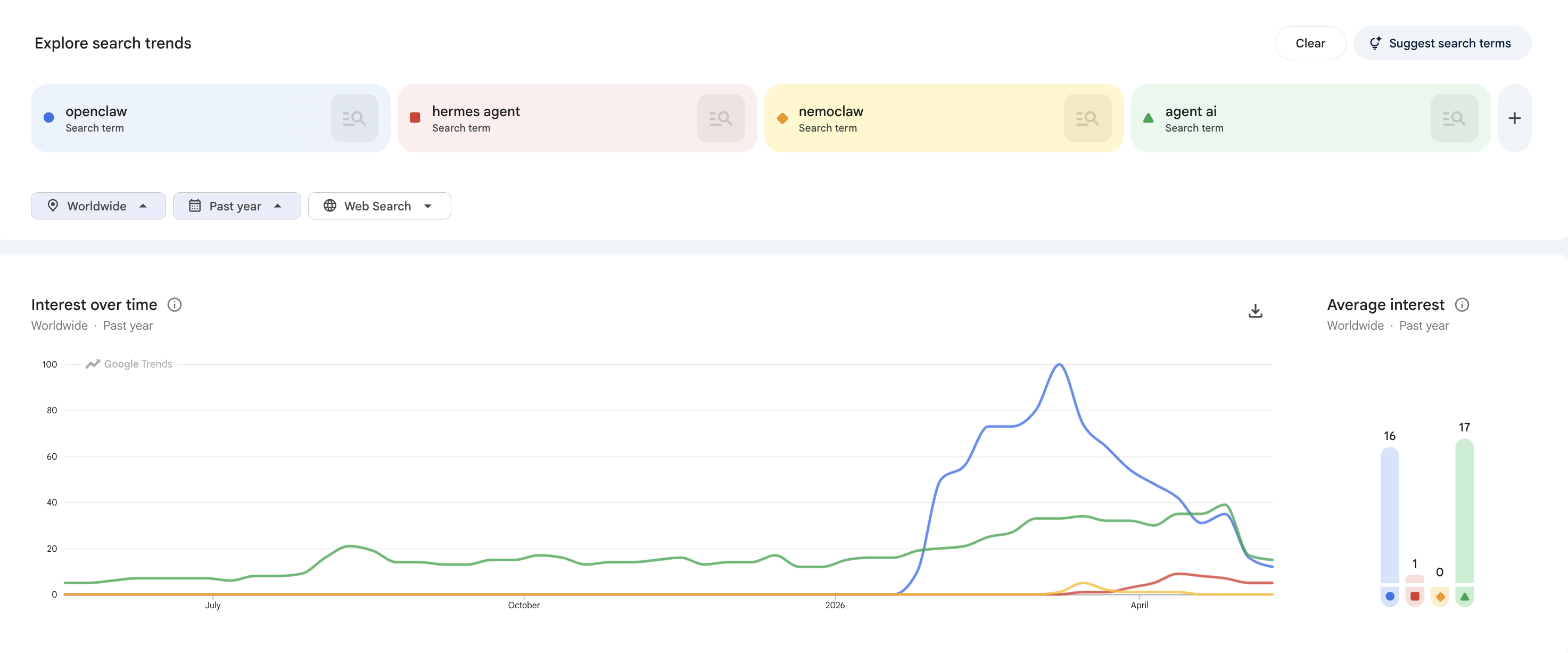
The Google Trends graph shows a dramatic shift. Search volume for “openclaw” peaked at 100 in April, then fell to 12 by May — a drop of roughly 88%. Hermes agent, the variant that got a lot of buzz in Korea, and nemoclaw, another clone, are both nearly invisible on the search graph too.
“Where did all those agents go?” Let me give you the answer up front: the agents haven’t disappeared. The word “agent” is disappearing. And this looks less like the death of a trend and more like the normalization of a category.
What the Search Graph Is Telling Us
Let’s start by reading the data carefully. There are four lines on the graph.
The blue line (openclaw) surged from mid-February, peaked at 100 in April, and has been dropping sharply since May, averaging 16 overall. The red line (hermes agent) ticked up slightly starting late April but averages just 1. The yellow line (nemoclaw) averages 0 — effectively no one is searching for it.
Then there’s the most important line: the green line (agent ai). It has held steady at an average of around 17 for the entire past year. It barely moved whether the crayfish craze was at its peak or on its way down. It briefly spiked to 36 in April before settling back to its normal level.
Two different stories are unfolding on the same graph at the same time.
One is the death of “tool names” (openclaw, hermes agent, nemoclaw). The proper nouns that were searched out of April’s curiosity are quickly fading. The other is the stability of the “category” (agent ai). The category those tool names once pointed to is holding at its usual baseline.
Words searched out of curiosity fade; the category survives. This simple pattern can explain the entire crayfish craze. Search is a function of curiosity. Once curiosity is satisfied, search disappears. But that doesn’t mean usage dies with it.
There’s data to prove this.
Related issues
🔒 North Korea Cited GPT-4 in an Official University Journal
Can Pyongyang actually build its own large language model?
🔒 Are the Growth Numbers in Press Releases Even Real?
We rarely know where or how a claimed "500% year-over-year growth" was actually measured.
🔒 The Day Meta Passed Its Tax Down to Advertisers
Europe taxed Big Tech, but it's advertisers and consumers footing the bill.
Your take shapes the next issue
Reply with your experience or perspective — the best responses feed into future issues.
Sign in to commentAny registered reader can comment — it takes 10 seconds.