
Right on the Trade, Liquidated Anyway
The real cause of last week's Korean market rollercoaster was someone else entirely
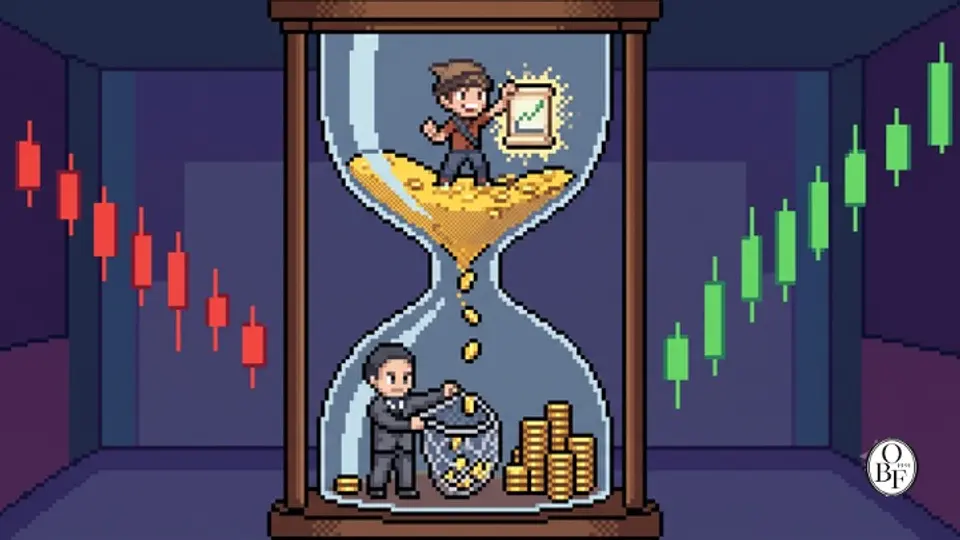
Opening
Reader, do you remember last Monday morning? At 8:00 AM on July 28, the moment NextTrade’s premarket—Korea’s alternative trading platform—opened, a single share of SK Hynix traded at ₩1,272,000, 29.99% below the previous close. The price bounced back into the ₩1,700,000 range soon after, but that one print alone was enough to trigger the liquidation of a derivatives position overseas. Four days later, on Friday, the KOSPI—Korea’s benchmark stock index—jumped 1,001.89 points, or 17.91%, setting a new all-time record for both the largest single-day gain in points and in percentage terms, simultaneously. SK Hynix closed at its daily upper limit, up 29.95%.
The same stock printed minus-30% and closed out the same week at plus-30%. What happened?
Here’s the short version: the depth and timing of this rollercoaster weren’t decided in Seoul—they were decided in a single office in San Francisco. A 25-year-old had built a balance sheet on borrowed money, one once valued at $45 billion, and the 30 hours it took for that balance sheet to collapse and get unwound were transmitted directly into Korean investors’ accounts. Today, I want to take apart those 30 hours and pull out one old lesson: the market pays the people who hold on, not the people who are right.
The 165-Page Essay That Became a $45 Billion Fund
Let’s start with the protagonist. Leopold Aschenbrenner. Born in Berlin, he entered Columbia University at 15 and graduated at 19, top of his class. He turned down a spot at Yale Law School to work in FTX’s philanthropic arm — and then FTX collapsed. His next stop was OpenAI. In April 2024, the company fired him, citing a confidentiality breach; he countered that the documents he’d shared contained no secrets, and that the real reason was a memo he’d sent the board flagging security concerns.
Two months later, he published a 165-page essay called “Situational Awareness.” It predicted superintelligence would arrive around 2027 — and went so far as to propose creating an investment fund to bet on that trajectory. The essay became required reading across Silicon Valley, and when strangers started reaching out with money in hand, he actually founded a hedge fund with the same name as the essay. That November, he raised $100 million from tech industry heavyweights, with early investors reportedly including the Collison brothers (founders of Stripe) and Nat Friedman.
Investor documents reviewed by The New York Times contain a striking clause: there are “no limits” on investment types, position concentration, or leverage1 usage. New York’s big money split on this. Blackstone, the world’s largest hedge fund investor, declined to invest, and one investor reportedly asked what the contingency plan was if AI didn’t pan out as expected — but got no concrete answer. Aschenbrenner apparently just genuinely believed everything would work out.
Still, performance silenced every objection. Investors reportedly told others the fund returned over 200% net of fees in 2025 alone; some tallies put returns at 439% in just the first half of this year, and over 1,000% cumulative since inception according to The Wall Street Journal. Reports say assets swelled to as much as $45 billion earlier this month. The New York Times, however, puts the figure at roughly $30 billion as of early July — I’ll get into why these numbers diverge later on.
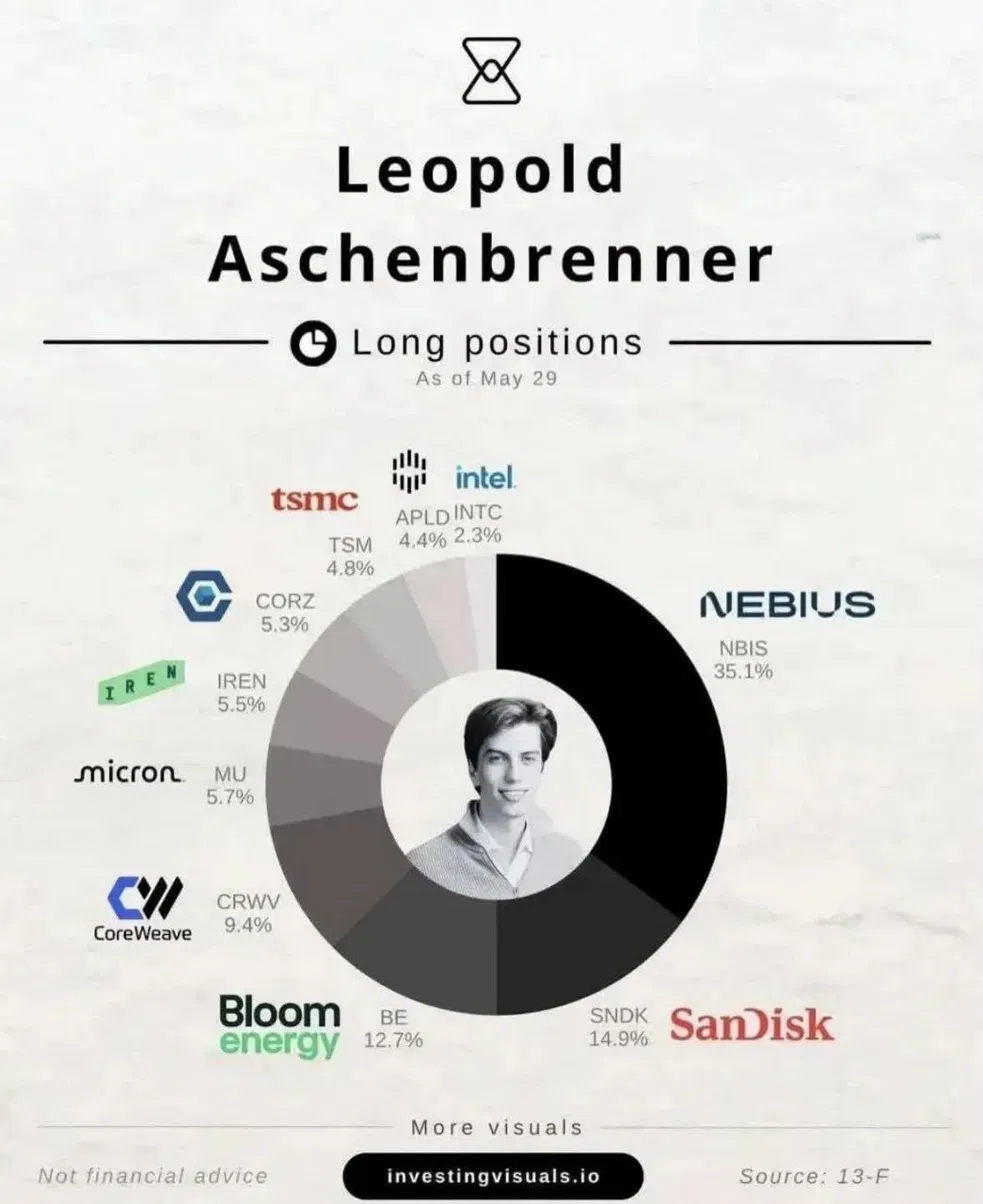 The portfolio was AI optimism made flesh. Per a disclosure filing as of late May, long positions in public stocks broke down as follows: Nebius 35.1%, SanDisk 14.9%, Bloom Energy 12.7%, CoreWeave 9.4%, Micron 5.7%. Outside what shows up in filings, the fund was a cornerstone investor2 in the SK Hynix ADR that listed on the Nasdaq this month — according to the FT, it expressed intent to invest up to $7 billion alongside Baillie Gifford and Coatue. On the flip side, it shorted software companies like Adobe, betting they’d be displaced by AI. In other words, this fund amplified a single AI worldview in both directions — long and short — using leverage reportedly reaching as high as 400%.
30 Hours of Forced Liquidation, and the Arithmetic of 4x
July was the problem. This month, the major holdings listed above dropped more than 35% in a single month. It was the result of spreading skepticism that AI infrastructure investment wasn’t translating into immediate revenue. But the real problem was on the other side. Software stocks like Adobe—supposedly destined to be steamrolled by AI—rebounded instead, so both the long and short positions moved the wrong way at once. The side he’d believed was a hedge became a second engine amplifying the losses.
Let’s look at the arithmetic of 4x leverage here. If you put up 100 million won of your own money, borrow 300 million won, and buy 400 million won worth of stock, a mere 25% drop in the share price wipes out 100 million won—your entire principal. This is precisely the point former hedge fund manager Martin Shkreli made about this incident: at 4x leverage, a 25% correction means elimination, and market prices are often set not by the whole body of investors but by the marginal 5% who use high leverage.
This month’s decline pulled that trigger. Goldman Sachs demanded repayment on part of its loans, and prime brokers3 like Bank of America and JPMorgan pressed him to meet margin requirements. Aschenbrenner himself described the situation in an investor letter this way:
“This was, in essence, akin to a bank run. It was a structure where one vulnerability begat another.”
A fund whose positions become known turns into prey. The moment the market knows a fund has no choice but to sell, selling that stock first becomes the rational move for everyone. And so began a 30-hour selling war. According to The New York Times, the fund had to unload roughly $20 billion worth of stock. At first it sought buyers by describing the holdings as risk-hedging assets, but what it actually contained were massive directional bets. Frightened prospective buyers backed away, and in the end, a phone call between Aschenbrenner and Ken Griffin in the early hours of Thursday sealed a deal for Citadel to acquire the position at a discount. The FT pegged the size of this block deal4 at roughly $16 billion—the largest emergency block deal in Wall Street history.
Wait—$45 billion and $30 billion, $20 billion and $16 billion. Why are the numbers so different? I think this discrepancy itself is the essence of the story. For a leveraged fund, the total position (including borrowed money) and the actual equity capital differ by multiples. The fact that you can’t even state a single figure for the fund’s size—it depends on when and by what measure you’re counting—that’s the true nature of a balance sheet inflated by borrowing.
And this deal is what produced last Friday’s surge. When a forced liquidation plays out in the open market, the order book floods with sell orders and triggers a chain reaction downward. But when an off-market block deal simply changes ownership, that entire process gets skipped. On news that the fear of forced selling pressing down on the market had disappeared, the Nasdaq 100 jumped more than 3%, and the following day the KOSPI rose 17.91%. It’s telling that the second-largest gain on record was 11.95%, on October 30, 2008—the day the Korea-U.S. currency swap was announced. The two biggest single-day surges in Korean stock market history both came not on days when fundamentals improved, but on days a rescuer appeared.
Here’s the summary. Last week’s decline began with worries over AI profitability, but what determined the depth of the drop and the timing of the rebound was one fund’s balance sheet. Price was set not by right or wrong, but by the maturity date of debt.
Déjà Vu from 1998, and What Remains
On the Thursday the sale news broke, Daniel Loeb of the hedge fund Third Point didn’t post a long commentary on X. He posted a purchase link to a book. “When Genius Failed” — the story of the 1998 collapse of the hedge fund Long-Term Capital Management (LTCM).
LTCM was, in its day, considered the smartest fund around — two Nobel laureates in economics and some of Wall Street’s best traders, running sophisticated models on leverage dozens of times its own capital. And the direction of those models was, for the most part, not wrong. The problem was that when Russia defaulted in 1998, the market moved longer and more irrationally than the models anticipated. The margin ran out before the positions could find their footing, and only after the Federal Reserve stepped in to broker a bailout, with 14 banks putting up money, was a market-wide contagion averted. In fact, many of LTCM’s bets eventually converged after liquidation. They were right — just not there to see it.
There’s a saying in markets, often attributed to Keynes though its actual origin is unverified: the market can stay irrational longer than you can stay solvent. 4x leverage was a device that shrank that “longer than you can stay solvent” window down to the space of a single 25% correction.
The line in Aschenbrenner’s letter that caught my eye most was this one:
“If AI equities have fallen sharply even as the technical and business fundamentals of AI companies have actually been improving, it is a natural consequence that our fund would also register substantial losses.”
This is probably true. There’s a decent chance his AI outlook will ultimately prove correct, too. But what this episode demonstrated is the opposite proposition: whether a forecast is right and whether a fund survives are separate variables. By the unaudited estimates disclosed in the letter, this fund’s performance this year was down 67% in July alone, while still up 80% year-to-date. Same strategy, same person, two very different numbers.
The seat of the winner is a familiar one too. Citadel’s Ken Griffin played the white knight during the 2006 Amaranth collapse as well, scooping up distressed assets for pennies on the dollar. But reading this acquisition simply as “Wall Street buying the AI dip” misses a layer. Some corners of the market read it differently: Citadel likely took the entire portfolio at more than 10% below market price while simultaneously shorting the index and related names to strip out directional risk. Indeed, once forced liquidation ended and short-covering kicked in, names like SanDisk and Nebius rebounded 15–35% off their lows — by which point Citadel had already locked in its margin of safety. Selling down the position gradually as volume recovers turns the gap between “the price someone was forced to sell at” and “the market price” into profit, regardless of whether AI goes up or down. Aschenbrenner bet borrowed money on a direction. Griffin bet his own money on the other side’s desperation. The ultimate winner of this game was the side that never traded on being right or wrong at all.
 Roughly $8 to $10 billion remains in the fund. Most of it sits in private assets, including the Anthropic stake (valued by the FT at roughly $5 billion). Private equity stakes carry wide latitude in valuation, so whether the number on the books is the real price won’t be confirmed until the next downturn. The “paper wealth” problem I covered in the last issue applies directly to this fund’s remaining assets. The fund hasn’t been liquidated — it has announced it will rebuild its public-equities book entirely with its own capital.
And this fund isn’t the only leverage left standing in the market. By Citadel Securities’ count, global leveraged ETF assets grew 4.6x, from $47 billion in June 2020 to $218 billion in June this year, with two-thirds of that — $147 billion — concentrated in semiconductor and tech stocks. Leveraged ETFs buy when the underlying rises and sell when it falls, mechanically rebalancing to hit their target multiple at every market close — meaning that in a downturn, they sell the same names at the same time of day, in unison, regardless of any fund manager’s judgment. Aschenbrenner’s margin call has been resolved, but the automatic sell machines moving in the same direction are still sitting there, wired up. And the fact that it’s Citadel of all firms that has mapped out the remaining leverage feels like a footnote revealing exactly who understands this game’s structure best.
Meanwhile, according to the New York Times, even as he juggled margin call5 phone calls and wedding invitations in the same week, his wedding is going ahead as planned. The only thing that changed in the office, apparently, was one newly hired security guard.
Oswald’s Lens
In my work doing GTM strategy consulting, I’ve watched this scene play out more than once: the market call was right, but the company died first. A founder nails the exact moment the market will open, then runs out of cash and shuts down six months before it blooms. Every time, I’ve confirmed the same principle: conviction about direction and the size of your bet are two separate decisions. The stronger your conviction, the more you want to raise the stakes — but survival isn’t determined by how strong your conviction is, it’s determined by whether you can survive the worst month. This incident is the hedge-fund version of that principle. Aschenbrenner may have been winning on the prediction, but he lost on position design.
As someone who works with data, let me add one more thing: whenever you look at a returns figure, always ask what this number is a proxy for. A 1,000% return since inception and a -67% month are two sides of the same strategy. A return that doesn’t account for volatility isn’t a measure of skill — it’s a measure of exposure. The next time you hear someone claim they made a few hundred percent off AI, ask about the leverage multiple before you ask about the return.
There’s something to credit here too, in fairness. Unwinding all the leverage within two days and owning up to responsibility — that speed of response is actually worth learning from. But as he himself wrote in his letter, the real principle of risk management is not to create that situation in the first place. I think that line is the most accurate summary of this whole episode.
And this isn’t just a hedge-fund story. Last month, data showed that daily trading volume in Korea’s single-stock leveraged and inverse ETFs hit ₩15 trillion. Betting your entire career on one company. Concentrating your business on a single client. Taking on debt because you’re sure you’re right. We’re all running leverage somewhere. The stronger your conviction that you’re right, the more you need a design that can survive the stretch where that conviction looks wrong — that’s the conclusion I keep coming back to, confirmed once again by this whole affair.
Closing
Here’s the summary.
First, the depth and timing of last week’s Kospi rollercoaster weren’t set by fundamentals — they were set by one AI hedge fund’s forced liquidation and a block deal. The largest single-day surge in the index’s history is, in effect, a record of the day a rescuer showed up.
Second, his AI thesis may not have been wrong. But in the face of leverage reported at up to 4x, being right and surviving were two different things — and the market only pays out to those who make it through.
Third, what’s left in the fund is unlisted equity with wide latitude for valuation, and what’s left in the market is $147 billion in leveraged ETFs concentrated in semiconductor and tech stocks. That’s the epicenter of the next bout of volatility.
For the record, this piece is not investment advice, nor is it a basis for judging any specific stock or fund. Please keep in mind that the figures in this piece are based on reporting and unaudited estimates as of publication.
Have you, Reader, ever been right on direction but failed to hold on? Investing, business, career — any of it counts. I’m just as curious about the opposite: times when deliberately dialing back conviction is what let you survive. Tell me in the comments, and I’ll gather the stories for a follow-up issue on the art of position sizing.
💬 Tell Reader about a time you were “right but couldn’t hold on” in the comments. I’ll fold it into the next issue. 📨 If you have a colleague who trades on leverage, forward this piece to them.
(Web version only) 📬 Curious what’s next? Subscribe · Cross-disciplinary analysis of tech, economics, and the humanities every Tuesday, Thursday, and Sunday at noon
📎 References & Further Reading
Primary sources
- The New York Times, “Inside the Meltdown of a Wunderkind’s A.I. Hedge Fund,” August 2026. ··· The in-depth reporting that forms the backbone of this piece. The 30-hour sale process and the “no constraints” investment memo both come from here. Worth reading alongside the report on the Citadel acquisition agreement.
- CNBC, “Leopold Aschenbrenner Situational Awareness fund: $45B to fire sale,” July 31, 2026. ··· A comprehensive account of the fund’s $45 billion peak and how the sale unfolded.
- Quartz, “Situational Awareness hedge fund margin call,” July 31, 2026. ··· Lays out the up-to-400% leverage, the drawdowns in key holdings, and the list of prime brokers involved.
- Newspim, “Citadel’s ‘Rescue of AI Semiconductor Stocks’,” July 31, 2026. ··· Provides context that the epicenter of the losses was SK Hynix ADRs, and details the participation of cornerstone investors.
- Nate News, “The SK Hynix-Triggered Derivatives Unwind and FT’s Tally,” July 31, 2026. ··· The source for the July 28 pre-market execution scene, the FT’s $16 billion figure, and the phrase “the largest emergency block deal on Wall Street.”
- Capital Market News, “Citadel’s Acquisition of Aschenbrenner Fund Shares,” August 1, 2026. ··· Explains why the block deal produced the rebound, framing it as a shift in how the overhang of shares was absorbed.
- Hankyung, “Kospi’s Historic Surge at Close: Market Report,” July 31, 2026. ··· The source for the 17.91% figure, the stocks that hit their upper limit, and the scale of foreign net buying.
Background
- Roger Lowenstein, When Genius Failed, Random House, 2000. (Korean edition: Cheonjae-deul-ui Silpae, lit. “The Failure of Geniuses”) ··· The very book Daniel Loeb linked to. It’s fascinating to read the 1998 LTCM collapse alongside this one.
- Leopold Aschenbrenner, “Situational Awareness: The Decade Ahead,” June 2024. ··· The original 165-page essay where all of this began.
- Aschenbrenner’s investor letter, July 30, 2026. ··· The letter made public through press reporting. It’s both the source of the quotes in this piece and worth reading as a document of crisis communication.
- Wall Street CN (华尔街见闻), “Leveraged ETF Asset Chart,” August 2026. ··· The source for the leveraged-ETF data compiled by Citadel Securities. Also offers a view from the Chinese-language market on reading this acquisition as a liquidity arbitrage.
- Seoul Shinmun, “Leveraged ETF Trading Volume Plunges,” July 31, 2026. ··· On the domestic single-stock leveraged ETFs that saw daily trading volumes of ₩12-15 trillion (~$8.7-10.9 billion). This is exactly why this story isn’t someone else’s problem.
Recommended past issues
- Why Did Jensen Huang Praise a Chinese Model? ··· Covers the Kimi panic and semiconductor correction that touched off this whole crash. A prequel to today’s piece.
- A World of Paper Wealth, Barter in San Francisco ··· A framework for understanding the valuation problems around the unlisted assets left in this fund — “paper wealth” and its four paths to adjustment.
📝 Glossary

Footnotes
-
Leverage: Borrowing money to add to your own capital and scale up an investment. Both gains and losses grow by that multiple — with 4x leverage, a 25% drop in the stock price wipes out all of your own equity. ↩
-
Cornerstone investor: An anchor investor who agrees in advance to take a large allocation before an IPO. In exchange for underwriting the offering’s success, they also absorb outsized losses if the stock drops right after listing. ↩
-
Prime broker: A division within a large financial institution that lends cash and securities to hedge funds and settles their trades. When collateral values fall, a prime broker can demand additional margin — making it, in a crisis, the entity that holds a fund’s fate in its hands. ↩
-
Block deal: A transaction in which a large volume of shares changes hands off-exchange, bypassing the public order book. It allows ownership to change without shocking the market with a sudden supply of shares. ↩
-
Margin call: A demand for additional collateral issued by a lender when the value of an asset purchased with borrowed money falls. If the shortfall isn’t covered in time, the asset gets sold off by force. ↩
Related issues
 Issue #174Business
The '57% Never Dated' Number Was Wrong From the Start
Fix the denominator and it drops to 21%—the real problem lies outside the dating statistics.
 Issue #173Business
The Luddites Never Actually Hated the Machine
What 65% of today's workers miss is the same thing Luddites once fought for
 Issue #172Business
The Day Tesla Stock Fell 14%, Musk Talked Abundance
Zuckerberg's op-ed dropped the day before Meta's earnings too — that timing wasn't an accident.
Your take shapes the next issue
What resonated most in this issue, or where has your experience been different?