
Yakult Ladies: Japan's Safety Net, Korea's Delivery App
The same probiotic drink delivery workers prevent lonely deaths in Japan and deliver credit cards in Korea.
Opening
Dear reader, did you know that Yakult’s image in Korea is quite different from Yakult’s image in Japan?
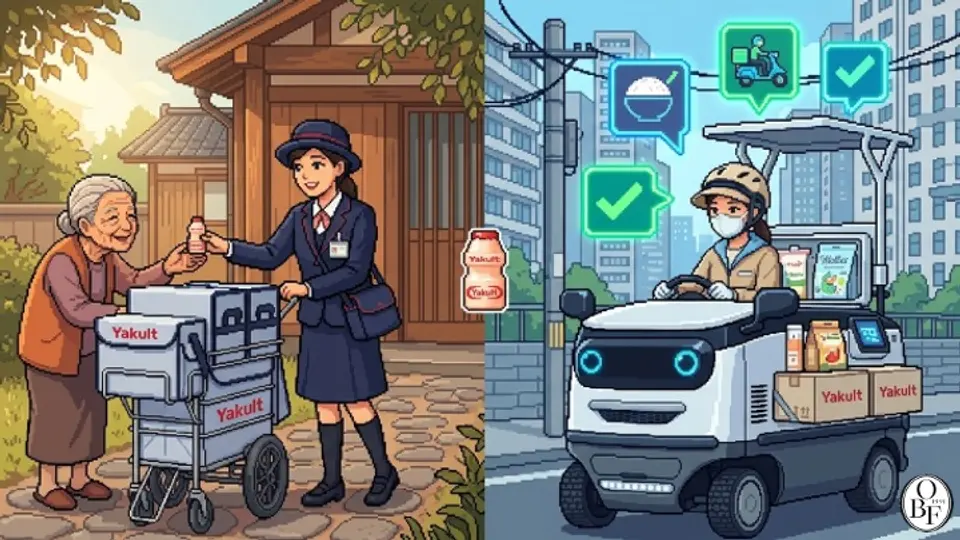
Last week, the BBC ran a fascinating story about how Japan’s Yakult Ladies function as an “informal social safety net.” It featured a Yakult Lady who has visited an elderly couple in their eighties in northwest Tokyo every Monday for 25 years. The couple put it simply: “After our children moved out, just having someone come to see our faces every week is a huge comfort.”
Around the same time, Korea’s hy (formerly Korea Yakult) was preparing to launch its own delivery app, “Hi-Knock.” The company is designing a future where its Fresh Managers deliver food instead of Yakult. Starting from the same root in 1971, the Yakult Ajumma (literally “Yakult auntie,” the term Korea uses for its Yakult delivery women) of these two countries are evolving in completely different directions. Today, let’s talk about what this fork in the road tells us.
Japan: How Probiotic Drink Delivery Became Lonely-Death Prevention
Japan currently has about 40,000 Yakult Ladies (Japan’s term for its Yakult delivery workers) in operation, out of roughly 80,000 worldwide. Their job is simple: every morning, they walk the same route to the same houses in the same neighborhood, delivering probiotic drinks. Each one visits 40 to 45 households a day.
But this simple repetition has produced an unexpected social function.
In Japan, 29% of the population is 65 or older. In the first half of 2024 alone, 40,913 people died of kodokushi—dying alone and unnoticed. That’s 3,686 more than the same period the previous year. The problem is serious enough that the Japanese government appointed a “Minister of Loneliness” in 2021.
Yakult Ladies are filling this gap. If they arrive at the scheduled time and find no sign of life, or if the last delivery is still sitting untouched, they flag it as a warning sign. As of 2020, around 3,000 Yakult Ladies, working at the request of 131 local governments, were making regular visits to more than 37,000 elderly people living alone.
How this system began is fascinating. A Yakult Lady in Fukushima heard about the lonely death of an elderly resident and started delivering Yakult to elderly people at her own expense. Her voluntary act moved local social workers and municipal governments, and it eventually spread nationwide as the “Courtesy Visit” program. One individual’s initiative spread through the entire company.
The same thing happened during the 2011 Great East Japan Earthquake. When Yakult’s Fukushima plant shut down and there was no product left to deliver, the Yakult Ladies made the call themselves and started delivering water and instant cup noodles to customers for free. At the time, the CFO proposed cutting staff, but CEO Hiromi Watanabe chose instead to keep every employee on payroll. Five months after production resumed, sales had recovered to the previous year’s level.
Korea: Same Network, an Entirely Different Equation
Korea’s hy also has about 11,000 Fresh Managers active nationwide, operating out of 550 logistics hubs and handling 5 million products a day. In sheer scale, it’s not far behind Japan. But hy’s view of this network is entirely different.
In 2021, the company changed its name from Korea Yakult to hy and declared its transformation into a “distribution specialist company.” It launched the online mall Fredit and began selling cosmetics, meal kits, and household goods alongside dairy products. The Fresh Managers’ refrigerated electric cart, “Coco,” no longer carries just Yakult—it now handles baby food delivery, partnered deliveries for household goods company Wisely, and even credit card delivery.
In 2024, hy acquired the delivery-agency platform Vroong (formerly Mesh Korea) and made a move into the delivery app market itself. It’s clearly picturing a future where Fresh Managers deliver food, not just Yakult. That’s not to say Korea’s Fresh Managers have zero caregiving function—according to hy’s own official materials, they also check in on about 30,000 elderly people living alone in Korea, and just last year, a Fresh Manager who discovered the scene of an elderly person’s lonely death received a commendation from the Minister of Health and Welfare. But this is closer to a side effect than the core of the business model. The company’s investment and strategic direction are pointed squarely at building a logistics platform. The caregiving work is, at most, a volunteer effort—part of its corporate social responsibility activities.
The numbers back this direction up. hy’s 2024 revenue was ₩1.6826 trillion (~$1.2 billion), up 10.8% year over year. Its B2B ingredient business grew 278%, from ₩3.5 billion (~$2.5 million) in 2020 to ₩10 billion (~$7.2 million) in 2021. Fredit’s revenue target is ₩100 billion (~$72 million).
Why the Same Network Evolved in Different Directions
What created this fork in the road wasn’t corporate choice—it was social conditions.
First, the two countries are at different stages of aging. Japan is already a super-aged society, with 29% of its population 65 or older, and the number of single-elderly households is projected to reach 11 million by 2050. At this stage, the gap in caregiving arrives first as a social crisis, not a business opportunity. Korea is still on the verge of becoming a super-aged society. Its pace is the fastest in the world, but right now, the market is hotter for “delivery competition” than for “caregiving demand.”
Second, the competitive environments are completely different. Korea is a fierce battleground for last-mile1 delivery, with Coupang, Baemin, Kurly, and Market Kurly all fighting for share. hy’s Fresh Manager network can serve as a differentiating weapon in this war, since it already has refrigerated delivery infrastructure in place. In Japan, by contrast, convenience stores (konbini) have already absorbed most of everyday life’s infrastructure—ATMs, utility bill payments, administrative document issuance, even parcel drop-off. Since 2017, Seven-Eleven has opened specialized stores in neighborhoods with a high concentration of elderly residents, handling meal delivery, move-in/move-out paperwork, and even large waste disposal. While convenience stores handle the “hard infrastructure,” Yakult Ladies have come to fill the “soft infrastructure”—human warmth—that convenience stores can’t replace.
Third, the institutional context differs. The Japanese government has made lonely death a national agenda item, and local governments have built systems by signing agreements with private companies to establish check-in networks. This system, called mimamori2—literally “watching over”—includes Yakult, mail carriers, and even gas meter readers. In Korea, care for elderly people living alone runs through a separate welfare system (such as the comprehensive support centers for elderly people living alone), so there’s relatively little incentive for a private delivery network to become institutionalized as a social safety net.
Oz’s Lens
In this story, I see hints about the conditions under which a private company becomes social infrastructure.
Yakult Ladies didn’t become a social safety net because Yakult’s headquarters declared, “We are a social enterprise.” It started when a single Yakult Lady in Fukushima began delivering drinks to elderly people at her own expense, and local governments recognized the value of this model and built institutional support around it. And the company didn’t resist this current. That’s the key point.
The Yakult Ladies’ caregiving function is a classic unintended market. It wasn’t designed from the start—it formed naturally when a byproduct of an existing business model happened to meet a social need. Markets like this are almost impossible to manufacture on purpose. What you need instead is an organizational culture capable of recognizing and embracing one once it has already formed.
hy’s choice to pivot into a platform is also a rational call. It’s natural for a company stuck at around ₩1 trillion in revenue to look for new growth engines. But I want to raise one careful question. Korea will enter a super-aged society similar to Japan’s within a decade. When that happens, the moment hy’s Fresh Manager network becomes most valuable might not be when the network has maximized its efficiency as a delivery platform—it might be the moment it becomes the one person who checks in on someone.
What Japan’s Yakult shows us is that the condition for a company to become social infrastructure isn’t technology or capital—it’s the sustained continuity of repeated face-to-face contact. In Japan, it’s not just Yakult; convenience stores like Seven-Eleven are also filling in gaps in social welfare that the government itself can’t cover. In a world being optimized by AI, the most irreplaceable asset might, ironically, be “the person who knocks on your door every Monday.”
Closing
To sum up: Japan’s Yakult Ladies converged into an informal social safety net under the conditions of a super-aged society, while Korea’s Fresh Managers expanded into a logistics platform under the conditions of last-mile delivery competition. It’s a case of the same business model producing entirely different value depending on social context.
By the mid-2030s, when Korea enters a super-aged society, what role will hy’s 11,000-strong network—now pursuing platform expansion—end up playing? That’s partly a matter of corporate choice, but it’s also a matter of what role society decides to assign that network. Japan’s example shows that this role isn’t designed from above—it’s made on the ground first.
References & Further Reading
- BBC, “The yoghurt delivery women combatting loneliness in Japan”, 2026.03.: An in-depth report on the role Japan’s Yakult Ladies play as a social safety net.
- Yakult Corporate, “Yakult Ladies Social Pioneers”: Yakult’s Japanese headquarters’ official summary of the Yakult Ladies’ social contribution activities.
- Harvard Business School Working Knowledge, “Why Japanese Businesses Are So Good at Surviving Crises”, 2020.: An HBS case study covering Yakult’s response during the Great East Japan Earthquake.
- Deokyoung Lim, “Japan’s Check-In Services: The Potential of Multi-layered Care Combining IoT and Human Contact”, International Social Security Review Vol.12, 2020.: An academic analysis of Japan’s mimamori service system, including a comparison with Korea’s support for elderly people living alone.
- KOTRA, “Japanese Convenience Stores’ Strategies for Serving the Elderly”, 2017.: A report summarizing Seven-Eleven Japan’s strategy for elderly-focused stores.
- The Value News, “hy’s ‘Fresh Managers’: The Evolution of the Yakult Ajumma”, 2026.01. An article covering hy’s business diversification alongside the Fresh Managers’ caregiving function. There’s also a video I personally follow on Shuka World that does a great job explaining how convenience stores (konbini) like Seven-Eleven function as national infrastructure in Japan.

The author, Kwangseob Ahn, is a professor of business administration at Sejong University and lead consultant at OBF (Oswarld Boutique Consulting Firm). He teaches statistics and data analysis — business data management and business analytics — while leading GTM and AI strategy consulting in the field, designing the seam between technology and business. He has published academic research on a memory architecture for AI dialogue systems (HEMA) and runs Daily Arxiv, a daily curation of global AI papers. He holds a master’s from Korea University’s Graduate School of Technology Management and a KMBA. He is the author of Homo Brainless: The People Who Outsource Their Thinking.
Footnotes
-
Last mile: In logistics, this refers to the final leg of delivery—from the last distribution hub to the customer’s door. More than 50% of total delivery costs occur in this segment, making it a key competitive battleground for logistics companies. ↩
-
Mimamori (見守り): A Japanese word meaning “to keep watching over.” It’s not a legally defined term, but it’s used broadly to refer to activities that check in on elderly people living alone and prevent social isolation. It refers to a multi-layered care system involving local governments, private companies, and community residents together. ↩
Related issues
 Issue #31Society
AI Firms' Ethical Red Lines Collapse in Wartime
Principles are easy to set in peacetime — war is where they're actually tested.
 Issue #30Society
How Huxley's 1961 'Law of Technology' Became the Algorithm
Technology was built to serve us—now we exist to serve it.
 Issue #15Society
Companies Want to Hire, Korea's Youth Don't Want to Go
The government and corporations shook hands perfectly—the only thing missing is the young workers' consent.
Your take shapes the next issue
What resonated most in this issue, or where has your experience been different?