
3,800 Hours of Speech: Inside a Brain Implant's Record
In March, brains trained robots. This time, a brain reclaimed its voice.
Opening
Training Robots with Brainwaves? Here’s Why China and the US Are Betting Big Right NowAI’s next textbook isn’t a book — it’s the human brain itself.Dear reader, back in March I sent you a newsletter titled “Training Robots with Brainwaves?” It was about extracting human brainwaves and feeding them to robots — in short, a story about lending out the brain. But the paper published this week in Nature Medicine runs in exactly the opposite direction. It’s a record of implanting electrodes in a brain to give someone who had lost speech their voice back.
Casey Harrell, 47, an ALS1 patient and climate activist. Over three years with a chip in his brain, he’s racked up some numbers: 3,800 hours of independent use, 2 million words, 56 words per minute. The bottom line: what these numbers prove isn’t accuracy — it’s independence. And that shift is redrawing the entire landscape of BCI2 technology.
3,800 Hours of a Man Who Lost His Voice
Casey Harrell’s story goes back to July 2023. David Brandman, a neurosurgeon at UC Davis, implanted four microelectrode arrays into Harrell’s left precentral gyrus3. 256 electrodes in total. What they do is simple: they read, in real time, the electrical signals the brain’s motor cortex generates when Harrell “attempts” to speak.
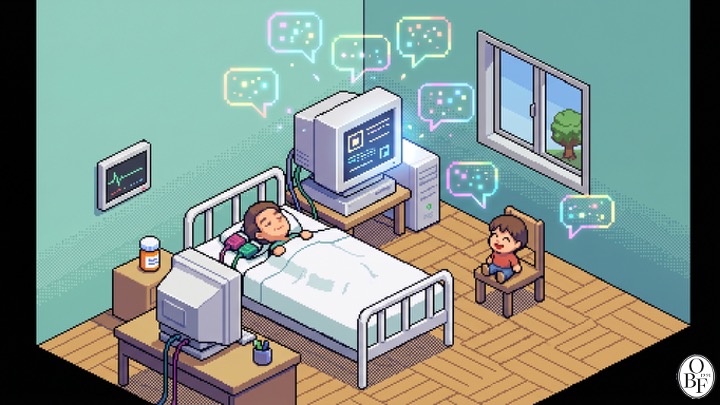
Here’s the crux of it. ALS has paralyzed his mouth muscles so he can’t actually produce sound — but his brain is still sending speech commands. The electrodes capture those commands, and machine-learning software decodes the patterns phoneme by phoneme, converting them into text. That text is then rendered as sound through a voice synthesizer cloned from Harrell’s voice before his ALS onset. His daughter has never heard her father’s “real” voice — but thanks to this device, she can hear him read her a book.
Here’s a summary of the key findings from the paper, published in Nature Medicine in June 2026:
- 3,800+ hours of independent use at home (without researcher supervision)
- 183,000 sentences, roughly 2 million words generated
- 99% accuracy in controlled settings, 92% accuracy in everyday use (self-reported by Harrell)
- Average speed of 56 words per minute (comparable to slow conversational speech)
- A working vocabulary of about 125,000 words — nearly every word an adult English speaker uses day to day
Impressive as these numbers are, the real significance lies elsewhere. Until now, the bottleneck in BCI research wasn’t “accuracy” — it was “independence.” No matter how accurate a system is, if a researcher has to sit beside you every single time to set it up, that’s a tech demo, not a tool for living. In Harrell’s case, a caregiver simply plugs two docking ports into a computer each morning, and from there he runs the system independently for 12+ hours straight. He writes emails, browses the web, and maintains a full-time job as a climate activist. Over time, the research team has added features like a privacy mode and a profanity filter — the latter to prevent decoding errors from producing swear words when he talks with his daughter. Details like this could never emerge from a lab. They only surface when a real person is using the system every day of their real life.
The BrainGate2 clinical trial that Harrell is part of has been running for more than 20 years. The first 17 years focused on “point-and-click” — moving and clicking a cursor with brain signals — before the project pivoted to speech decoding in recent years. As lead researcher Brandman put it, BCI had spent years as a proof-of-concept device confined to controlled labs, and it has now crossed that threshold. He compared BCI’s current position to pacemakers in the 1950s, when they had to be plugged directly into a battery mounted on the wall. Seventy years later, pacemakers are routine devices implanted through outpatient procedures.
From 67 to 150: Crossing the Tipping Point
Harrell isn’t alone. The entire BCI field is in the middle of a rapid inflection point.
In 2024, a team led by Michelle Patrick-Krueger (then at the University of Houston) published a roundup paper cataloguing every BCI clinical trial conducted from 1998 through the end of 2023. The result: 21 research groups, 67 volunteers total. In 25 years, only 67 people worldwide had ever had electrodes implanted in their brains.
But according to Mariska Vansteensel, a BCI researcher at Utrecht University Medical Center, that number has more than doubled since 2024. The current estimate is around 150 people.
Both companies and nation-states are driving this surge.
On the corporate side, Neuralink announced that as of January 2026 it had implanted chips in 21 people. Its first patient, Noland Arbaugh (29, quadriplegic), moves a cursor, plays games, and posts on social media using thought alone. Neuralink has signaled a shift toward high-volume production and nearly fully automated surgical procedures in 2026, saying its surgical robot R1 now achieves single-electrode insertion in 1.5 seconds at depths beyond 50mm, covering 99% of human brain anatomical variation.
Synchron, which takes a transvascular approach, threads a stent-shaped electrode array (the Stentrode) into brain veins via catheter — no skull-opening required. It raised a $200 million Series D in November 2025 and is preparing an FDA pivotal trial for 2026. Precision Neuroscience, which places electrodes on the brain’s surface, and CorTec, which is developing a fully implantable wireless BCI, are also running clinical programs.
On the national-policy side, the most notable mover is China. My March newsletter noted that “China is systematically laying down a technology → standards → industrialization pipeline” — and its first concrete result has now arrived.
On March 13, 2026, China’s NMPA (National Medical Products Administration) approved NEO, made by Shanghai-based Neuracle Technology. It’s the world’s first invasive BCI to move past clinical trials and receive approval as a commercial medical device. NEO is a coin-sized wireless device placed on top of the dura mater4, meaning it doesn’t penetrate brain tissue. It targets quadriplegic patients aged 18–60 with cervical spinal cord injuries, and restores hand-grasping function through a pneumatic glove. The clinical evidence base: 36 implantations (4 feasibility + 32 multicenter confirmatory), 18 months of follow-up, and zero serious device-related adverse events.
What’s even more striking is the speed after approval. Just 48 hours after NMPA clearance, China’s National Healthcare Security Administration (NHSA) assigned NEO a reimbursement code for medical consumables — something the industry dubbed “hyper-speed coding.” Three months later, on June 11, Neuracle filed for an IPO on Shanghai’s STAR Market, targeting to raise 2.5 billion yuan (~₩345 billion). Of that, 1.54 billion yuan is earmarked for BCI research and 410 million yuan for production facilities.
Here’s the comparison: Neuralink has implanted more than 20 people, but all of it under research protocols; FDA market approval isn’t expected before 2028–2029 at the earliest. China hasn’t just pulled ahead technologically — it’s already laid down the institutional pipeline of approval → reimbursement → capital markets first.
What We Still Don’t Know: Why BCI Sometimes Stops Working
Read this far, and it might seem like BCI is about to become an everyday medical device. But there’s one uncomfortable fact.
Sometimes BCIs simply stop working — and scientists still don’t know why.
Most BCI trials to date have focused on spinal cord injury patients. These patients can’t move their limbs, but in many cases their facial expressions and speech are unaffected. Data on ALS patients is comparatively much scarcer.
The problem lies in how ALS progresses. It’s a disease that progressively destroys motor neurons. Early on, only the limbs are paralyzed (Locked-In Syndrome), but it can eventually progress to a state where even eye movement is lost — Completely Locked-In State (CLIS). And in some cases, patients whose BCI worked well early on lost their ability to control the BCI as they progressed to CLIS.
Why this happens isn’t clear yet. There are several hypotheses: the feedback loop breaking down due to vision loss, a shift in goal-directed cognition itself, or changes in the pattern of evoked potentials5. None of them is confirmed. A 2022 case report in Nature Communications documented successful BCI-based communication in a CLIS patient — but that’s a single case.
This is exactly why Casey Harrell’s record is exceptional. Three years of stable operation is the strongest evidence yet that long-term BCI use is possible in ALS patients. But as the research team itself acknowledges, one success story doesn’t mean the same applies to every ALS patient. How neural signals change as the disease progresses, and how a BCI might adapt to that change — these are questions that can only be answered with more volunteers and longer studies.
Oz’s Lens
Having covered “feeding brainwaves to robots” in March and now covering “implanting technology in a brain to restore speech,” the dual nature of BCI technology comes into sharper focus for me.
On one end, human brainwaves are being extracted and used as training data for robots. On the other, technology is being implanted into the brain to restore lost abilities. Extraction and restoration — two ends of the same technology. The question I raised in March — “whose brainwaves are these?” — reappears in a different form on the restoration side: “Whose brain gets this technology, and who bears the cost and responsibility?”
From my experience building GTM strategy, there’s always the same pattern in the moment a technology leaves the lab and enters the market: securing the first real-world user is the hardest and the most important step. Calling Casey Harrell BCI’s “first power user” isn’t just a flourish. 3,800 hours of real-world usage data is evidence that no controlled experiment can replace. Pacemakers went from wall-mounted battery devices to outpatient procedures over 70 years — BCI is on the same trajectory now. The pace, though, could be much faster.
Closing
To sum up:
First, Casey Harrell’s 3,800 hours is evidence that BCI has crossed the threshold from “lab demo” to “everyday tool.”
Second, the number of BCI implant patients worldwide has more than doubled from 67 to 150 in just two years, and China has moved to seize institutional first-mover advantage with the world’s first commercial BCI approval.
Third, we still don’t know why BCIs stop working in ALS patients — and answering that question will require more volunteers and longer studies.
Do you think BCI technology will remain a “medical device,” or will it become an everyday interface like the smartphone? Leave a comment and let me know.
References & Further Reading
Primary sources
- Card, N. S. et al., “Brain-computer interface enables independent, accurate communication for man living with ALS”, Nature Medicine, 2026.
- Patrick-Krueger, M. et al., “A roundup of all trials of BCIs conducted between 1998 and 2023”, 2024. A comprehensive census of BCI clinical trials from 1998 to 2023 — the paper that gives us the baseline of 21 groups and 67 people.
- MIT Technology Review, “Brain-computer interface trials are taking off”, June 19, 2026. A comprehensive rundown of the surge from 67 to 150 patients and the state of major companies and academic teams.
Background
- MIT Technology Review, “China has approved the world’s first invasive brain-computer chip — here’s what’s next”, June 1, 2026. An in-depth look at the background and significance of Neuracle’s NEO approval.
- Paradromics, “China’s Recent BCI Developments & What They Mean for the U.S.”, April 30, 2026. An analysis of China’s institutional first-mover strategy from the perspective of a US BCI company — it makes the speed gap in the approval–reimbursement–capital markets pipeline very clear.
- Nature, “At-home brain implant gives man with motor neuron disease his daily life back”, June 15, 2026. Nature’s news team’s writeup of Harrell’s case, including expert commentary on the possibility of signal degradation over long-term use.

The author, Kwangseob Ahn, is a professor of business administration at Sejong University and lead consultant at OBF (Oswarld Boutique Consulting Firm). He teaches statistics and data analysis — business data management and business analytics — while leading GTM and AI strategy consulting in the field, designing the seam between technology and business. He has published academic research on a memory architecture for AI dialogue systems (HEMA) and runs Daily Arxiv, a daily curation of global AI papers. He holds a master’s from Korea University’s Graduate School of Technology Management and a KMBA. He is the author of Homo Brainless: The People Who Outsource Their Thinking.
Footnotes
-
ALS (Amyotrophic Lateral Sclerosis): a neurodegenerative disease that progressively destroys motor neurons. It starts with paralysis of the limbs and eventually affects speech, swallowing, and breathing. Also known as Lou Gehrig’s disease. ↩
-
BCI (Brain-Computer Interface): technology that reads electrical signals from the brain to relay commands to a computer. This is the flip side of the same technology I introduced in March for training robots. ↩
-
Precentral Gyrus: the region of the cerebral cortex that sends voluntary motor commands. Because the motor cortex responsible for speech sits here, speech BCIs primarily read signals from this area. ↩
-
Dura Mater: the outermost of the three membranes surrounding the brain. Neuracle’s NEO places its electrodes on top of this membrane, so it doesn’t directly penetrate brain tissue. ↩
-
Evoked Potential: an electrical signal generated by the brain in response to a specific stimulus (sound, light, touch, etc.). It’s one of the key signals BCIs use to read a user’s intent. ↩
Related issues
The Agency That Stole a Logo, and a Word Called 'GEO'
'Guaranteed exposure' and 'algorithm domination'—these two phrases are the scam signal.
The Price of Not Looking at China Properly
Two large-scale studies show Western scientists barely cite Chinese papers — and Korea has the same blind spot in batteries and chips.
The Houseplant That Talked to Me
The moment we can speak to something, we start a relationship with it.
Your take shapes the next issue
Reply with your experience or perspective — the best responses feed into future issues.
Sign in to commentAny registered reader can comment — it takes 10 seconds.