
The 4-Hour Video Call Behind DeepSeek's $7.4B Raise
In DeepSeek's record funding round, the winning strategy was simple: want less than everyone else.
Opening
Dear reader, one day in mid-May, some of China’s busiest investors received a single link to a Tencent Meeting call (think of it as China’s version of Zoom). Each institution was allowed 2 attendees. On the other side of the screen was Liang Wenfeng, founder of DeepSeek. The call ran 4 hours, and Liang answered 118 questions. As the story goes, one investor spent so long on self-introduction and then fired off 3 long questions in a row that after finishing his answer to the second one, Liang had to ask, “What was the third question again?” — and still answered it in full.
A full transcript of this meeting was released by Chinese media this week. And the deal it closed came to over ¥50 billion — about ₩11 trillion (~$7.4 billion). It’s the largest “first” external funding round in the history of Chinese AI startups.
But there’s something odd if you actually read the transcript. In a meeting called to raise money, the one thing Liang Wenfeng repeated for 4 straight hours was, “We have no intention of wanting more.” Let me give you the conclusion up front: I think this paradox wasn’t decoration on the deal — it was the mechanism itself. Today, I want to unpack the structure behind a story where the person who wanted the least ended up raising the most money, on the best terms.
What the ₩11 Trillion Video Call Locked In
Let’s start with the facts. Last June, DeepSeek closed its first external funding round since the company was founded in 2023. The raise topped ¥50 billion (about $7.4 billion, or roughly ₩11 trillion), and the post-money valuation came in at around ¥400 billion — about $59 billion. That’s the price tag placed on a company that, until now, had run entirely on capital from the hedge fund Huanfang Quant (known internationally as High-Flyer) without taking a single outside dollar — and it got this valuation on its very first round. Some analyses put the jump nearly 7x above earlier estimates.
The investor list is impressive too. Pooling the reports together: Tencent put in around ¥10 billion, CATL about ¥5 billion, and JD.com, NetEase, and IDG Capital each contributed roughly ¥3 billion, while the National AI Industry Investment Fund added about ¥1 billion. Among the VCs, besides IDG, names like Monolith (a new fund founded by Cao Xi, a former Sequoia China partner) and Zhengxin Valley (Royal Valley Capital) appear on the list. According to Chinese venture-media analysis, only about 10 institutions show up on the surface, but peel back just one layer of each fund’s limited partners and you find close to 100 institutions and individuals involved — from local-government state capital to insurers to listed companies. This is, in effect, a “national-team round.”
But two things about this list are genuinely striking.
First, the single largest investor is Liang Wenfeng himself. The founder personally put in around ¥20 billion — roughly 40% of the entire round — and did so through a limited partnership1 he himself controls. It’s a structure where taking in outside money somehow makes his grip on the company tighter, and Forbes called this “the catch” of the deal. A founder who contributed more of his own money than anyone else, in a round meant to raise money from others — there’s no clearer illustration of where the negotiating leverage actually sat.
Second, a name you’d expect to see is missing. Sequoia China (now rebranded HongShan) and Hillhouse — two names so central to Chinese venture capital that it would be strange for them not to appear in a deal this size — don’t show up on the final list. Chinese media have floated various theories for their absence, from the structure of their overseas LPs to other factors, but none of it is confirmed. What’s certain is only the outcome: two firms nearly synonymous with Chinese venture capital stood outside what may be the hottest deal in the history of China’s VC industry.
”Whoever Wants More, Loses”
Now let’s step inside the meeting itself. The line quoted most often from the transcript is this one:
“Let’s say AGI ends up accounting for 20% of GDP. Whoever wants 5% of that loses to whoever wants 1%, and whoever wants 1% loses to whoever wants 0.1%.”
He said this in front of investors who had come to hand over money — that the side wanting less would win. And throughout the meeting, he backed it up with examples showing it wasn’t just talk.
Pricing is the clearest example. When DeepSeek launched one model, Liang says he initially set the price high out of fear that demand would overwhelm capacity, then later cut it to a quarter (1/4) of that. The team’s group chat erupted in celebration, he said: “We worked hard to build this model so everyone could use it freely, and now that reason has actually come true.” He’s just as unenthusiastic about the API business itself: “You just need a handful of people to maintain it — no sales, no customer support, users show up on their own. I don’t think it’s that attractive a business.”
He’s equally blunt about becoming a super-app: “We have zero interest in being the next ByteDance or the next Tencent.” Neither last year’s chatbot wars nor this year’s race for enterprise revenue interest DeepSeek. In his framing, there’s a watermelon sitting right in front of you, and these are just sesame seeds. Open source runs on the same logic. The model DeepSeek uses internally is the same one it releases publicly — nothing better is kept in a drawer. Liang’s calculation: “If you want 100x margins, open source gets in your way. But if you’re content with reasonable margins, it makes no difference at all.”
And in exchange for all this restraint, he asked investors for exactly one thing. Not equity terms, not a board seat. “Don’t poach DeepSeek’s people, and don’t encourage them to leave and start their own companies.” Liang said team stability matters more than money or resources, and that it’s DeepSeek’s biggest risk and its biggest challenge. Which means that in this ₩11 trillion round, the asset the founder most wanted to protect wasn’t capital — it was people.
It’s worth flipping this over once. This restraint isn’t kindness — it’s calculation. Liang himself says, “restraint is a strategy.” Give something up, and you gain something else. Open source and low pricing generate a sense of accomplishment among employees, cohesion within the organization, and goodwill across the industry and society at large. He even says he’d gladly help rivals like Alibaba, Zhipu AI, or Moonshot AI, as long as they don’t poach his people. When a company makes no enemies, its model turns the entire ecosystem into its distribution network. DeepSeek’s de facto status as “standard infrastructure” within China’s AI landscape is the result of this attitude. Wanting less created a bigger position.
What ₩11 Trillion Actually Bought Wasn’t Equity
So why did DeepSeek need the money at all? The roadmap laid out in the transcript gives the answer.
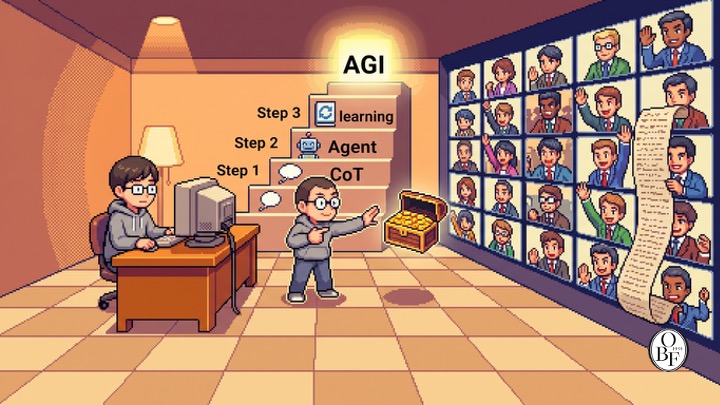 Liang Wenfeng compares the path to AGI to a staircase. Last year’s step was chain-of-thought reasoning (CoT)2; this year’s step is agents; and the next step is continuous learning3. His diagnosis: “What AI lacks right now isn’t taste or intuition — it’s the ability to keep learning.” A person learns by doing a job; AI, given the same task, has to be re-fed the entire context every time, which is why it can’t replace an employee. That’s why the first customer for DeepSeek’s next-generation model isn’t an external user — it’s DeepSeek itself. “Our first goal isn’t a model that’s easy for everyone to use — it’s a model that’s easy for us to use. That’s the fastest path to AGI.” The step after that is a gradual singularity in which AI accelerates AI research itself, and at the very end of that path lies embodied intelligence4 — AI that moves out into the physical world. The near-term priority is clear: focus on general-purpose agents, especially coding agents, and push verticals like finance and healthcare down the list.
Climbing this staircase requires two things. One is compute. Of everything said in the meeting, I found this line the most honest: “We’re not training models of this size because we think this size is enough — it’s because this is all the resources we have.” It’s an admission that DeepSeek’s famous low-cost approach was born of constraint before it was ever a virtue. The transcript reportedly also carried some optimism that the remaining gaps in China’s domestic chip ecosystem would be resolved before long.
The other is the team. The fact that this round’s only condition was “don’t poach our people” reveals something when you flip it around: the real bottleneck in China’s AI race isn’t capital, it’s talent flight. DeepSeek’s researchers have consistently ranked among the most sought-after recruiting targets in China’s AI industry, and there have been repeated reports of Big Tech companies trying to poach them. Liang says this funding round has “largely resolved our biggest risk, which is team stability.” So what this ₩11 trillion actually bought wasn’t growth rate or market share — it was a safety net to keep the team from cracking, and time to climb the next step.
Let’s zoom out on the bigger picture too, because it fits neatly with the story we’ve been following this week. As we covered two days ago, China has begun locking down AI models and chips as national assets; as we covered yesterday, the U.S. has split internally over Chinese open models. Right in the middle of that, China poured strategic capital from Tencent and CATL, a national fund, and the founder’s own money into its anchor AI company. If the U.S. funneled market capital into OpenAI, China put state capital, Big Tech capital, and personal capital all into the same boat with DeepSeek. Two countries are fighting the same frontier race with completely different capital structures.
Oswald’s Lens
In my work doing GTM strategy consulting, I’ve had a number of chances to watch startup fundraising up close, and one principle kept confirming itself every time: the strongest party at the negotiating table isn’t the one making the most demands — it’s the one who doesn’t need the deal to happen.
Through that lens, Liang’s language of restraint isn’t humility — it’s the highest form of leverage. Look at the actual outcome: founder control, valuation, and even an unusual no-poaching clause all went exactly the way he wanted. The man who said he wanted less walked away with essentially every term. His claim that whoever wants less, wins, was proven by the deal itself.
That said, I’d recommend reading two things with a filter on. First, what we’re reading isn’t a recording of the meeting — it’s the meeting’s “official memory.” The fact that a 4-hour closed-door session emerged as such a polished, quotable transcript could itself be a communications strategy. The narrative of extraordinary people doing something ordinary is beautiful, but it’s worth reading with the possibility open that even the beauty was part of the design. Second, even the investors who participated reportedly worried, “isn’t this too consensus a bet?” Historically, deals everyone agrees on tend to produce ordinary returns. But the variable here is that this round isn’t purely about financial return. A large share of this money is buying a seat at the table of China’s AGI race, not equity upside. If it’s money buying a future seat rather than a return, the usual grammar of venture investing can’t measure success or failure here.
One last thing about organizations. An organization run on vision rather than KPIs works like magic at 200 people, but nobody has yet proven it works the same way at 2,000. Which is why it’s interesting that Liang himself concedes, “an organization is dynamic, and as the company grows, the structures it needs will emerge.” How a company built on restraint passes through the gravity of scale — that, I think, is the next thing worth watching with DeepSeek.
Closing
Here’s the summary.
First, DeepSeek closed its first external funding round at over ¥50 billion, with Liang Wenfeng himself as the largest single investor. Taking in outside money somehow made his control tighter, not looser.
Second, the message running through the entire 4-hour meeting was restraint, and the only condition he demanded was, “don’t poach our people.” Restraint here isn’t a virtue — it’s a strategy for claiming trust and a position in the ecosystem first, and the deal’s terms prove that talent, not capital, is the scarcer bottleneck.
Third, what this money bought wasn’t growth — it was stability for the team, and time to climb the next step: continuous learning.
With Monday’s export controls, yesterday’s Jensen Huang, and today’s DeepSeek funding, this week’s three-part series on Chinese AI comes to a close here. Layer the three scenes together and one sentence remains: AI is shifting from being a company’s business to being a nation’s business.
Have you ever had an experience where wanting less in a negotiation or a deal actually got you more? Maybe you cut your price and landed a bigger contract, or chose different terms over equity and came out ahead in the end. I’d love to hear the opposite too — a time restraint cost you an opportunity. Share it in the comments, and I’ll gather the stories for a follow-up issue on “the strategy of restraint.”
💬 Tell me in the comments about a time you won by wanting less. I’ll bring it into the next issue. 📨 If a colleague is headed into fundraising or negotiation, forward this along.
📎 References & Further Reading
Primary sources
- Tencent News, “Full Transcript: Liang Wenfeng’s Four-Hour Investor Meeting” (in Chinese), Jul 22, 2026. ··· The primary source for this issue — the meeting transcript itself. If you can read Chinese, I’d recommend checking the original nuance directly.
- ChainCatcher, “Four Hours, 118 Answers: Liang Wenfeng Addresses Everything” (in Chinese), Jul 2026. ··· A version organized by topic. If the full transcript feels like too much, this is the easier read.
- Huxiu, “Liang Wenfeng’s Investor Meeting: DeepSeek’s Open Source and Restraint, Driven by an AGI Vision” (in Chinese), Jul 2026. ··· An analysis of the meeting through the lens of a “vision-driven organization.” The context around the team-stability condition is laid out well here.
- South China Morning Post, “How DeepSeek’s landmark funding secures Liang Wenfeng’s grip”, Jun 2026. ··· Covers Liang’s ¥20 billion self-lead and the resulting control structure. Used as the basis for this issue’s funding figures.
- Forbes (Anisha Sircar), “DeepSeek Just Raised $7.4 Billion. Here’s The Catch.”, Jun 17, 2026. ··· An analysis flagging the founder-control structure built through a limited partnership as the deal’s “catch.”
- Hankyung (Korea Economic Daily), “China’s DeepSeek Raises ₩11 Trillion — Liang Wenfeng Retains Control” (in Korean), Jun 2026. ··· The Korean-language report used as the basis for the won-denominated figures.
Background
- Asia Financial, “China’s DeepSeek ‘Valued at Over $50 Billion’ After Funding Round”, Jun 2026. ··· Lays out the list of participating institutions and the valuation.
- Newspim, “China’s Hard-Tech IPO Big Bang, Part 1: What DeepSeek’s 7x Valuation Jump Means” (in Korean), Jul 20, 2026. ··· Reads this funding round within the broader wave of Chinese hard-tech IPOs. Start here if you’re curious about IPO speculation.
Related past issues worth reading
- The China That Sanctions Built Is Now Locking Its Own Doors ··· The scene of China beginning to lock down AI models and chips as national assets. It shows the board this issue’s “national-team round” is being played on.
- Why Did Jensen Huang Praise a Chinese Model? ··· The internal U.S. split over Chinese open models like DeepSeek’s. The second scene in this week’s three-part series.
📝 Glossary

Footnotes
-
Limited partnership (LP): A fund structure that separates the people who provide capital (limited liability) from the manager who runs it (general/unlimited liability). Liang invested through a partnership in which he himself is the general partner, creating a structure where outside money comes in but voting rights and management control stay in his hands. ↩
-
Chain-of-Thought (CoT): A method where instead of just spitting out an answer, the AI works through its reasoning step by step. It was the core technology behind the 2025 reasoning-model race, and DeepSeek R1 was the model that represented this step. ↩
-
Continuous learning: The ability of a model to keep accumulating what it learns on the job, even after deployment. Today’s AI is closer to having its knowledge frozen the moment training ends — meaning the same “employee” has to be re-briefed every day as if it were their first day at work. ↩
-
Embodied intelligence: AI that goes beyond software on a screen to interact with the physical world through something like a body, as in a robot. Liang’s view is that what most people actually need isn’t a computer but human labor — and that this is where intelligence ultimately has to arrive. ↩
Related issues
Why Jensen Huang Praised Chinese AI Models
A same-day rebuttal to a sanctions warning — the answer lies in Nvidia's P&L
China Grew Under Containment. Now It Locks the Door.
U.S. sanctions meant to contain China ended up accelerating its self-sufficiency.
The Country Where Salaries Fund Parents' Pensions
Europe's collapse took 30 years to unfold—Korea may face it within a decade.
Your take shapes the next issue
Reply with your experience or perspective — the best responses feed into future issues.
Sign in to commentAny registered reader can comment — it takes 10 seconds.