
A 30,000-Follower Creator's $140,000 Pay Stub
Brands are trading one big star for a hundred small creators—and the math finally adds up.
Opening
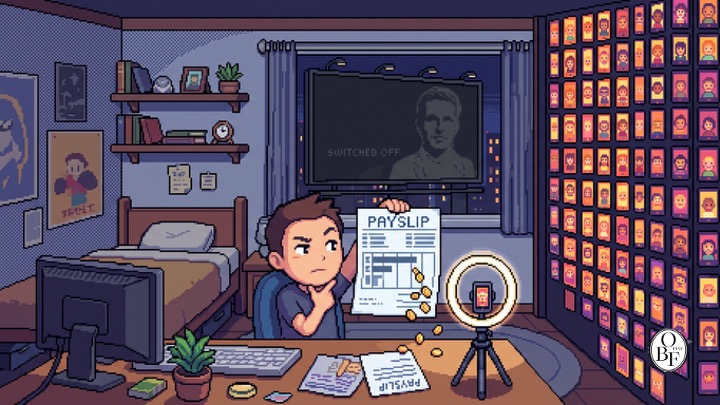
%name%, I have a pay stub to show you. It belongs to Anna Fenstermaker, a 30-year-old living in Florida, and it covers what she earned last year. The total: $140,000, roughly ₩190 million (~$140,000). Here’s the thing — she isn’t a celebrity. She has 33,000 TikTok followers. By day she works a full-time job in the hotel industry; after hours, she posts home-decor and fashion content. She’s an ordinary office worker.
The breakdown Bloomberg published is fascinating. Brand-sponsored posts brought in $29,000 — about a fifth of the total. The biggest chunk, $91,000, came from the Amazon Influencer Program: a commission every time a follower buys something she’s recommended.
Which raises a question: how does someone with 30,000 followers end up earning twice what a mid-level manager at a large Korean corporation makes? The short answer is that she isn’t special — the pipes through which brand ad dollars flow have themselves changed. Today, let’s take those pipes apart.
A “Creator Middle Class” Is Emerging
For a long time, saying you’d make a living as an influencer sounded a lot like saying you’d become a Hollywood actor — possible in theory, but roughly as likely as winning the lottery. What’s being observed in the US lately, though, is a different picture. It’s not the stars with millions of followers; it’s “ordinary creators” with followings in the tens of thousands who are increasingly pulling in mid-management-level incomes.
 Let’s look at a few of the cases Bloomberg interviewed. Abby Flatow, a 25-year-old marketer in New York, landed her first brand deal when she had 8,000 followers. Now, with about 25,000 followers, she’s signed $25,000 worth of brand deals this year alone. Bonsu Nemera, a 28-year-old dental resident earning a $76,000 hospital salary, has already landed $180,000 in deals this year from the content she makes on the side — twice her full-time salary, earned in two months.
Behind this is the expansion of the market as a whole. The influencer marketing market grew from $1.7 billion in 2015 to roughly $33 billion in 2025 — about ₩46 trillion (~$33 billion). That’s nearly a twentyfold jump in a decade. But I think the more important signal isn’t that the market grew — it’s where that growing pool of money is being allocated. Increasingly, it’s flowing to “small accounts.”
Why Brands Are Buying 100 Unknowns
Let’s look at the math from the side that actually spends the ad budget. Ally Grant, co-CEO of the creator management agency Digital Department, put it to Bloomberg this way: “Brands are hiring a large volume of micro-creators for the same money it would take to hire a handful of macro-creators.”
The data backing up this shift is fairly solid. A study published in Journal of Marketing, one of the top journals in the field, is the clearest example. The research team tracked roughly 1.9 million sales at a European direct-to-consumer company using influencer-specific discount codes. The findings are striking: macro-influencers1 generated 6 times the revenue of nano-influencers, but cost 18 times as much. Converted into return on spend, the smaller accounts came out more than 3 times more efficient.
Engagement data points the same direction. By common industry estimates, micro-influencers average an engagement rate2 of 3.2%, nearly three times the 1.1% seen among macro-influencers with over 1 million followers. As an account’s follower count grows, its character shifts — from “a friend’s recommendation” to “a celebrity endorsement” — and trust gets diluted along the way.
It’s worth breaking down the pricing structure here. According to Grant, a single TikTok post from a creator with 50,000 followers goes for $3,500 or more, while one from a creator with 500,000 followers runs about $10,000. Priced per follower, the bigger account actually looks cheaper. But what brands are really buying isn’t exposure — it’s conversion. The moment you factor in engagement and purchase conversion, the scale tips the other way. If you’ve ever worked with data, this trap will feel familiar: what counts as “cheap” depends entirely on which denominator you divide by.
Korea is moving in the same direction. Domestic influencer-marketing industry reports uniformly cite the rise of nano- and micro-influencers as the key trend of 2025. Deals increasingly weigh engagement and trust over raw follower counts, and in some ways Korea is ahead of the curve — take Instagram gongdong-gumae (“group-buy” posts), a model where creators are compensated purely through sales commissions.
Back to the Pay Stub: It Isn’t Ad Money
Let’s return to Anna’s pay stub. Of the $140,000 total, only $29,000 was brand-sponsored ad revenue. The $91,000 came from Amazon affiliate3 commissions — money earned every time an item sold. Similar ratios show up in the income breakdowns of other creators too.
This matters because it means the “creator middle class“‘s paycheck is being filled not by advertisers, but by commerce. Ad money comes out of a brand’s marketing budget; commissions come out of actual sales. The former is the first thing cut when the economy turns down; the latter keeps flowing as long as performance holds up. Whether the creator middle class can become a genuinely sustainable class hinges, in large part, on this distinction.
Still, this picture can’t be painted entirely rosy. The counter-evidence is just as clear. When the Influencer Marketing Hub surveyed 3,000 full-time creators, 57% said their content income fell below a living wage. Income is volatile, too — in Abby Flatow’s words, it’s a world where “some months are $0 and some are $10,000.” And on top of that, the entire foundation of this middle class is a platform. As last year’s 12-hour TikTok blackout in the US demonstrated, algorithms and monetization policies are variables creators can’t control. “Middle class” is the right term — just a middle class with no unemployment insurance and no severance pay.
Oz’s Lens
In building go-to-market strategy, I’ve spent a lot of time laying marketing budgets and sales-org budgets side by side. From that vantage point, what’s happening here isn’t really a shift in advertising fashion. It’s a shift between expense line items. When a brand pays 100 micro-influencers on a commission basis, that’s less “running an ad campaign” and more “outsourcing a commission-based sales force.” The brand isn’t buying media; it’s renting a sales channel. Money that looks like ad spend is, in practice, a substitute for sales headcount.
Seen this way, a few things come into focus. For a brand, a portfolio of 100 micro-influencers is easier to measure than a single star, and if one of them causes a scandal, the risk is spread out. Ad budgets that used to be concentrated on a handful of large media outlets are being split across a large number of small channels — that’s the structural shift I see in the ad market. It’s also, in effect, a redistribution of the margin that used to go to media companies and big talent agencies, now flowing to individuals instead.
The implication for creators connects directly to last Sunday’s issue, where I drew a line between “people who sell time” and “people who own assets.” The trust built up by 30,000 followers is clearly an asset. But the catch is that it’s a building erected on platform-owned land — the title deed isn’t in the creator’s name. So I think the next stage of this market will be a fight over converting commission income into assets creators actually own: a newsletter, a brand of their own, a customer relationship that lives off the platform.
Closing
Let me sum up. A “creator middle class” is emerging — creators with followings in the tens of thousands are earning mid-manager-level incomes. The driver is a change in how brands do the math. As evidence piles up that conversions from 100 unknowns beat the reach of one star by more than 3x on return, ad money is being reallocated to small channels. But the largest share of that paycheck is sales commission, not advertising, and the whole thing sits on someone else’s platform. The middle class is widening, but the floor underneath it is still thin.
If you’re the one signing off on marketing spend, I’d suggest rebuilding this quarter’s influencer budget sheet around cost-per-conversion instead of cost-per-follower. See for yourself which way the scale tips.
%name%, which side of this have you experienced? If you’re a brand or marketing practitioner who’s worked with micro-influencers, tell me in the comments how the results measured up against expectations. And if you’ve made content as a side hustle, tell me whether your income leaned toward ads or commissions. If enough stories come in, I’ll build a Korean-edition pay stub for a future issue.
💬 Whether you’re on the brand side or the creator side, share your experience working with micro-influencers in the comments — I’ll fold it into a future issue. 📨 If you know a marketer wrestling with an influencer budget, pass this along.
References & Further Reading
Primary sources
- Bloomberg, “The Creator Economy Has a New Middle Class”, 2026. ··· This is the article that sparked today’s issue. Just looking at the graphic breakdown of Anna Fenstermaker’s earnings gets you halfway there.
- Beichert, M., Bayerl, A., Goldenberg, J. & Lanz, A., “Revenue Generation Through Influencer Marketing”, Journal of Marketing, 2024. Link ··· This is the source of the “6x revenue, 18x cost” figures. It compares nano and macro returns using 1.9 million real sales records. Keep in mind the limitation that it’s based on a single European company’s data.
- Influencer Marketing Hub, “Creator Earnings Report”, 2025. Link ··· This is the source of the counter-data showing 57% of full-time creators earn below a living wage. Read it alongside the rest so you don’t get swept up in the middle-class narrative.
Background
- OpenAds, “Influencer Marketing Data Analysis: Marketing Trends to Watch in 2025”, 2025. Link ··· A report that uses domestic campaign data to trace the rise of nano- and micro-influencers. It’s a good gauge of where the Korean market stands.
- Morning Consult, “Gen Z and the Creator Economy”, 2023. Link ··· A survey in which about 60% of Gen Z said they’d become an influencer given the chance. It explains why the supply side keeps growing.
Related past issues
- Why Does the Rooftop-Room Developer Deliver Food Every Night? ··· This piece drew the line between “people who sell time” and “people who own assets.” Today’s creator middle class stands right on that boundary.
- The $6.7 Million Independence of an Academic Paper Platform, 35 Years On ··· A look, from another angle, at the question of who owns an asset built on top of someone else’s platform.
📝 Glossary

Footnotes
-
Macro/micro/nano influencer: A classification by follower count. Typically, “macro” refers to 1 million-plus followers, “micro” to 10,000–100,000, and “nano” to under 10,000. The exact thresholds vary a bit by source. ↩
-
Engagement rate: The share of followers who actually react — through likes, comments, shares, or saves. In the ad industry, 3% is considered solid and 10% is considered exceptional. ↩
-
Affiliate marketing: A setup where you earn a commission on a sale whenever someone buys through your link. Rather than getting paid up front for ad placement, you’re paid out based on what actually sells. ↩
Related issues
Meeting Recording Became Default. Nobody Asked.
It wasn't better tech that broke the taboo — it was a new justification.
Why a Rooftop Developer Delivers Food Every Night
The engineer who built AI is now watching AI slash his own rates.
A World Rich on Paper, a Barter Deal in San Francisco
Only 20% of new global wealth is real investment—today's San Francisco deals are what fills that gap.
Your take shapes the next issue
Reply with your experience or perspective — the best responses feed into future issues.
Sign in to commentAny registered reader can comment — it takes 10 seconds.