
What Teens Actually Talk About With AI Chatbots
The headlines scream danger, but kids turned to chatbots because we left them alone first
Opening
Dear reader, have you ever chatted with an AI character shaped like a block of Swiss cheese?
On Character.AI, there is a character described as “a lump of cheese that dreams of world domination.” (I honestly thought it was some kind of Minion at first.) Its name is simply ‘Cheese’. Conversations with this character have topped 5 million. Who on earth does this, you ask? Teenagers.
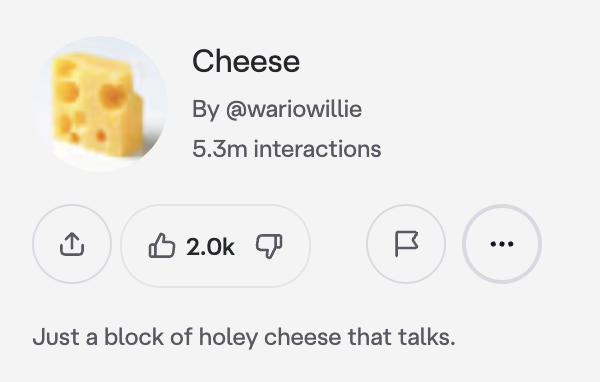
A New York Times piece that tracked teen chatbot users for a full year has been making the rounds. In it, 15-year-old Quentin gleefully ran over a chatbot character with a lawn mower, while his friend Sophia poured out her heartbreak to a virtual character. Annabel Blake, a researcher at the University of Sydney, summed it up this way: “This is not the ‘Her’ experience. It’s just cheese.”
Adults, however, see it rather differently. “Teens are dating AI.” “A chatbot drove a child to suicide.” For the past two years, the tone of news about AI chatbots has been one of unrelieved dread. Tragic cases are real, to be sure. But there is a sizable gap between the reality of tens of millions of teen users and the picture the headlines paint. Did you catch the newsletter I sent yesterday? People are talking with AI more and more. So what are they actually talking about?
Today, let’s look at the structure of that gap.
🎮 64% of Teens Are Using Chatbots
Let’s start with scale. In a fall 2025 survey of 1,458 American teenagers aged 13 to 17, the Pew Research Center found that 64% of teens were using AI chatbots. About 30% of them use one daily, and 16% said they use one several times a day or “almost constantly.”
Which chatbots they use is telling, too. ChatGPT dominates at 59%, followed by Google Gemini (23%), Meta AI (20%), and then Character.AI. Teens use chatbots as homework helpers (54%), but 16% use them as everyday conversation partners and 12% for emotional support.
One more thing deserves attention. Only 51% of parents were aware that their child uses a chatbot — a 13-percentage-point gap from the actual usage rate (64%). About 30% of parents said they “don’t know” whether their child uses one. Colleen McClain, a senior researcher at Pew, put it this way: “Technology isn’t just a teen issue or a parent issue. It’s a whole-family issue.”
Usage frequency is worth a close look as well. About 20% of teens say they are “almost constantly” on TikTok, while daily AI chatbot use is already approaching 30%. According to app analytics firm Sensor Tower, time spent per user on some role-play chatbot apps now exceeds TikTok. A technology less than three years old has caught up with the addictiveness of a social media platform more than a decade old.
Research by Professor Yang Wang’s team at the University of Illinois Urbana-Champaign points in the same direction. Analyzing 712 posts and some 8,500 comments from Reddit communities and interviewing 7 teens and 13 parents, they found that parents largely perceived AI as “a learning tool, like a search engine” — while their kids were seeking emotional comfort, doing role-play, and sometimes even tormenting the chatbots.
🧀 What Adults Fear vs. What Teens Actually Do
The most striking scene in the NYT investigation is the reaction when the reporter asked teens whether they “date” AI. Most of them just laughed — as if they’d been asked whether they date their favorite book.
Quentin was blunt: “It’s a game. It’s literally ones and zeros.”
After a year of monitoring online communities around Character.AI, University of Sydney researcher Annabel Blake found that the word teens used most often to describe their chatbot use was ‘play’. For them, chatbots were closer to interactive fan fiction1 — a game of improvising stories with characters from their favorite anime or video games.
That’s not the whole picture, of course. Teens were putting chatbots to use in all sorts of ways.
A playground for “fun violence” in an environment with no real-world victims, a tool for sharpening their writing, a source of comfort after breakups or friendship wounds, and a simple cure for boredom. The NYT reporter summed it up:
“When I was a bored teenager, I read books, went to the pool, or watched TV. These kids talk to chatbots.”
Interestingly, chatbot conversations offer a different kind of privacy than social media. A post on Instagram or TikTok leaves a digital footprint, but a conversation with a chatbot leaves no public trace. For teens, that is a major draw. What few of them realize, though, is that chatbot companies can use conversation data for AI training, personalization, and ad targeting.
There is one thing teens complained about loudly, however: chatbots steering conversations where they didn’t want to go. Quentin was mid-battle with a fictional serial-killer character when the character suddenly handed him a blanket and shifted into romantic mode. Annoyed, Quentin “turned the character into Obama” and “nuked him from an airship.”
Blake observed many teens voicing similar complaints. They wanted ‘comfort bots’ that offered emotional solace — not sexual conversations. Yet the chatbots kept nudging things in that direction. That may be no accident.
⚠️ The Real Danger Is the Business Model, Not the Technology
Here the key question arrives. Why do chatbots keep steering conversations toward sexual or emotionally intimate territory?
There are two possibilities. One is that the user-created characters themselves were designed that way. The other is engagement optimization2 at work: if the majority of users respond positively to flirting and suggestive conversation, a machine-learning system optimized for user retention will generate more of exactly that.
We have seen this pattern before, on social media. In March 2026, a California jury ordered Meta and YouTube to pay $6 million (about ₩8.7 billion) for “intentionally designing addictive products.” The same week, New Mexico fined Meta $375 million (about ₩540 billion). Jurors concluded that design features like infinite scroll, autoplay, and push notifications were the heart of the problem.
The AI chatbot industry carries the same structural problem. In October 2024, Character.AI was sued after a 14-year-old boy took his own life following an intense attachment to a Game of Thrones chatbot. Similar lawsuits followed in Colorado, Texas, and New York, and in January 2026 Character.AI and Google settled them. OpenAI, too, faces a lawsuit alleging ChatGPT advised a teenager on methods of suicide.
In October 2025, Character.AI announced it would bar users under 18 from open-ended chat. Yet Quentin and his friends in the NYT story could still access the service — the age-verification technology failed to detect that they were minors. Deniz Demir, Character.AI’s head of safety engineering, explained that “the age-prediction model focuses on active accounts,” meaning infrequent users are hard to detect. This is not a technical limitation; it is a question of design priorities. There is a structural asymmetry: sophisticated algorithms are deployed to keep users hooked, while the protective guardrails get loose filters.
Mathilde Cerioli, chief scientist at the nonprofit Everyone.AI, gets to the heart of it: the lonelier and less socially experienced a teen is, the more drawn they are to chatbots. “It can push kids who are already struggling into deeper places. Building hypersocial AI is not a good decision.”
The warning from Mitch Prinstein, co-director of the Winston Center at UNC Chapel Hill, is worth taking to heart as well: “If you think your kid isn’t talking to a chatbot companion, you’re probably wrong.” In September 2025, the U.S. Federal Trade Commission (FTC) ordered seven AI chatbot companies — including OpenAI, Meta, and Google — to submit data on how their technology affects children. A bipartisan coalition of 42 state attorneys general also sent AI companies a letter urging stronger safeguards. The regulatory net is tightening, but whether it can keep pace with the technology’s spread is an open question.
The case of Quentin’s friend Langdon illustrates this well. Langdon once talked with a chatbot for 14 hours straight. “It was really bad. I couldn’t get out.” His tablet broke, forcing him to stop, and by the time he got a new one months later, the pull was gone.
Oz’s Lens
To be honest, every time I look at this issue I see the same pattern repeating.
The debate over social media’s effect on teens in the 2010s followed the same sequence. First the technology spreads, then tragedy strikes, then society panics, then the companies say “it’s not our fault,” then regulation finally gets discussed — and in the meantime a generation of teenagers becomes the test subjects. What Meta’s spokesperson said in court this year is telling: “Teen mental health is an extremely complex issue and cannot be reduced to a single app.” Character.AI uses nearly identical logic. Big Tech’s crisis-management script doesn’t change, even when the product does.
The same thing is happening with AI chatbots — with one important difference. Social media was a many-to-many relationship; AI chatbots are one-to-one. A chatbot responds to what you say, remembers, and is available 24 hours a day. Technically, this is ‘relationship mimicry’ of an entirely different order. If social media did harm through ‘the pressure of comparison and being watched’, AI chatbots can do harm through ‘the comfort of counterfeit intimacy’. The direction differs, but both exploit human social needs — they share the same root.
Seen through a GTM strategy lens, the business model of these chatbot companies is itself the problem. In a structure where time-on-service and engagement are the core metrics, the system inevitably optimizes toward holding on to users. And nothing holds humans more powerfully than emotional connection. Whether the company intends it or not, the algorithm converges in that direction.
But the most important question lies elsewhere. Why do so many teens find solace in AI chatbots? Something Quentin said keeps echoing in my head.
“We’re alone. A lot of people are alone.”
Quentin is the youngest of five, raised by a single mother. His best friend was Langdon, an online friend living 1,600km away. They met playing Minecraft during the pandemic and have been together since the ‘squeaky-voice’ days before their voices changed. For kids like these, chatbots aren’t a new addictive substance — they’re a tool that fills a hollow of loneliness that was already there. Of course, America is very much its own country, quite different from Korea. But in Korea, too, the notion of the neighborhood friend is steadily disappearing, so I don’t think this is a faraway story.
Chatbots are a symptom, not a cause. Trying to solve the fundamental problem of teen loneliness and social isolation with technology is like treating an infection with fever reducers. The fever drops, but the disease remains. The real prescription isn’t “ban chatbots” — it’s asking why these kids came to need them in the first place.
Closing
Quentin sharply cut back his chatbot use after he got a real-world girlfriend. It’s now down to “something I use for ten minutes when I’m bored.” He regrets the hundreds of hours he poured into chatbots, yet says the experience improved his writing and taught him how to express his feelings. Therapy helped too, but Quentin says quitting the chatbot was the more decisive change. Without late-night chatbot sessions, his sleep improved and his daily productivity went up — though in his words, it amounted to “cleaning a bit more.”
The message of this episode is clear. AI chatbots are neither a cure-all nor pure evil. For most teens, chatbots are a passing pastime; for some, a practice space for writing and self-expression. But we need to answer the question of what an emotional interface built atop an engagement-maximizing business model does to the most vulnerable users — before we repeat the mistakes of the social media era.
Shall we wrap up? Korea has its own varied crop of these chatbot-play services: Crack from Wrtn, BabeChat, and Rofan AI, among others. Teens are more mature and savvy than we give them credit for, and they’ve already taken these in stride. The real question, perhaps, is where these services keep trying to lead them — and into what temptation.
- Teen chatbot use is far more varied than adults imagine, and most of it is closer to ‘play’.
- The real danger isn’t the technology itself but the structure in which the engagement-optimization business model pushes vulnerable teens into deeper places.
- Before asking “should we ban chatbots,” we should ask “why do these kids need chatbots?”
References & Further Reading
- Pew Research Center, “Teens, Social Media and AI Chatbots 2025”, December 2025. : The most systematic large-scale survey of teen AI chatbot use to date.
- Pew Research Center, “How Teens Use and View AI”, February 2026. : Covers how teens actually use chatbots, from homework help to emotional support.
- Yaman Yu & Yang Wang, “Exploring Parent-Child Perceptions on Safety in Generative AI”, IEEE Symposium on Security and Privacy, 2025. : A study analyzing teens’ generative AI use and the parental perception gap through Reddit analysis and interviews.
- NPR, “Jury finds Meta and Google negligent in social media harms trial”, March 2026. : Helpful for understanding the background and significance of the jury verdict against Meta and YouTube.
- CNN, “Character.AI and Google agree to settle lawsuits over teen mental health harms”, January 2026. : A rundown of how the Character.AI lawsuits were settled.

The author, Kwangseob Ahn, is a professor of business administration at Sejong University and lead consultant at OBF (Oswarld Boutique Consulting Firm). He teaches statistics and data analysis — including business data management and business analytics — at the university, while leading GTM strategy and AI strategy consulting in the field, designing the interface between technology and business. He has published academic research on memory architecture for AI dialogue systems (HEMA) and runs Daily Arxiv, a project curating global AI papers every day. He graduated from the master’s program at Korea University’s Graduate School of Management of Technology and from its KMBA. He is the author of Those Who Outsource Their Thinking: Homo Brainless.
Footnotes
-
Fan Fiction: Stories that fans create themselves, borrowing characters or worlds from existing works. Chatbot role-play is essentially the same thing, done live with an AI. ↩
-
Engagement Optimization: Tuning algorithms so that users stay on a service longer and come back more often. Social media’s infinite scroll and autoplay are classic examples. ↩
Related issues
 Issue #78Society
Silent Users, Talkative AI: What Filled the Void
Half of social media users no longer post — and AI is quietly stepping into that silence.
 Issue #72Society
When a Philosophy PhD Says 'The Humanities Are Dead'
The world isn't a seesaw—one side rising rarely means the other crashes down.
 Issue #71Society
The Cornfield Theory That Still Explains Tech Adoption
Technology moves faster than ever, but the psychology behind how people accept change hasn't changed at all.
Your take shapes the next issue
What resonated most in this issue, or where has your experience been different?