
The Two Suppliers Samsung and Nike Wait In Line For
One sold the machine that makes the product; the other hid it.
Opening
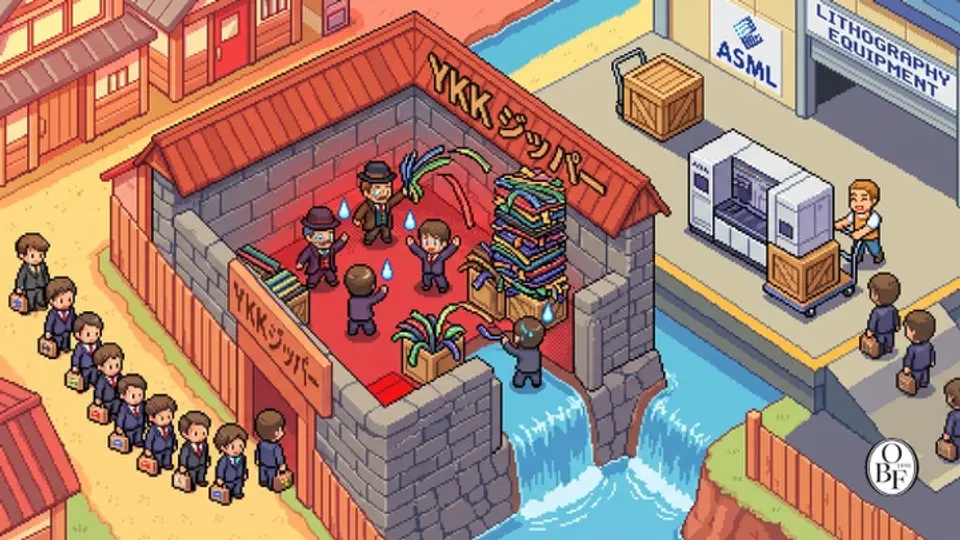
Samsung Electronics executives fly to a Dutch town of 40,000 people just to secure one more EUV lithography machine1. Nike, Levi’s, and Patagonia specify, by name, the zippers made by a company in Toyama Prefecture, Japan, when they place their manufacturing orders. Companies known as the “gap” — the dominant party in a business deal — end up lining up in front of the “eul,” the weaker one. It’s why the Korean press nicknamed ASML the “super eul.”
But the two companies arrived at that position by opposite paths. To cut to the conclusion: what they share is control over “the machine that makes the product”; what separates them is that ASML sold that machine, while YKK never let anyone see it. Today I want to dig into how these opposite choices led to the same outcome, and what criterion, at that fork in the road, decided their diverging fates.
The Company That Hid the Machine: The Fortress of Kurobe
Let’s start with the numbers. In fiscal year 2024, YKK sold 10 billion zippers. Lined up end to end, that’s 3 million km — enough to circle the Earth 80 times. By Harvard Business Review’s estimate, this single company captures roughly 40% of the global zipper market by value and about 20% by volume. Its zippers show up everywhere from NASA spacesuits to blue jeans; in Japan alone, YKK makes more than 100,000 different zipper variants.
Quality is the usual explanation, but I’d say that’s only half right. The principle founder Tadao Yoshida laid down in 1934 wasn’t “make a good zipper” — it was “build a process that can’t help but produce a good zipper.” YKK smelts its own brass, spins its own polyester yarn, and weaves its own zipper tape in-house. And crucially, it designs and builds, at its own facility in Kurobe, Toyama Prefecture, the machines that carry out every one of those steps. Those machines are never sold to outsiders at any price. Competitors can copy the zipper; they can’t even get a look at the machine that makes it.
This fortress proved its power in the American market. When YKK opened its New York office in 1960, Talon — then America’s No. 1 zipper maker — held roughly 7 of every 10 zippers sold in the country. But the board flipped once YKK started leasing its own machines to American garment factories. According to Bloomberg, within ten years of starting the machine-leasing program, YKK’s U.S. subsidiary’s revenue jumped from under $100 million to roughly $450 million, and by the late 1980s it had taken the No. 1 spot in America. The moment your machine is running inside a customer’s factory, switching zipper suppliers stops being a matter of swapping a trim component and becomes a matter of replacing a production line. Talon’s market share today is in the single digits.
There’s an extreme customer case that shows exactly why the quality this machine produces is decisive: Switlik, which supplies survival equipment to the U.S. military. In Switlik’s drysuits, the zipper is the last line of defense against water — the instant it leaks, gear designed to save a life becomes gear that endangers one. So Switlik co-developed with YKK a “quick-burst” zipper for U.S. Air Force life vests, one that bursts open on its own under inflation pressure. A zipper is less than 1% of a garment’s cost, but buyers like this aren’t pricing on cost — they’re pricing on the cost of failure. In this market, undercutting on price simply doesn’t work.
YKK’s response to China’s low-cost challengers follows the same grammar. SBS, founded in 1984 in Fujian Province, is a company that openly says it wants to knock YKK off its perch. In a WSJ video, a YKK executive explained that the company’s countermeasure wasn’t a price cut — it was developing new in-house machines that could produce cost-competitive zippers without sacrificing quality. YKK fights back with machines, not with products. The fact that YKK remains privately held today, free from quarterly-earnings pressure and able to commit to equipment investments on a ten-year horizon, also underwrites this grammar.
Of course, there’s a shadow side too. In 2007, the European Commission fined seven corporate groups a combined €328 million for price-fixing in zippers and fasteners, and YKK’s share — roughly €150 million — was the largest of all. It’s a record of how a locked market is also a market with a strong temptation to collude.
The Company That Sold the Machine: The Web of Veldhoven
Now for the opposite case. In 1984 — exactly 50 years after YKK’s founding — about 30 people started ASML in Veldhoven, the Netherlands. Today, the company is the only maker on Earth of EUV lithography machines, and in 2025 it posted revenue of €32.7 billion with a gross margin of 52.8%. Its next-generation machine, the High-NA2, reportedly costs around ₩500 billion per unit. If YKK became king by selling 10 billion units of a component that wholesales for tens to hundreds of won apiece, ASML became king by selling the most expensive machine on Earth, a few dozen units a year.
But let me correct a common assumption here: ASML is not the embodiment of vertical integration. It’s actually the opposite. More than 80% of its components are sourced from outside suppliers, and it has more than 5,000 of them. A single EUV machine contains roughly 100,000 parts, and shipping one requires 40 containers and 3 cargo planes. Where YKK pulled everything inside its walls, ASML kept almost everything outside them.
Instead, it wove a web. Germany’s Zeiss, which makes the optical systems, is ASML’s sole supplier for that component — and ASML is Zeiss’s sole customer for it. More than 25 years of joint development have made each irreplaceable to the other, and ASML holds a 24.9% stake in Zeiss’s semiconductor division. The multilayer mirrors Zeiss makes for EUV are polished to a flatness that is, for all practical purposes, atomic-scale — no other company on Earth can make them. ASML outright acquired the light-source maker Cymer in 2013. It buys the components, but it traps the companies capable of making those components inside its own web. Instead of a fortress, a web; instead of ownership, an exclusive relationship — that’s ASML’s lock-in mechanism.
This web reached its peak in 2012. As EUV development costs ballooned, ASML reached out to its customers. Intel, TSMC, and Samsung Electronics together bought a combined 23% equity stake for €3.85 billion, and separately committed €1.38 billion in R&D funding spread over five years. Samsung alone put in €500 million for equity and €276 million for R&D. And yet every share of that stake carried no voting rights at all — the terms let ASML take the money while ceding not an inch of control. It’s a rare scene in industrial history: three “gap” companies funding the R&D budget of a single “eul.” Why did they pay? Because the customers understood, before anyone had to explain it to them, that without this machine, they had no future.
To sum up: YKK makes everything itself but refuses to sell the one machine that matters; ASML makes almost nothing itself but sells that one machine. Why did the two diverge this way?
Fortress and Web: Why Opposite Choices
I see two axes behind why the two companies answered the same question in opposite ways.
First, is the machine itself the recipe? ASML’s equipment is a necessary condition, not a sufficient one. Buy the same EUV machine, and TSMC’s yields versus a latecomer’s yields are worlds apart. The fact that the same equipment produces such different outcomes means the real recipe lives outside the machine. Since selling the machine still leaves the customer to supply the process know-how — the actual recipe — ASML could become king by selling it. YKK’s zipper machines, by contrast, are close to being the recipe itself. Sell the machine, and decades of process knowledge go with it, whole. So hiding it was the only option.
Second, the size of the market at the machine layer. The semiconductor equipment market alone exceeds $100 billion a year, big enough on its own to support a world-class company that sells nothing but machines. A standalone “zipper-manufacturing equipment market,” by contrast, is simply too small to exist. The only way to turn a good zipper machine into money was to use it yourself to stamp out 10 billion zippers. That’s exactly why equipment specialists like Applied Materials or Tokyo Electron exist in semiconductors and have no counterpart in zippers.
This choice also determined each company’s geographic fate. Because YKK owns the machine, it could replicate identically high-quality factories across 69 countries, and its principle of “make where you sell” became a shield in the age of tariffs — clearing the Berry Amendment3, the U.S. military procurement rule, through its Georgia factory, for instance. ASML, whose machine is itself the product, has no choice but to concentrate assembly in a single location, Veldhoven — which is exactly why it ended up standing at ground zero of the U.S.-China export-control fight. Two opposite risk profiles, grown from the same root.
 Both kings now have a foothold on Korean soil, as it happens. YKK Korea is headquartered in Seoul’s Bangbae neighborhood and runs a factory in Pyeongtaek, South Korea, supplying zippers to the domestic apparel and bag industries. ASML completed its Hwaseong campus — in Hwaseong, a city south of Seoul — a ₩240 billion investment, last year; its core facility is a remanufacturing center that repairs and revives lithography components. ASML has also announced plans to raise the share of domestically sourced parts used there from 10% to 50%. Even the company that sold the machine wants to keep the machine’s lifecycle management right next to the customer. Meanwhile, in 2023, YKK moved its global sales headquarters outside Japan for the first time since its founding — to Vietnam, since 90% of its production already takes place outside Japan. The fortress company replicates its fortress across the world; the web company plants the end of its web right beside the customer. Even geographic strategy follows each company’s own grammar.
Oswald’s Lens
When I run product-definition workshops in GTM strategy consulting, there’s one question I always ask: “Of everything your company makes, what should you never sell?” Most people find the question itself strange at first — they’ve always managed what they make and what they sell as a single list. The two companies in today’s piece are ones that split that list apart. They show that what you sell isn’t handed to you; it’s something you design. The same goes for gap-eul relationships. The real hierarchy isn’t the one printed on a business card — it’s the hierarchy of replaceability, and both companies simply designed themselves into the layer that can’t be replaced.
You can extract a decision rule from this case: find the layer of your capability that’s hardest to copy, and check whether an independent market exists for that layer alone. If the market is big enough, promote that layer into a product, the way ASML did. If no such market exists, seal it off and monetize it only through the finished good, the way YKK did. For Korean component-and-equipment suppliers accustomed to building whatever the customer’s spec demands, this framework offers a way to reconsider: which drawings can you hand over, and which jigs and fixtures should you never, under any circumstance, let out the door?
But lock-in isn’t free. YKK’s cartel fine shows the temptation that comes with a locked market; ASML’s exposure to export controls shows the fragility that comes with locked geography. Deciding what to lock up is also deciding which risk you’re choosing to carry.
Closing
To summarize. First, both companies’ power comes not from the product but from control over the machine that makes the product. Second, the lock-in method is opposite — a fortress (bring everything in-house) versus a web (outsource, then seal the exit) — but the underlying principle is identical: never hand the machine layer to anyone else. Third, the question worth asking, then, isn’t “how good is our product?” It’s “who controls the machine layer of our value chain?”
In the industry Reader works in, which company “holds the machine”? And conversely, is there something at Reader‘s own company that it never sells — or something it should never have sold? Tell me in the comments. I’ll dig into the most interesting cases in the next issue.
💬 Share your industry’s own “hidden machine” story in the comments — I’ll fold it into the next issue. 📨 If you know a colleague working in components, equipment, or B2B, forward this piece to them.
Past issues worth reading alongside this one
- The China That Containment Built ··· This one read the U.S.-China AI race through the lens of “who holds the switch.” It’s the same question as today’s machine-layer story.
- A World of Paper Millionaires, and San Francisco’s Barter Economy ··· This one argued that bargaining power comes not from declarations but from bottlenecks. ASML and YKK are companies that designed those bottlenecks themselves.
📎 References & Further Reading
Primary sources
- YKK, “YKK Surpasses 10 Billion Annual Global Zipper Unit Sales in FY2024”, 2025. Link ··· The original source for the 10-billion-unit and 80-times-around-the-Earth figures.
- WSJ, “YKK Sells 10 Billion Zippers a Year. How Did It Get So Big?” (video), 2026. Link ··· The video that sparked today’s piece. It covers YKK’s in-house machines and its military supply story.
- Bloomberg Businessweek, “How the World’s Largest Zipper Maker Is Weathering the Tariffs Era”, 2025. Link ··· This is where the detail on the 4.5x revenue jump after machine leasing and the secretive Kurobe facility comes from.
- ASML, “2025 Fourth Quarter and Full-Year Results”, 2026. Link ··· The original source for the €32.7 billion revenue and 52.8% gross margin figures.
- ASML, “Samsung joins ASML’s Customer Co-Investment Program”, 2012. Link ··· The primary source for the 2012 scene where three “gap” companies funded the “eul“‘s R&D.
- European Commission, “Antitrust: Commission fines members of fasteners cartels over EUR 328 million”, 2007. ··· The original record of YKK’s €150 million fine. You need to see the shadow side of dominance too, for balance.
Background
- The Fashion Law, “The Humble Zipper is at the Center of an Almost $20 Billion Global Battle”, 2020. Link ··· A good single-piece overview of zipper industry history, from Talon’s decline to SBS’s challenge.
- The Elec (a Korean tech-industry publication), “ASML Builds ₩240 Billion Hwaseong Cluster”, 2022. Link ··· An article covering ASML’s Hwaseong campus and its plan to localize remanufactured parts (10% → 50%).
📝 Glossary

Footnotes
-
EUV (extreme ultraviolet) lithography machine: The equipment used to etch circuits onto wafers with light, for the most advanced process nodes. The shorter the wavelength, the finer the lines you can draw — EUV represents the current extreme of that, making it essential for producing cutting-edge chips. ↩
-
High-NA: The next generation of EUV. It increases the numerical aperture — the lens’s light-gathering power — to draw even finer circuits. Think of it as opening a camera’s aperture much wider. ↩
-
Berry Amendment: A U.S. rule requiring that clothing, textiles, and similar items procured by the U.S. military be made in America. To supply the U.S. military, your supply chain has to sit inside the United States. ↩
Related issues
 Issue #184Business
Kevin Warsh's Third Door, Not Crisis or Collapse
There's a third door — and the bond market has already priced it in.
 Issue #182Business
No Solo Unicorn Yet, but Solo Millionaires Have Doubled
The prophesied one-person unicorn never arrived, but payment data reveals a new way to grade solo-founder success stories.
 Issue #181Business
$800 Billion: The World's Most Famous Wrong Number
It undercounts global AI spending by $200 billion while overcounting America's by exactly the same amount.
Your take shapes the next issue
What resonated most in this issue, or where has your experience been different?