
Same Company, 100x Bonus Gap: Korea's New Problem
Citizen dividends, a sovereign fund, solidarity wages—three rival fixes emerged in just three weeks.
Opening
Dear reader, the results of Samsung Electronics’ union ratification vote came out on the 27th. 73.7% in favor — passed. Looking at the number alone, it seems like a clean resolution.
But look closer and you see a completely different picture. Among Semiconductor (DS) division union members, 80.6% voted yes — while the Smartphone and Home Appliances (DX) division managed only 21.1%. Same company, same vote, completely different response. The moment voting ended, more than 10,000 people joined Donghaeng Union, a labor union centered on the DX division, within a single day.
What I want to unpack in this newsletter isn’t the internal conflict at Samsung Electronics itself. Let me give you the conclusion up front: Korea has become the first country in the world forced to answer, in practice rather than in theory, the question of how a society should divide the wealth that AI creates.
I’ve covered this case in my classes and mentioned it publicly on several occasions, and I’ve always asked the same question. Was the problem the amount they receive? Or was it the duration? Or was it who receives it? In today’s newsletter I want to share the answer I’ve landed on. Spoiler: it’s none of the three.
Three Prescriptions in Three Weeks
Let’s start with scale. This year, Samsung Electronics’ semiconductor memory division employees can receive up to ₩600 million (~$435,000) in bonuses. Based on a ₩100 million annual salary, that’s roughly ₩550 million in special management performance bonuses plus ₩50 million in OPI1. Employees in the same company’s DX division get nothing but ₩6 million worth of company stock. That’s roughly a 100x gap.
To see why this number has become more than a single company’s labor dispute, just trace the timeline of May.
On May 11th, Kim Yong-beom, Chief Policy Officer at Cheong Wa Dae (the presidential office), posted a 2,500-character piece on Facebook. Its key line: “The fruits of the AI infrastructure era are not the result of any single company alone.” He proposed paying citizens a “citizen dividend” funded by excess semiconductor tax revenue. Markets reacted instantly. The KOSPI, which had been approaching the 8,000 mark, plunged, and the presidential office distanced itself the same day, calling it his “personal opinion.”
On May 20th, at Samsung Electronics’ Pyeongtaek plant, a dramatic agreement was reached just 90 minutes before a general strike was set to begin — the result of direct mediation by Kim Young-hoon, Minister of Employment and Labor.
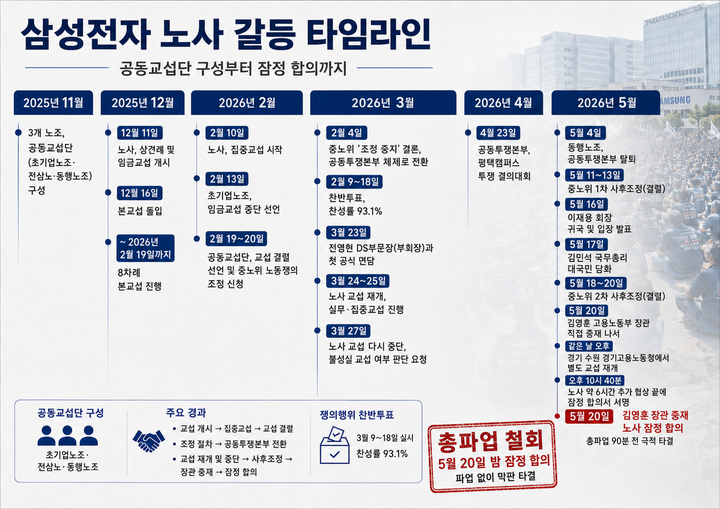
After the agreement, though, directions diverged. The government shifted its focus toward building a Norwegian-style sovereign wealth fund2 . The idea: start with ₩30 trillion (~$21.7 billion) in seed money and invest excess semiconductor tax revenue for future generations. On May 30, 2026, Deputy Prime Minister Koo Yun-cheol appeared on the finance YouTube channel SamproTV and officially confirmed that “a significant portion of the excess tax revenue will go into the sovereign wealth fund.”
Meanwhile, on the 27th, Minister Kim Young-hoon raised a new topic: a “Korean-style solidarity wage.”3 The idea was to link large corporations’ excess profit-sharing to closing the wage gap between primary contractors and subcontractors, but the discussion forum scheduled for it was postponed within two days. He explained, “This isn’t about slaughtering the goose to split it up,” but the controversy was too large.
To sum up: within a single month, three fundamentally different prescriptions — citizen dividends, a sovereign wealth fund, and a solidarity wage — appeared simultaneously. That shows just how urgent this issue is, and also that nobody yet has the right answer.
Related issues
🔒 Founders Banned, $2 Billion Meta-Manus Deal Unwound
The chip war's next battlefield: AI agents.
🔒 Why Anthropic Is Hiring a $320K Copywriter
AI can write, but only humans can figure out what to say.
🔒 Why Starbucks Pulled AI Out of Its Stores
It promised 99% accuracy, but baristas trusted their own hands more.
Your take shapes the next issue
Reply with your experience or perspective — the best responses feed into future issues.
Sign in to commentAny registered reader can comment — it takes 10 seconds.