
The Crash Day China Still Wanted More Nvidia Chips
Two fears—demand collapse and substitution—collided in a single day's plunge.
Opening
Dear reader, let’s start with the scene in Seoul at 9am yesterday morning. The KOSPI opened down more than 5%, hovering around the 6,400 level, and at one point during the session it broke below 6,000. Samsung Electronics closed the day down 13%, SK Hynix down 14%. Both numbers rank among the steepest single-day drops either company has ever recorded, and three months of gains were erased in a single trading day.
But on that very same day, a story broke overseas with an entirely different flavor. Moonshot AI, based in Beijing, was reportedly moving to secure additional Nvidia Blackwell GPUs to build its next-generation model, “Kimi K4.” The market dumped Korean chip stocks on the fear that “China has achieved semiconductor self-sufficiency”—yet at that very moment, the AI company sitting on China’s front line was moving to buy more American chips.
I want to start today’s issue from this contradiction. To cut to the conclusion first: this crash layers together two fears of a different character. One is the demand fear—that if AI gets cheaper, fewer chips will be needed. The other is the substitution fear—that China is making its own memory and equipment in-house. And half of this fear is substance; the other half is narrative.
SK Hynix at ₩1.55 Million: A Month-Long Record
Let me lay this out in chronological order first.
The starting point was June 25. That day, Samsung Electronics and SK Hynix both hit all-time highs side by side. SK Hynix climbed to ₩2,987,000 (~$2,152) intraday, and just before that, it had spent two days overtaking Samsung Electronics as the top company by market cap on the KOSPI. Some in the securities industry drew comparisons to the dot-com bubble in 2000, when Cisco overtook Microsoft as the top company by market cap on the Nasdaq. That’s how peaked expectations had become.
The first correction began in early July. It wasn’t a specific piece of bad news so much as valuation strain and supply-demand pressure. Regulations on single-stock leveraged products tracking Samsung Electronics and SK Hynix took effect, and margin-debt and leverage liquidations amplified the decline. On July 13 alone, SK Hynix dropped more than 15%, and by that point it was already down 38% from its peak.
The second wave hit on July 16. When Moonshot AI released “Kimi K3,” an open-weight model with 2.8 trillion parameters, the same question that had haunted markets since DeepSeek’s debut early last year resurfaced: “If AI can be built this cheaply, can all that expensive infrastructure spending still be justified?” Semiconductor stocks worldwide wobbled together, and I covered this episode in detail in a previous special feature.
Now the third wave, this week. The day before yesterday (the 27th), CXMT (ChangXin Memory Technologies), China’s largest DRAM maker, listed on the Shanghai stock exchange and surged 466% on its opening day. That same night, The Information reported that “China has begun mass production of immersion DUV lithography equipment1.” Yesterday, the Korean market priced in both events at once. The KOSPI fell as much as 9% intraday, briefly slipping below the 6,000 mark before closing around 6,100, and foreign investors net-sold ₩4.8 trillion (~$3.5 billion) in a single day. A leveraged product tracking 2x the combined performance of Samsung Electronics and SK Hynix collapsed 29%, and yet retail investors bought ₩730 billion (~$526 million) worth of it.
Cumulatively, Samsung Electronics is down about 38% from its all-time high, and SK Hynix is down about 48% from its intraday peak. The KOSPI itself has slid more than 30% from its high. Yesterday alone, the two companies lost a combined ₩370 trillion (~$267 billion) in market capitalization — more than half of the Korean government’s entire annual budget.
It looks like the same decline repeating itself, but the flavor of fear differs at each stage. Let me break them down one by one.
The First Fear: If AI Gets Cheaper, We’ll Need Fewer Chips
The logic chain behind the demand fear goes like this: if China releases frontier-class models at rock-bottom prices — with the weights open to boot — the justification for Big Tech’s astronomical infrastructure spending gets weaker. Fewer GPU orders mean fewer orders for the HBM2 that goes inside them. HBM is currently the profit engine for Samsung Electronics and SK Hynix, so the conclusion follows that Korean memory earnings forecasts need to be cut. That’s the calculation Kimi K3 revived.
It sounds plausible. But three facts have emerged in just the past few days that shake the premise of this calculation.
First, there’s Moonshot AI’s own moves. According to reporting from The Information, Moonshot is preparing K4, a next-generation model far larger than K3, and is trying to secure additional Nvidia Blackwell chips to do it. K3 itself was trained on Nvidia GPUs, including Blackwell. On the 22nd, Michael Kratsios, director of the White House Office of Science and Technology Policy, publicly called out Moonshot for securing GB300 servers and accessing a GB300 cluster in Thailand to train its model. Sources say part of the training ran in parallel inside China because of data-export restrictions. Alibaba’s latest model, Qwen3.8-Max, is also reported to have been trained on Blackwell. In the middle of a panic over “efficient Chinese models” supposedly crushing chip demand, the very companies building those models are hunting down banned chips harder than ever — even carving out workarounds to get them.
Second, look at the other end of demand. The same week, in the US, AMD and Core Scientific announced an AI data center partnership of up to 2.5 gigawatts. The deal starts at over 500 megawatts from 2027 and scales up in stages — 2.5 gigawatts is more output than two large nuclear power plants combined, all earmarked for AI computation. That’s not the kind of contract that comes out of a market where demand is collapsing.
Third, there’s history. The fear that “if AI gets cheaper, infrastructure investment shrinks” also rattled markets when DeepSeek broke early last year — but what actually happened over the following year and a half was the exact opposite. As prices fell, usage exploded, and Big Tech’s investment only grew. Jensen Huang’s blunt remark last week — “free AI is good for hardware” — fits the same pattern. Granted, he sells chips, so his words should be taken with a grain of salt, but at least so far, the data has been on his side.
So I think the demand fear behind this sell-off is more memory than substance. It looks less like a fresh, reasoned response and more like the memory of the DeepSeek shock reflexively replaying itself, with Kimi as the trigger.
The Second Fear: China Building It Themselves
This week’s fear has a different character. It’s not a story about demand but about supply — the substitution fear that “China is going to take that market.” There were two triggers.
The entity called CXMT. CXMT listed on Shanghai’s STAR Market3 on the 27th and closed its first day at 49 yuan, up 466% from its 8.66 yuan offering price. Its market cap came to roughly 3.28 trillion yuan — about ₩712 trillion in Korean won terms — instantly overtaking Industrial and Commercial Bank of China to become the largest listed company on mainland Chinese exchanges. The listing alone raised 57.9 billion yuan, roughly ₩12.5 trillion. It’s Asia’s largest IPO this year and the largest capital raise ever by a Chinese semiconductor company, and YMTC, the top NAND maker, is preparing its own listing before year’s end.
And CXMT isn’t a threat on paper only. It’s the world’s fourth-largest DRAM maker, accounting for about 11% of global DRAM wafer capacity as of last year, with that share projected to grow to 15% by 2028. Right now it’s expanding market share by dumping commodity DRAM like DDR4 at roughly half the market price — and this happens to coincide with commodity DRAM prices having risen eightfold from a year earlier as production shifted toward AI servers, so even selling at half price is still profitable. HP, Dell, Asus, and Acer have begun quality testing on CXMT’s products, and Apple, while lobbying the U.S. government, is running certification procedures for CXMT DRAM to go into devices sold in China. Apple tried something similar in 2022 with Chinese memory adoption but backed off amid U.S. government pushback; this time it’s taking the approach of completing certification first and waiting for political approval afterward. On top of the picture of the Chinese government pushing from behind, there’s now a picture of Western demand pulling from ahead.
CXMT is also reportedly converting 20% of its Shanghai fab capacity to HBM3. It’s not the most advanced tier, but it’s a script of climbing the next rung using money earned from commodity products.
The DUV narrative. The lithography news that broke the same night has a different texture. According to The Information, a state-owned enterprise in Shanghai has begun initial mass production of immersion DUV equipment, planning to supply roughly 5 units this year to SMIC, Hua Hong Semiconductor, and CXMT, then scale up to about 20 units next year. The company’s name hasn’t been disclosed, but the industry suspects it’s SiCarrier, an entity tied to Huawei affiliates, and there was also a Financial Times report that SMIC has been testing this equipment since last September. On this news, ASML’s stock dropped more than 8% in a single day. For context, China is ASML’s third-largest market by last quarter’s revenue. The duality of this story shows up here too: a country declaring self-sufficiency remains one of the largest customers.
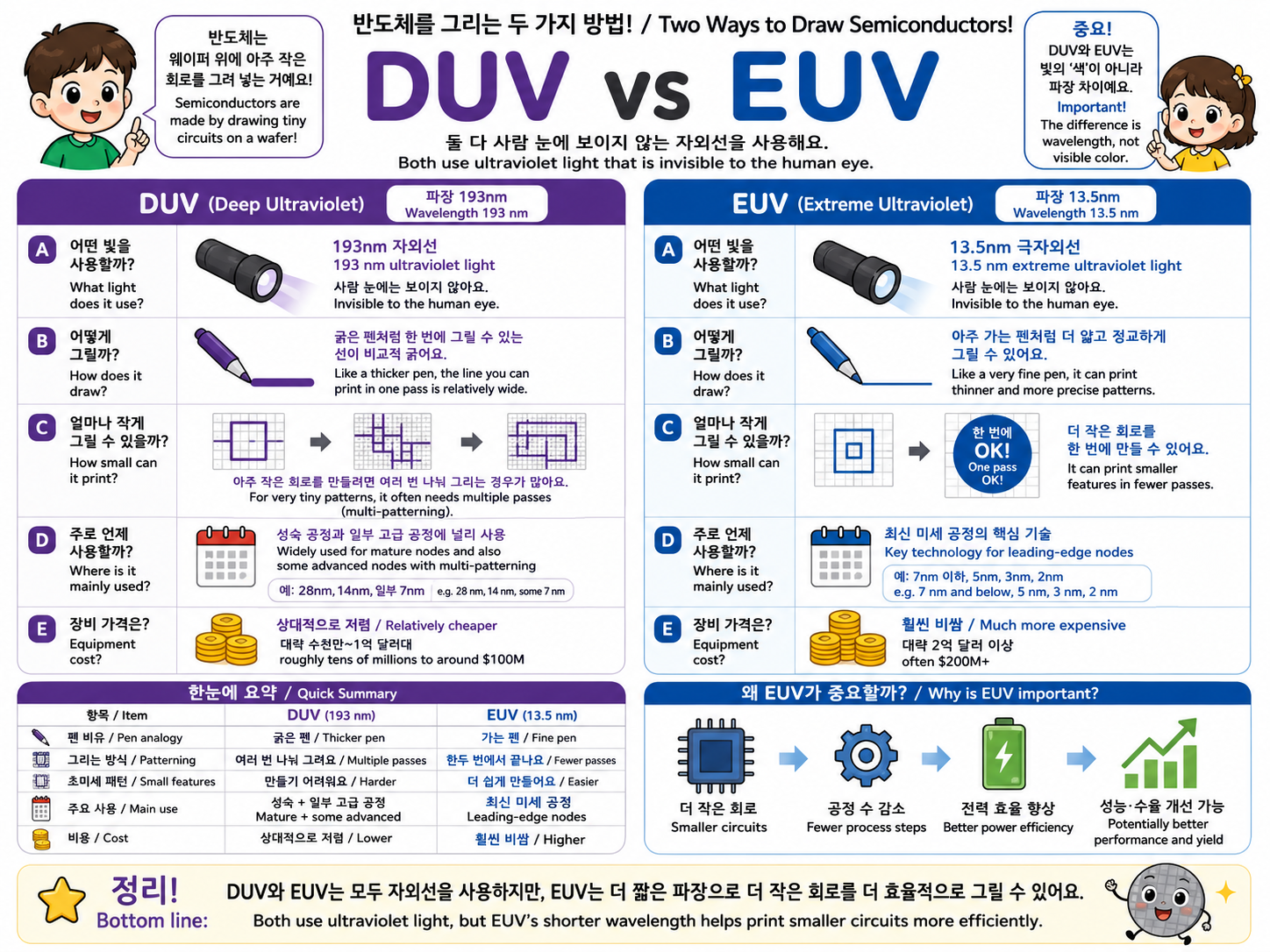 Lithography equipment has long been cited as the last bottleneck for China’s semiconductor self-sufficiency, which is why the symbolism here is significant. But if you measure the distance between the symbol and the substance in actual numbers, here’s what you get. (As a long-time ASML shareholder myself, this one stings a bit personally.)
Start with scale. This year’s 5 units come to less than 4% of the 131 immersion DUV units ASML shipped last year alone (per The Information’s tally). Next, the generation. This Chinese-made equipment uses a 28nm-class ArF immersion method — the same tier of technology ASML commercialized in the mid-2000s. That means it’s 20-year-old technology, and some key components are still Japanese-made. There remains a fundamental gap of two to three generations, from light source to precision, versus EUV and, above that, High-NA EUV.
The economics are even more sobering. According to Goldman Sachs’ analysis, attempting sub-7nm processes with DUV alone, without EUV, requires forcing through multi-patterning4 — etching the same circuit multiple times in separate passes — and the more complex the process gets, the more defect rates spike. To produce the same volume of chips, you need exponentially more equipment and investment, and the math at the end of that road works out to a cost structure 40–50% higher than TSMC’s. For context, even ASML began EUV research in the late 1990s and didn’t get it onto production lines until the late 2010s. It’s a mountain that took 20 years to climb for a single generation of equipment.
So does that mean the 5 units are meaningless? I’d argue the opposite — the real significance of these 5 units lies not in substitution but in insurance. Right now, there’s a bill before the U.S. Congress (the MATCH Act) that names SMIC, Hua Hong, CXMT, Huawei, and YMTC specifically, and would cut off not just new exports but also maintenance and technical support for ASML equipment already installed. If that becomes reality, Chinese fabs would have to shut down even the equipment they already own. Against that scenario, even 5 domestic machines that are 20 years behind in performance carry bargaining power simply by existing. It’s a signal that says, “Even if you cut us off, we keep running.” The mere possibility of this — which I covered in an earlier newsletter — is enough to send shockwaves through the market.
The Blockade That Grew China, Now Locking the Door · Issue No. 157 · OZ TalkingThe U.S. blockade ended up accelerating self-sufficiency insteadHere’s the summary. Among the substitution fears, self-sufficiency in the cutting edge — HBM and leading-edge process — is still narrative. But encroachment in mature process, commodity DRAM, isn’t narrative — it’s substance already in progress. And according to reports, more than half of Samsung Electronics’ and SK Hynix’s DRAM production is exactly that commodity product.
The Two Fears Contradict Each Other—Yet the Market Bought Both
Step back for a moment, and something strange comes into view.
The demand-fear premise is “AI demand is rolling over.” The substitution-fear premise is “AI demand is so massive that it’s a disaster if China captures that market.” CXMT’s 466% first-day surge is itself a bet on a memory demand explosion. The two fears collide at the premise level. The more one is right, the weaker the other should logically become—yet the market priced in both fears, at maximum intensity, within a two-week span.
 Of course, both fears can partially hold true for Korean memory at once, since HBM demand slowdown and commodity-chip encroachment hit different business units. So it’s not fair to say yesterday’s sell-off was entirely irrational. But the sheer size of the drop isn’t explained by the content of the fears alone. There were three amplifiers.
First, the starting point was too high. Expectations had run ahead of reality to the point where SK Hynix reached the top market cap spot and comparisons to Cisco surfaced—and the bigger the expectations, the bigger the reversal. Second, leverage. With 2x leveraged products collapsing 29% in a single day and margin-call liquidations cascading, forced-selling volume poured out regardless of the actual reason to sell. Third, synchronization. With the KOSPI and Nasdaq bound together by a single AI narrative, the structure became one where fear in one market spread directly to the other.
Goldman Sachs judged this crash to be a psychological overreaction to the news of CXMT’s listing and DUV mass production. Their view: while this has meaning as self-sufficiency centered on mature process nodes, the probability that it shakes the competitiveness of the advanced AI semiconductor value chain and the dominance of leading firms is very low. On the other side, there’s a “this time is different” substantive-threat view. I think the difference between the two camps ultimately comes down to time horizon. Looking out 5 years, the overreaction camp is right; looking out 15 years, it’s hard to dismiss the substantive-threat camp. Yesterday, the market tried to price in 15 years’ worth of fear in a single day.
Oswald’s Lens
As it happens, two days before this crash hit, I said something along these lines in a press interview: the real shock of Chinese AI isn’t that some particular model beat America’s — it’s that they’ve secured their own models and infrastructure and are now spreading them across the world. And sovereign AI isn’t a question of having one homegrown model; it’s a question of the entire supply chain — accelerators, memory, data centers, right down to the operating software. Two days later, the market handed back a response worth hundreds of trillions of won to exactly that supply-chain story.
Here’s something I learned while building GTM strategy: the market doesn’t buy a product’s current performance — it buys its roadmap. What the market bought yesterday wasn’t five machines; it was the ten-year path those machines were tracing. The problem is that a path has no fixed price. So when fear meets narrative, there’s no ceiling on how far the drop can go.
That said, I’m not in the camp that wants to laugh this fear off. The path that starts with commodity products, gets pushed forward by volume, and catches up on technology — it really does look like the early stages of a script we’ve already lived through once with LCDs. The difference is time. It took ten years for that script to play out in LCDs, and memory is a far steeper mountain to climb than that was. This is something to watch closely, but it wasn’t something that should have been priced in all at once, in a single day.
The English draft matches the Korean source accurately in meaning, numbers, structure, and footnote count. No corrections needed.
Closing
Let me sum this up in three lines. This drop was the result of two distinct fears colliding: fear of demand and fear of substitution. Self-sufficiency at the leading edge is still narrative; erosion in commodity memory is already fact. What the market priced in wasn’t a machine — it was a trajectory.
Four things to watch from here: SK Hynix’s Q2 earnings released this morning [to be updated with a one-line note once confirmed], Hynix’s ADR listing on Nasdaq slated for August, the US Congress’s handling of the MATCH Act, and how fast CXMT moves into HBM. This piece is an analysis of market structure, not trading advice. Investment decisions are each reader’s own judgment and responsibility.
Which fear do you weigh more heavily in this drop — demand fear or substitution fear? Leave a comment with your reasoning, and I’ll round up readers’ perspectives in the next issue.
💬 Cast your vote in the comments — demand fear or substitution fear. I’ll fold your take into the next issue. 📨 If you have a colleague who stared at their portfolio yesterday with a knot in their stomach, send them this piece.
📎 References & Further Reading
Primary sources
- Park Ju-pyeong, “Samsung Electronics down 13%, SK Hynix down 14% — three months of gains wiped out (comprehensive),” News1, 2026.7.28. Link ··· The closing prices and flow figures for yesterday’s crash are drawn from this article.
- ”‘#1 with a market cap of ₩712 trillion on day one’ — China’s CXMT has Korea’s semiconductor industry on edge too,” Kyunghyang Shinmun, 2026.7.27. Link ··· The cleanest rundown of the numbers and context from CXMT’s debut day.
- “China Starts Mass-Producing Homegrown DUV Chipmaking Tools,” The Information, 2026.7.27. Link ··· The original source for the DUV mass-production report. It’s a paid outlet, so a subscription is needed for the full text.
- “Chinese AI Startup Moonshot Seeks More Nvidia Blackwell Chips for Next Model,” The Information, 2026.7.28. Link ··· The original source for the “chip China wanted that day” story in the headline. A Bloomberg-cited report also ran alongside it.
- Kim Mun-gi, “Breaking through US sanctions with homegrown DUV mass production — is China cracking ASML’s monopoly?,” DigitalDaily, 2026.7.28. Link ··· This is where you can check the contents of the MATCH Act and the “maintenance blockade” context.
- Lee Jung-hyun, “Apple begins testing China’s CXMT DRAM,” ZDNet Korea, 2026.7.9. Link ··· The evidence behind “CXMT pulled in by Western demand.” The capacity forecast rising from 11% to 15% is also in this article.
- Goldman Sachs, research note analyzing China’s homegrown DUV mass-production issue, 2026.7. ··· The source for the 5-versus-131 figure, the 20-year technology gap, and the yield/cost simulations.
Background
- Yang Won-mo, “SK Hynix down 38% from its peak — how it compares to Cisco during the dot-com bubble,” Block Media, 2026.7.14. Link ··· Good for understanding the supply-demand structure (leverage and margin-call liquidation) of the first correction phase.
- “China’s CXMT pressures Samsung and SK’s HBM4 race with half-price DDR4 supply,” Korea Herald, 2026.1. ··· The evidence that commodity DRAM erosion is “ongoing.”
- “‘China begins production of DUV lithography equipment’… ASML shares plunge,” Electronic Times, 2026.7.28. Link ··· Shows the weight of this report as seen from ASML’s side.
- Core Scientific, “Second Quarter 2026 Results and AMD Partnership Announcement,” 2026.7. Link ··· Cited as evidence that demand remains intact.
Past issues worth reading alongside this one
- OZ Talking: Containment Built China, Now It’s Locking the Door ··· Covers the bigger picture of how containment accelerated self-sufficiency. This is the prequel to today’s story.
- OZ Talking: Why Did Jensen Huang Praise a Chinese Model? ··· Dissects the first phase of this decline, the Kimi K3 shock.
- OZ Talking: The Four-Hour Video Call Where DeepSeek Raised ₩11 Trillion ··· A scene that showed the scale of Chinese AI capital.
📝 Glossary

Footnotes
-
DUV / immersion lithography: Lithography is the process of etching circuits onto a wafer using light. DUV refers to the deep-ultraviolet method, and immersion lithography fills the space between the lens and the wafer with water to boost resolution. When even finer circuits are needed, the industry moves to EUV, which uses a shorter wavelength. ↩
-
HBM (High Bandwidth Memory): Memory that stacks DRAM vertically, like an apartment building, to dramatically widen the data pathway. Because it sits next to AI accelerators and determines GPU performance, demand for it rises in step with AI investment. ↩
-
STAR Market (Kechuangban): A board of the Shanghai Stock Exchange dedicated to technology companies. Think of it as similar to Nasdaq in the US — a venue with relaxed listing requirements designed to help advanced-tech firms raise capital. ↩
-
Multi-patterning: A technique for etching circuits too fine for a single exposure pass, given the resolution limits of the equipment, by splitting and overlaying the pattern across multiple passes. More process steps mean more time, more cost, and greater risk of defects. ↩
Related issues
A 30,000-Follower Creator's $140,000 Pay Stub
Brands are trading one big star for a hundred small creators—and the math finally adds up.
Meeting Recording Became Default. Nobody Asked.
It wasn't better tech that broke the taboo — it was a new justification.
Why a Rooftop Developer Delivers Food Every Night
The engineer who built AI is now watching AI slash his own rates.
Your take shapes the next issue
Reply with your experience or perspective — the best responses feed into future issues.
Sign in to commentAny registered reader can comment — it takes 10 seconds.